
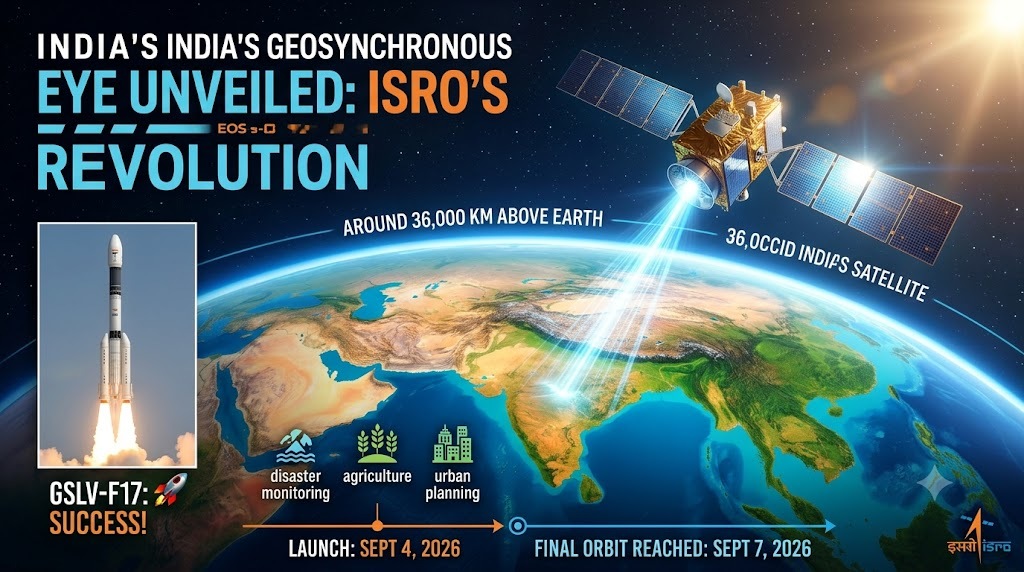
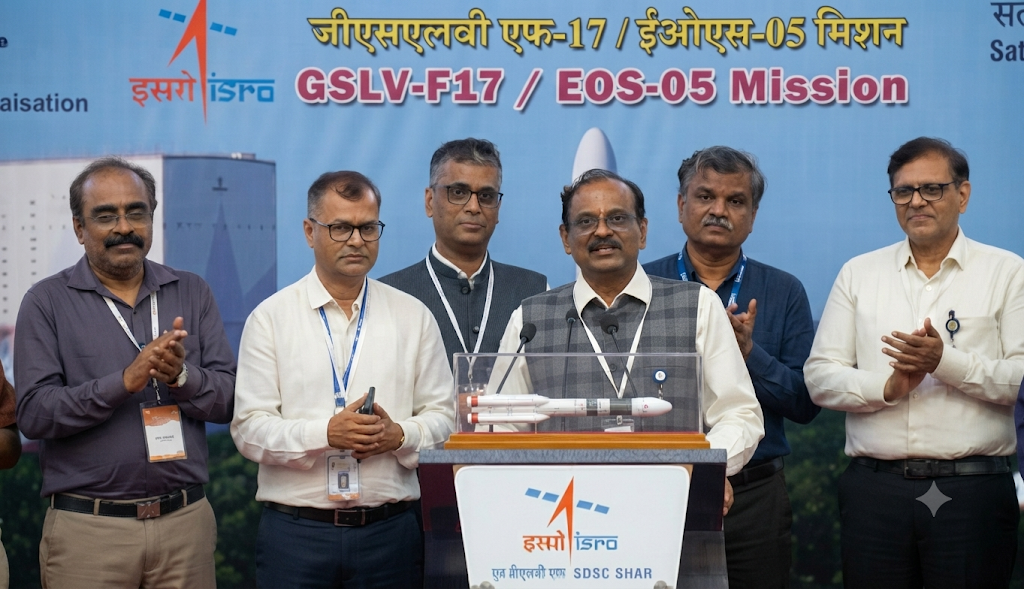
India has added a new capability to its Earth-observation program. On September 4, 2026, under the chairmanship of Indian Space Research Organisation chairman Dr. V. Narayanan, ISRO successfully launched EOS-05, an advanced Earth-observation satellite, aboard the GSLV-F17 rocket from the Satish Dhawan Space Centre in Sriharikota.
What makes this mission particularly interesting is not simply that ISRO has launched another satellite. EOS-05 is India’s first imaging satellite designed to operate from a geosynchronous orbit, giving it a very different vantage point for observing the Indian region. The satellite weighs about 2,367 kg and was initially placed into a sub-geosynchronous transfer orbit before undergoing orbit-raising maneuvers.
Also Read: Independence Day campaign ideas from 2024-25: Learn & Create for 2026
The mission also gave ISRO’s GSLV another successful flight—and brought the rocket’s long-running “Naughty Boy” nickname back into the spotlight. Read the article and find more such interesting topics covered on ContentbyMayank and subscribe to our newsletter for the latest blogs.
What Is ISRO latest satellite EOS-05 mission?
The latest satellite launched by ISRO is EOS-05, an Earth-observation spacecraft designed for imaging from geosynchronous orbit. ISRO describes it as its first-ever imaging satellite from geosynchronous orbit.
Unlike a typical Earth-observation satellite that moves across different parts of the planet as it orbits, a satellite operating from a high geosynchronous orbit can repeatedly observe a broad region over time. That makes the orbital position especially useful when the objective is to keep watching a particular part of the Earth rather than simply passing over it periodically.
EOS-05 is also associated with the GISAT program and has been referred to as GISAT-1A in coverage of the mission. Its purpose is essentially to provide advanced imagery and observation of the Indian region from a much higher orbital vantage point.
When Was EOS-05 Launched?
EOS-05 was launched on September 4, 2026, at 2:55 AM IST from the Second Launch Pad at Satish Dhawan Space Centre, Sriharikota. The launch vehicle was GSLV-F17.
The rocket initially placed EOS-05 into a Sub-Geosynchronous Transfer Orbit (Sub-GTO). The satellite then had to raise and refine its orbit using its own propulsion system to reach its intended operational orbit.

ISRO latest satellite Mission eos-05 at a Glance
| Mission Detail | Information |
|---|---|
| Satellite | EOS-05 |
| Mission type | Earth observation |
| Launch vehicle | GSLV-F17 |
| Launch date | September 4, 2026 |
| Launch time | 2:55 AM IST |
| Launch site | Satish Dhawan Space Centre, Sriharikota |
| Satellite mass | About 2,367 kg |
| Intended orbit | Geosynchronous orbit |
| Current status | Successfully launched and orbit raised |
ISRO’s spacecraft mission list records EOS-05 as the latest spacecraft mission in its current listing, following the unsuccessful ANVESHA (EOS-N1) launch in January 2026.
Also Read: Is SEO Still Worth It If AI Doesn’t Cite You?
What Makes EOS-05 Different From ISRO latest satellites?
The biggest point to understand about EOS-05 is where and how it is designed to observe Earth.
Calling it simply “another Earth-observation satellite” misses the important part of the mission. EOS-05 combines an imaging mission with a geosynchronous orbital vantage point, allowing it to repeatedly observe a large region rather than behaving like a conventional lower-orbit imaging spacecraft that moves rapidly from one area to another.
Higher-Quality Imaging for a Clearer View
EOS-05 is an imaging satellite, meaning its core job is to collect imagery and Earth-observation data.
That matters because Earth observation isn’t just about taking a picture. The usefulness of satellite imagery depends on factors such as spatial detail, spectral information, coverage and how often an area can be observed.
A clearer and more detailed image can help analysts identify changes on the ground more effectively. When those observations can also be repeated over time, the satellite becomes useful not only for seeing what an area looks like, but also for understanding how that area is changing.
This is where EOS-05’s orbital design becomes particularly important.
More Persistent Observation From Geosynchronous Orbit
EOS-05 is designed to operate from a geosynchronous orbit at roughly 36,000 km above Earth. Its orbital configuration gives it a broad and persistent vantage point over the Indian region.
That doesn’t mean EOS-05 is simply hovering motionless over one point in space. A geosynchronous orbit means the satellite’s orbital period is synchronized with Earth’s rotation. A perfectly circular geostationary orbit is a specific type of geosynchronous orbit, but EOS-05’s mission has been described in terms of a geosynchronous orbit rather than simply treating the two terms as interchangeable.
The distinction is technical, but important.
The practical benefit is easier to understand: EOS-05 can repeatedly observe a large region from a consistent high-altitude vantage point.
Why Frequent Observation Matters
Imagine having only one photograph of a flood-affected area. It tells you what the situation looked like at one particular moment.
Now imagine being able to repeatedly observe the same broad region.
The second approach can provide much more useful information about changes over time.
That can be valuable for applications such as:
- Disaster monitoring
- Flood and cyclone assessment
- Agriculture and crop monitoring
- Environmental observation
- Urban and infrastructure monitoring
- Regional mapping and planning
The advantage isn’t simply “a sharper photograph.” It is the combination of imaging capability, broad coverage and repeated observation.
In simple terms: EOS-05 is designed to help ISRO see a large part of the Indian region with useful detail and return to the same broad area repeatedly, making changes easier to track.
How Does EOS-05 Observe Earth From Around 36,000 Km Above?
At first glance, putting an imaging satellite roughly 36,000 km away from Earth might seem counterintuitive. After all, a camera generally gets more detail when it is closer to its subject.
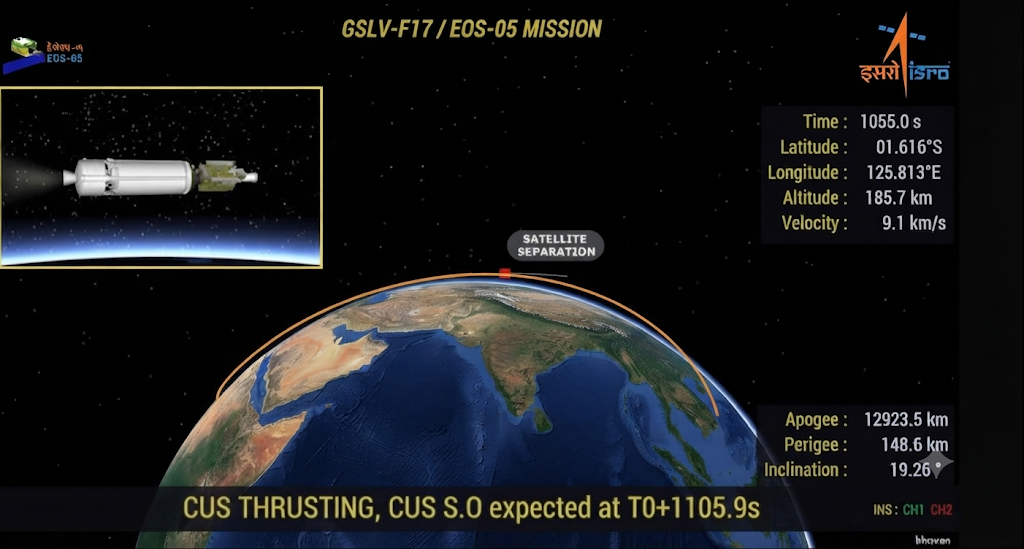
But EOS-05 isn’t designed simply to produce the most detailed photograph of a tiny area. Its mission involves large-area observation from a high orbital vantage point.
This is where the choice of orbit becomes important.
Why Did ISRO latest satellite Choose a Geosynchronous Orbit?
Lower-orbit Earth-observation satellites can provide highly detailed imagery because they operate much closer to the Earth’s surface. However, they also move rapidly around the planet.
That means a particular location may only be visible during certain passes.
A geosynchronous satellite offers a different trade-off. From its much higher altitude, it can maintain a recurring view of a broad region, making it particularly useful when time and repeated observation matter alongside image detail.
EOS-05 is therefore not simply competing with every other Earth-observation satellite on the basis of resolution alone. Its strength comes from the combination of its imaging capability and orbital position.
What Can ISRO latest satellite EOS-05 Be Used For?
The satellite’s Earth-observation role can support a range of applications where timely information about large areas is valuable.
These can include:
- Disaster management: observing affected regions before and after major events.
- Agriculture: monitoring large agricultural areas and changes in vegetation.
- Environmental monitoring: tracking changes across broad regions.
- Weather and atmospheric observation: contributing imagery and data useful for monitoring changing conditions.
- Urban development: observing changes in cities and infrastructure.
- Regional planning: providing Earth-observation data for large-scale analysis.
The important point is that EOS-05 is not a conventional communications satellite. Its central role is observing Earth and generating useful imagery/data.
GSLV-F17: The Rocket Behind ISRO latest satellite
EOS-05 needed a powerful launch vehicle because of both its mass and its intended orbital destination.
That vehicle was GSLV-F17, the 17th flight in the GSLV-F series and the launch vehicle that carried EOS-05 into its initial sub-geosynchronous transfer orbit.
The mission was significant for GSLV as well. EOS-05, weighing about 2,367 kg, represented the heaviest payload carried by a GSLV according to reporting on the mission.
The successful launch was therefore about more than getting one satellite off the ground. It also demonstrated the rocket’s ability to deliver a relatively heavy Earth-observation spacecraft toward a high-energy orbital destination.
Also Read: 2-DAY RISHIKESH TRIP FROM DELHI: COMPLETE TRAVEL GUIDE (2026)
What Happened After GSLV-F17 Released EOS-05?
The launch itself was only the first stage of the satellite’s journey.
After GSLV-F17 placed EOS-05 into its initial transfer orbit, the spacecraft had to perform a series of orbit-raising manoeuvres.
These manoeuvres gradually changed the satellite’s orbit, bringing it closer to the intended operational configuration.
The third and final orbit-raising manoeuvre was successfully completed at 8:57 PM on September 7, 2026. ISRO reported that the manoeuvre increased the satellite’s perigee, resulting in an estimated orbit of 34,903 × 35,884 km, with the spacecraft’s health reported as normal.
That is an important detail because “launch successful” and “satellite fully positioned for its mission” are not necessarily the same event.
Why Is ISRO’s GSLV Called the “Naughty Boy”?
Here’s where the EOS-05 story gets a little more interesting. The “Naughty Boy” nickname belongs to the GSLV rocket, not EOS-05.
The nickname comes from the vehicle’s history of setbacks and its sometimes unpredictable record, particularly around earlier missions and the challenges associated with its cryogenic upper stage.
That history made every successful GSLV mission meaningful for ISRO.
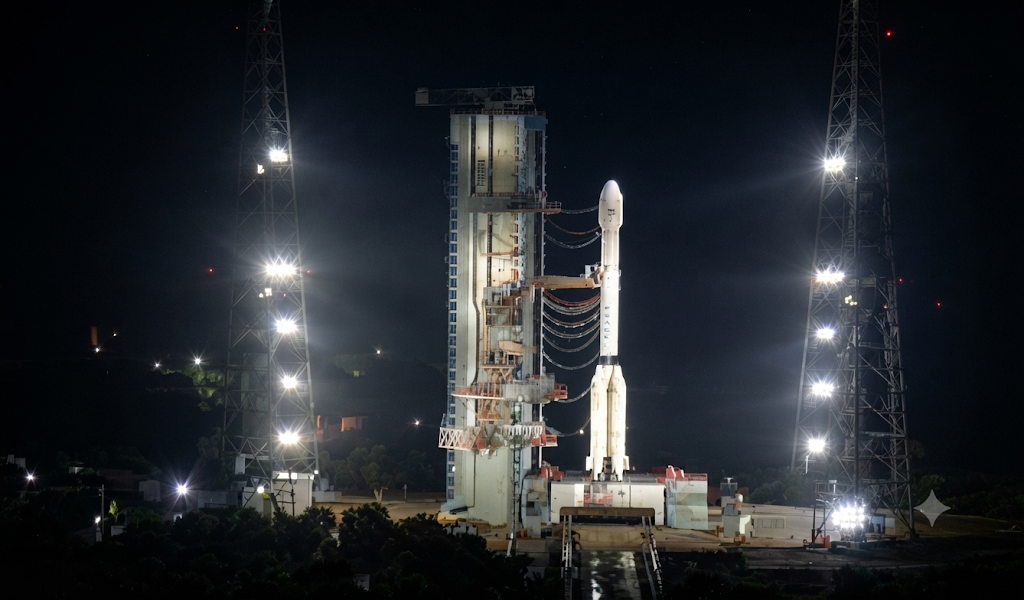
Did GSLV-F17 Finally Shed the “Naughty Boy” Tag with ISRO latest satellite?
GSLV-F17 certainly gave the rocket a strong reason to celebrate.
The vehicle successfully launched EOS-05 on September 4 and placed the satellite into its planned initial transfer orbit. The satellite subsequently completed its orbit-raising sequence, with the final maneuver successfully completed on September 7.
So while one successful mission obviously does not erase the GSLV’s entire flight history, GSLV-F17 was another important successful step for a rocket that has spent years trying to build a more consistent record.
That is why the “Naughty Boy” reference has become such a popular part of the story surrounding this launch.
Rocket fact: “Naughty Boy” is a nickname associated with GSLV, not EOS-05. The satellite itself is an Earth-observation spacecraft.
Why Is ISRO latest satellite EOS-05 Important?
The real importance of EOS-05 lies in the type of observation it is designed to provide.
India is a large and rapidly changing country. Monitoring agriculture, infrastructure, weather-related events, natural disasters and environmental changes requires information that is not only detailed, but also repeated and timely.
EOS-05 adds a different capability to India’s existing Earth-observation fleet.
Its geosynchronous vantage point allows it to repeatedly observe a broad region, while its imaging payload is designed to provide useful Earth-observation information.
That combination can be particularly valuable when the question isn’t simply:
“What does this place look like?”
but:
“How is this place changing?”
That is the bigger story behind India’s latest satellite launch.
EOS-05 vs Conventional Earth Observation: What Changes?
It is tempting to say that EOS-05 is simply “better” than every earlier Earth-observation satellite, but that would be misleading.
Different satellites are built for different jobs.
A lower-orbit satellite can be excellent for highly detailed imagery of comparatively smaller areas. EOS-05, meanwhile, is designed around the advantage of high-altitude, broad-area and repeated observation.
| Feature | Conventional Lower-Orbit Imaging | EOS-05 Approach |
|---|---|---|
| Orbital altitude | Generally much lower | Around 36,000 km-class geosynchronous orbit |
| Observation style | Satellite passes over regions | Broad, repeated regional observation |
| Main advantage | Detailed observation from closer range | Persistent regional vantage point |
| Coverage | Depends on satellite and orbit | Large regional coverage |
| Best suited to | Detailed mapping and targeted observation | Repeated observation of large regions |
The important takeaway is that EOS-05 adds a different kind of capability rather than replacing every other Earth-observation satellite.
Also Read: AI Search Visibility: Best AEO Guide for Website
What’s After ISRO latest satellite eos-05 launch?

With the launch and orbit-raising sequence completed, EOS-05 can move toward its operational phase.
ISRO has reported that the spacecraft’s health is normal following the final orbit manoeuvre.
The next important stage is the commissioning of the satellite’s systems and imaging capabilities before routine operational use.
This distinction matters because a satellite launch is not the finish line. Once a spacecraft reaches its intended orbit, engineers still have to ensure its systems are functioning correctly and prepare it for its actual mission.
For EOS-05, that means turning its new high-altitude vantage point into useful Earth-observation data.
ISRO latest satellite: Key Facts at a Glance
| Detail | EOS-05 |
|---|---|
| Satellite type | Earth observation |
| Launch vehicle | GSLV-F17 |
| Launch date | September 4, 2026 |
| Launch time | 2:55 AM IST |
| Launch location | Sriharikota, Andhra Pradesh |
| Approx. mass | 2,367 kg |
| Intended orbit | Geosynchronous |
| Initial deployment | Sub-Geosynchronous Transfer Orbit |
| Final orbit after raising | Estimated 34,903 × 35,884 km |
| Current spacecraft health | Normal |
| Key capability | Large-area, repeated Earth observation |
ISRO officially identifies EOS-05 as its first imaging satellite from geosynchronous orbit and confirms that GSLV-F17 placed it into the intended transfer orbit.
FAQs
What is ISRO’s latest satellite?
EOS-05 is ISRO’s latest satellite launch as of September 2026. It is an Earth-observation spacecraft designed to operate from a geosynchronous orbit.
When was ISRO’s latest satellite launched?
EOS-05 was launched on September 4, 2026, at 2:55 AM IST aboard GSLV-F17 from Sriharikota.
What is EOS-05 used for?
EOS-05 is designed for Earth observation and imaging, with its high-altitude orbital position enabling repeated observation of a broad regional area.
How high is EOS-05 above Earth?
EOS-05 is designed to operate in a geosynchronous orbit at roughly 36,000 km above Earth. Its orbit-raising sequence brought it to an estimated 34,903 × 35,884 km orbit after the final manoeuvre on September 7.
What rocket launched EOS-05?
EOS-05 was launched aboard GSLV-F17, which placed the satellite into a sub-geosynchronous transfer orbit before the spacecraft began raising its orbit.
Why is GSLV called the “Naughty Boy”?
“Naughty Boy” is a nickname associated with India’s GSLV rocket, reflecting its history of launch setbacks and challenges. The nickname does not refer to EOS-05.
Is EOS-05 a weather satellite?
EOS-05 is primarily an Earth-observation and imaging satellite, rather than being described simply as a dedicated weather satellite. Its imagery and observation capabilities can nevertheless contribute to applications involving weather, disasters and environmental monitoring.
What makes EOS-05 different from earlier ISRO satellites?

Its major distinction is the combination of Earth imaging with a geosynchronous orbital vantage point, allowing repeated observation of a broad region. This gives it a different operational advantage from many lower-orbit Earth-imaging satellites.
Also Read: Delhi Prayagraj Varanasi trip: Our 4-Day Spiritual Journey
Concluding
ISRO’s latest satellite launch is more interesting when viewed beyond the successful liftoff.
EOS-05 brings together three important elements: an Earth-imaging mission, a high geosynchronous vantage point, and the ability to repeatedly observe a broad region. That combination can make satellite imagery more useful for understanding changes on the ground rather than simply capturing isolated snapshots.
The GSLV-F17 launch also matters for the rocket itself. After years of being associated with the playful “Naughty Boy” nickname, the GSLV delivered another successful mission, while EOS-05 went on to complete its planned orbit-raising maneuvers.
For India, the bigger achievement is therefore not just putting another satellite into space. It is adding another way to observe a large and constantly changing country from above—with greater continuity and useful imaging detail.
If you find our blog interesting and knowledge useful, please do give us your views in the comment section. If you’re looking for blog writing services, website content, news and articles, or any other content services, you can explore our competitive yet affordable packages.