
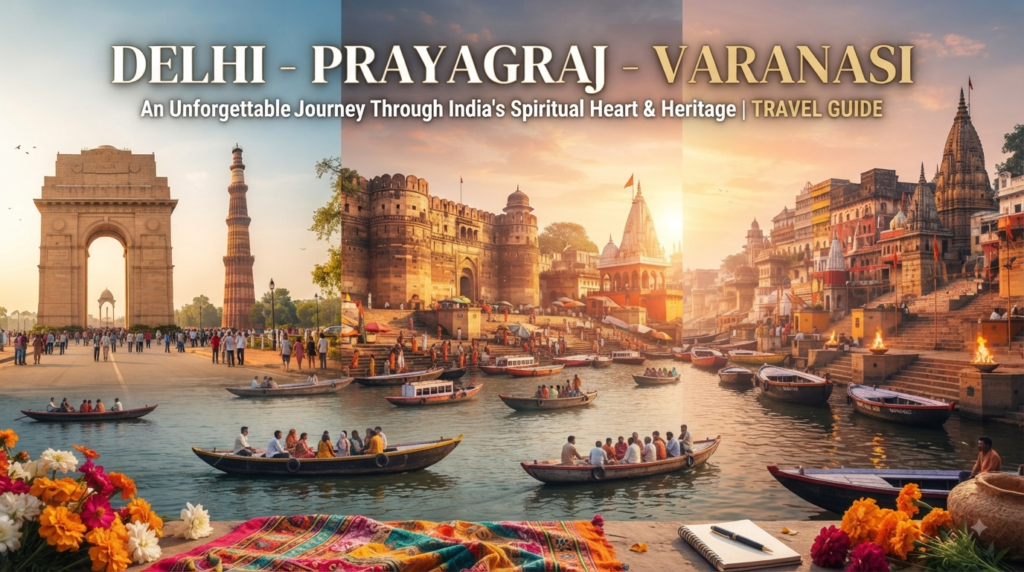
Some journeys are planned around destinations. Others are planned around experiences. Our June 2026 journey was different from a regular holiday because we wanted to experience the spiritual side of our Delhi Prayagraj Varanasi trip without rushing through either city.
Over four days, three of us travelled from New Delhi to Prayagraj, continued to Varanasi, explored temples and ghats, experienced the Ganga by boat, attended Ganga Aarti, and returned to Delhi by train.
This is the complete account of that journey, including the trains we used, where we stayed, what we experienced, what we paid, the role of India Trip Planner at ContentbyMayank and the practical lessons we learned along the way.
Also Read: 2-DAY RISHIKESH TRIP FROM DELHI: COMPLETE TRAVEL GUIDE (2026)
Our Delhi–Prayagraj–Varanasi Trip at a Glance
| Trip Detail | Our Experience |
|---|---|
| 🗓️ Travel dates | 11–14 June 2026 |
| ⏳ Duration | 3 nights / 4 days |
| 👥 Travellers | 3 people |
| 🚉 Starting city | New Delhi |
| 🛕 First destination | Prayagraj |
| 🕉️ Second destination | Varanasi |
| 🚆 Main transport | Indian Railways |
| 🗺️ Route | Delhi → Prayagraj → Varanasi → Delhi |
| 🎯 Trip type | Religious and spiritual journey |
Our Route for Delhi Prayagraj Varanasi trip
Our journey followed a straightforward route, but every stop offered a completely different experience.
🚆 New Delhi
Starting point
⬇️ Prayagraj Express
Prayagraj
Triveni Sangam + Holy Dip + Temples
⬇️ Vande Bharat Express
Varanasi
Ghats + Ganga Aarti + Kashi Vishwanath + Temples
⬇️ Vande Bharat Express
New Delhi
Journey completed
Why We Chose Prayagraj and Varanasi Together
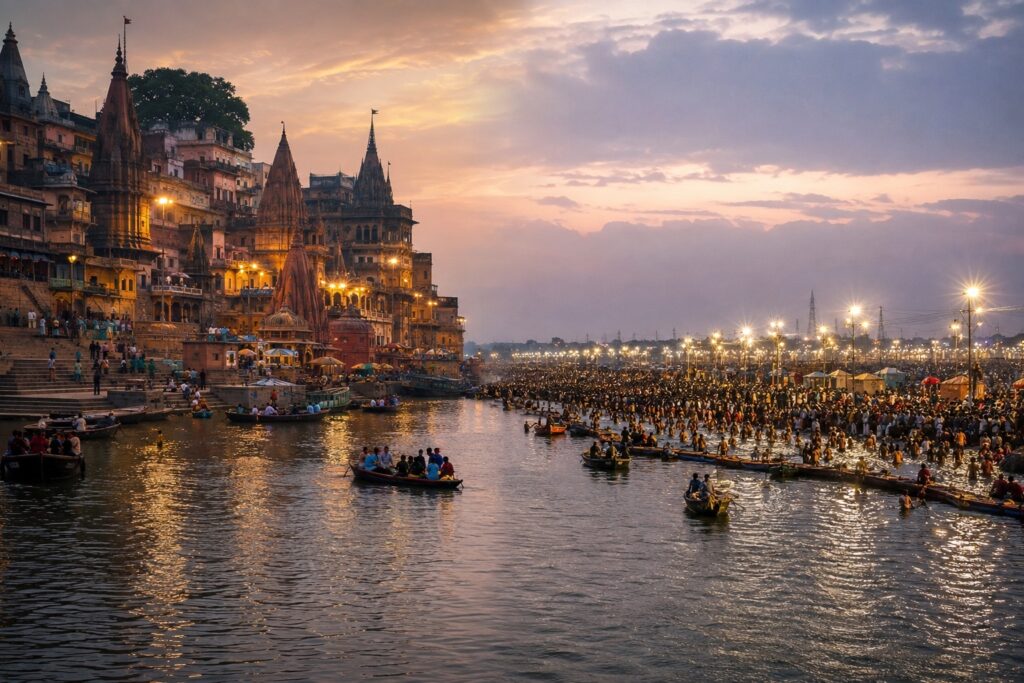
Our original plan was actually much simpler. We were initially planning a Delhi to Varanasi trip, with most of our time dedicated to experiencing Kashi and its major spiritual sites. Then we remembered something we had regretted for a while.
We had missed the Maha Kumbh Mela 2025 in Prayagraj. That missed opportunity stayed somewhere in our minds. So when we started planning our Varanasi journey, adding Prayagraj felt like the natural decision. If we were already travelling through this region, we wanted to finally visit Prayagraj and experience the Triveni Sangam ourselves.
Most importantly, we wanted to take the holy dip at Sangam. That decision changed our original itinerary from roughly three days into a three-night, four-day journey.
Why We Didn’t Treat Prayagraj as a Quick Stop
Prayagraj isn’t simply a place where you arrive, visit Sangam, and leave. At least, that wasn’t how we wanted to experience it. After adding Prayagraj to our plans, we realized that the city had several other important spiritual sites worth visiting.
We therefore needed dedicated time for the Sangam, boat ride and temples before continuing towards Varanasi. That extra day made the itinerary considerably more comfortable. We didn’t have to spend the entire day watching the clock and worrying about our next train.
The Spiritual Reason Behind Our Delhi Prayagraj Varanasi trip
There was also a deeply personal reason behind choosing these destinations. I am a strong believer in Lord Shiva, so visiting Kashi had a special meaning for me. Varanasi’s ancient spiritual identity and its association with Lord Shiva were major reasons I wanted to experience the city personally.
The idea of arriving in Kashi after visiting Prayagraj made the journey feel even more meaningful. Prayagraj gave us the experience of the Sangam. Varanasi gave us the experience of Kashi, the Ganga, its ghats and its temples.
We weren’t travelling simply to collect photographs. We wanted to experience the spiritual atmosphere of both cities.
From Triveni Sangam to the Ghats of Kashi
One of the most memorable aspects of the journey was the contrast between the two cities. In Prayagraj, our experience centred around Triveni Sangam and the holy dip. In Varanasi, the Ganga became part of almost everything we did.
- We walked along the ghats.
- We took a private boat to experience the city’s riverfront.
- We watched Ganga Aarti.
- We visited temples connected with Kashi’s religious traditions.
The two cities, therefore, felt different yet connected through the spiritual importance of the Ganga.
Our 4-Day Delhi Prayagraj Varanasi trip Itinerary
Here’s the journey before we get into every experience.
| Day | Route | Major Experiences |
|---|---|---|
| Day 1 — 11 June | New Delhi → Prayagraj | Delhi Metro, New Delhi Railway Station, overnight train |
| Day 2 — 12 June | Prayagraj → Varanasi | Sangam, holy dip, boat ride, temples, Vande Bharat, Ganga Aarti, Kashi Vishwanath |
| Day 3 — 13 June | Varanasi | Assi Ghat, boat ride, temples, Kaal Bhairav, hidden temple, ghats |
| Day 4 — 14 June | Varanasi → New Delhi | Checkout, final meal, Vande Bharat to Delhi |
💡 OUR TAKEAWAY
Four days worked well for us because we prioritized the places we genuinely wanted to experience. We didn’t try to cover every attraction in either city.
How We Planned our Delhi Prayagraj Varanasi trip
We started planning approximately one month before departure, around 9–10 May 2026. There were several reasons for starting early. This was our first visit to both Prayagraj and Varanasi. I wasn’t familiar enough with the local accommodation, transportation and practical arrangements to leave everything until the last moment.
We also wanted the journey to remain comfortable for all three travellers. The third reason was Indian Railways. Since trains were going to be the backbone of our journey, securing our reservations early was important. We eventually booked our train tickets on 26 May 2026.
What We Researched Before Leaving Delhi
Before the journey, I researched several parts of the trip.
These included:
- 🚆 Train routes and timings
- 🏨 Hotels and accommodation
- 🛕 Temples
- 🌊 Ghats
- 🚕 Local transportation
- 💰 Approximate expenses
- 📍 Places to visit
- 🍛 Food options
I used Google, ChatGPT, Gemini, and other platforms during the research process. Accommodation was where I spent considerable time comparing options. We wanted somewhere convenient for reaching the major ghats and temples.
However, we eventually decided not to finalize our accommodation online. That turned out to be one of the better decisions we made.
How India Trip Planner Helped Us Plan
🔗 PLANNING RESOURCE
Planning your own India trip? Try India Trip Planner and customize your journey according to your destination, budget, interests and preferred travel pace.
Before this journey, I wanted something more practical than simply searching for places on Google and creating a rough itinerary manually.
I used India Trip Planner to build our initial travel plan. It helped me organize destinations, travel preferences, distances and estimated expenses before we started making reservations.
Here’s exactly how I used it.
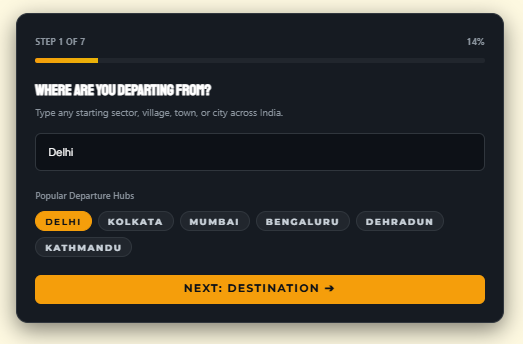
Step 1: Select Your Departure Location
The first step was to enter where we were starting our journey.
Since we were travelling from Delhi, I selected:
📍 Departure Location: Delhi
This gave the planner a starting point for calculating the overall journey and itinerary.
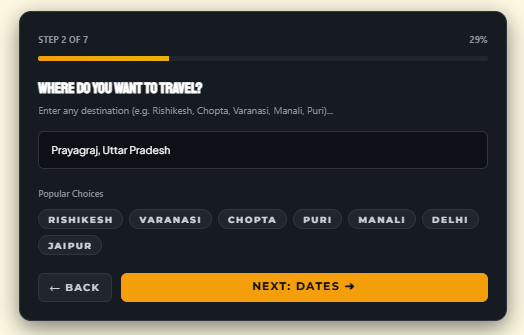
Step 2: Enter Your Destination
Next, I entered the destination we were planning to visit first.
For our trip, I selected:
📍 Destination: Prayagraj, Uttar Pradesh
Although our overall journey was Delhi → Prayagraj → Varanasi → Delhi, I started the planning process with Prayagraj because it was our first destination after leaving Delhi.
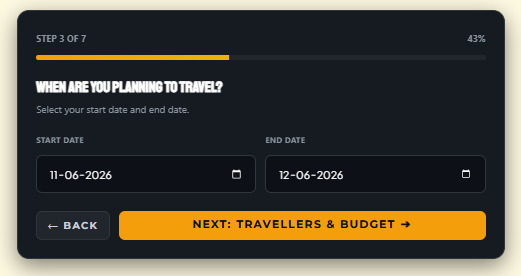
Step 3: Enter Your Travel Dates
The next step was to enter our planned travel period.
We were travelling from
📅 11 June 2026 → 12 June 2026 (for Delhi-Prayagraj Only)
This was important because the itinerary and estimated expenses needed to correspond with the duration of our actual trip.
Step 4: Enter the Number of Travellers and Select Your Budget
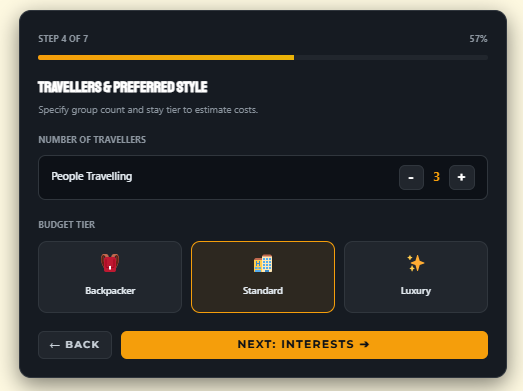
Next, I entered the number of people travelling.
For this trip:
👥 Travellers: 3
The planner also asked us to choose a preferred budget category.
The available options were:
- Backpacker
- Standard
- Luxury
I selected:
Standard
I chose Standard because we wanted a reasonable balance between comfort and affordability.
We weren’t looking for luxury accommodation or premium experiences everywhere.
At the same time, we didn’t want to plan the trip around the cheapest possible options.
Step 5: Select Your Travel Interests
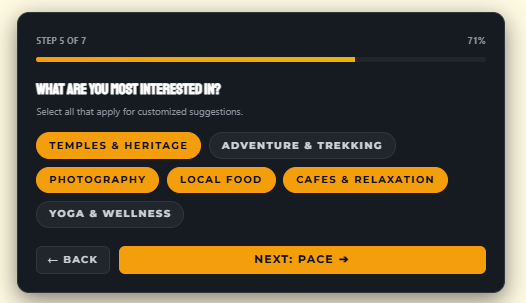
The next step was particularly useful because the itinerary could be shaped around the things we actually wanted to experience.
The available interests included:
- 🛕 Temples & Heritage
- 🏔️ Adventure & Trekking
- 📸 Photography
- 🍛 Local Food
- ☕ Cafes & Relaxation
- 🧘 Yoga & Wellness
For our Prayagraj and Varanasi journey, I selected:
Temples & Heritage + Photography + Local Food + Cafes & Relaxation
Our trip was primarily spiritual, but we didn’t want it to become only a temple-hopping itinerary.
We also wanted opportunities to photograph the cities, experience local food and have some relaxed moments between sightseeing.
Step 6: Choose Your Travel Pace
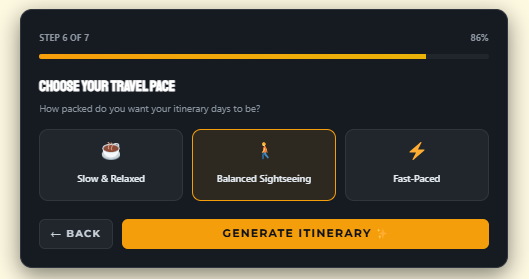
The planner then asked us to choose how quickly we wanted to explore the destination.
There were three options:
🐢 Slow and Relaxed → ⚖️ Balanced Sightseeing → ⚡ Fast Paced
I selected:
⚖️ Balanced Sightseeing
This was a deliberate choice.
We weren’t travelling with the objective of visiting the maximum possible number of locations every day.
At the same time, travelling too slowly could have meant missing some of the important places we specifically wanted to experience.
Balanced Sightseeing felt like the right middle ground for our group.
Step 7: Generate Your Itinerary
After entering these preferences, I submitted the details and generated the itinerary.
The planner then used the information I had provided to create a trip plan based on our:
Departure location + destination + travel dates + group size + budget + interests + travel pace
This was particularly useful because I could see the trip from a more structured perspective instead of maintaining a separate list of places, distances and estimated expenses.
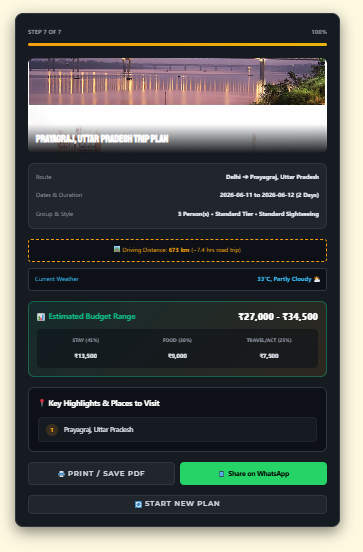
Carefully Check Destinations, Distances and Estimated Expenses
The generated itinerary gave me a clearer idea of what we could cover and how the different places fitted into the journey.
It also provided information such as:
- 📍 Places worth visiting
- 📏 Estimated distances
- 🌤️ Current weather conditions
- 🏨 Estimated accommodation expenses
- 💰 Estimated trip budget
- 🗺️ Suggested itinerary structure
This was especially helpful because I was planning the trip approximately a month in advance. I could use these estimates as a reference before making our actual travel decisions.
You Can Download or Share the Itinerary at India Trip Planner
Once the itinerary was generated, I also had the option to download it as a PDF.
The planner also allowed the itinerary to be shared through WhatsApp.
That can be useful when you’re travelling with family or friends because everyone can access the same plan instead of one person keeping all the information.
How Accurate Was the Planner for Our Actual Trip?
This was the part I found most interesting.
The estimated expenses generated during planning were surprisingly close to what we eventually experienced during the trip. Of course, actual expenses can change depending on your hotel, food choices, transportation, shopping and personal preferences.
But for my journey, the estimates gave me a useful starting point when deciding how much money we should keep aside. That’s one of the reasons I found the planner useful while preparing for this Delhi–Prayagraj–Varanasi trip.
We repeated the same process from Prayagraj to Varanasi to prepare our checklist for Varanasi’s top highlights and locations.
Plan Your Own Trip
If you’re planning a similar journey and want to build your itinerary before booking everything, you can try the India Trip Planner here:
What We Booked in Advance
We kept our advance bookings relatively simple. Train tickets were the main thing we booked before leaving Delhi. We researched hotels beforehand but didn’t finalize one online.
Instead, we decided to explore accommodation options after reaching Varanasi. This approach gave us more freedom to see the actual rooms before paying. It was particularly important because three people were traveling together.
Online photographs can give you a general idea about a property. They don’t always tell you whether the room will actually feel comfortable for three people. That became one of our biggest accommodation lessons during this trip.
Our First Lesson from Delhi Prayagraj Varanasi trip
Our planning experience taught us something that became useful throughout the journey.
- Online research should help you prepare, but it shouldn’t eliminate real-world judgment.
- A hotel can look spacious online but feel completely different in person.
- A railway station can be manageable at one time and overwhelming at another.
- A road journey can take considerably longer when traffic builds up.
We therefore planned the important parts carefully while keeping some decisions flexible. That balance worked well for us.
And Then We Left Delhi
After weeks of planning, researching and making reservations, the journey finally began on 11 June 2026. Our first destination was Prayagraj.
We had an overnight train from New Delhi Railway Station, followed by an early morning arrival in Prayagraj. From there, we would experience the Sangam before continuing to Varanasi on the Vande Bharat Express. And this is where the actual journey begins.
Our Prayagraj Express Experience
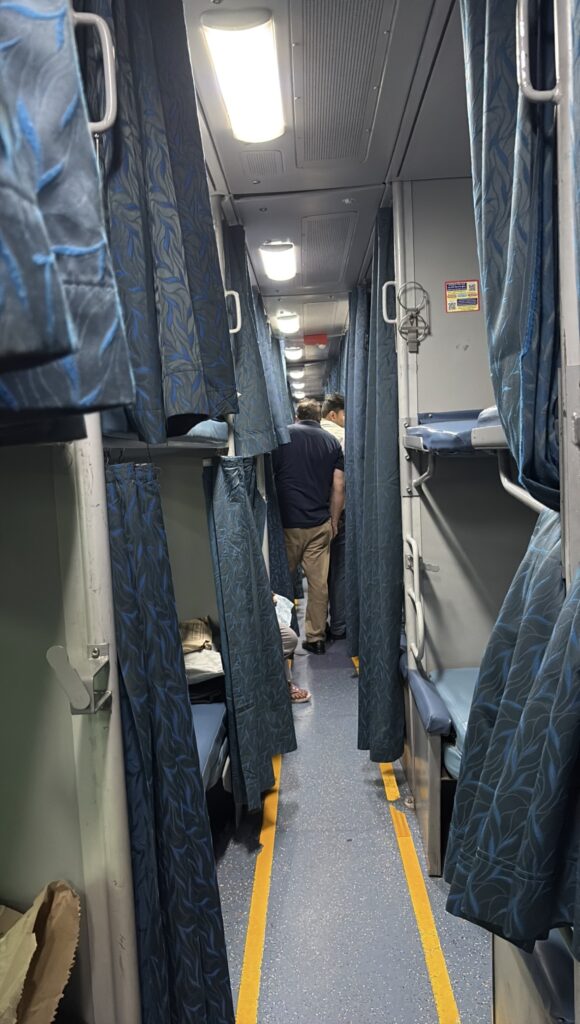
Our train was the Prayagraj Express, and we travelled in 2AC. The coach was neat, clean and well maintained. The overall journey was smooth and comfortable. We departed New Delhi at approximately 10:00 PM. Our scheduled arrival at Prayagraj was around 8:00 AM, but the train reached considerably earlier.
We arrived at approximately 7:00 AM. An early arrival was particularly useful because our Vande Bharat to Varanasi was scheduled for later that morning.
The Seat Allocation Problem
There was one thing that affected our overnight journey All three of us were allocated upper berths, with the seats separated from one another. Because we had booked within less than a month of travelling, we couldn’t sit together. It wasn’t a major problem for sleeping.
However, when three people are traveling together, being separated isn’t exactly ideal. Interestingly, this wasn’t the only time we experienced the problem. Even after booking our Vande Bharat tickets much earlier, we again received separate
How Was the Overnight Journey?
Apart from the seat allocation issue, the overnight journey was comfortable. Most of the journey happened while we were sleeping. There were no significant delays or disruptions that affected our experience. The train remained comfortable throughout the journey.
The best part was arriving in Prayagraj about an hour earlier than scheduled. That gave us additional time to freshen up, have breakfast and begin exploring before our afternoon train to Varanasi.
Our First Impression of Prayagraj Junction
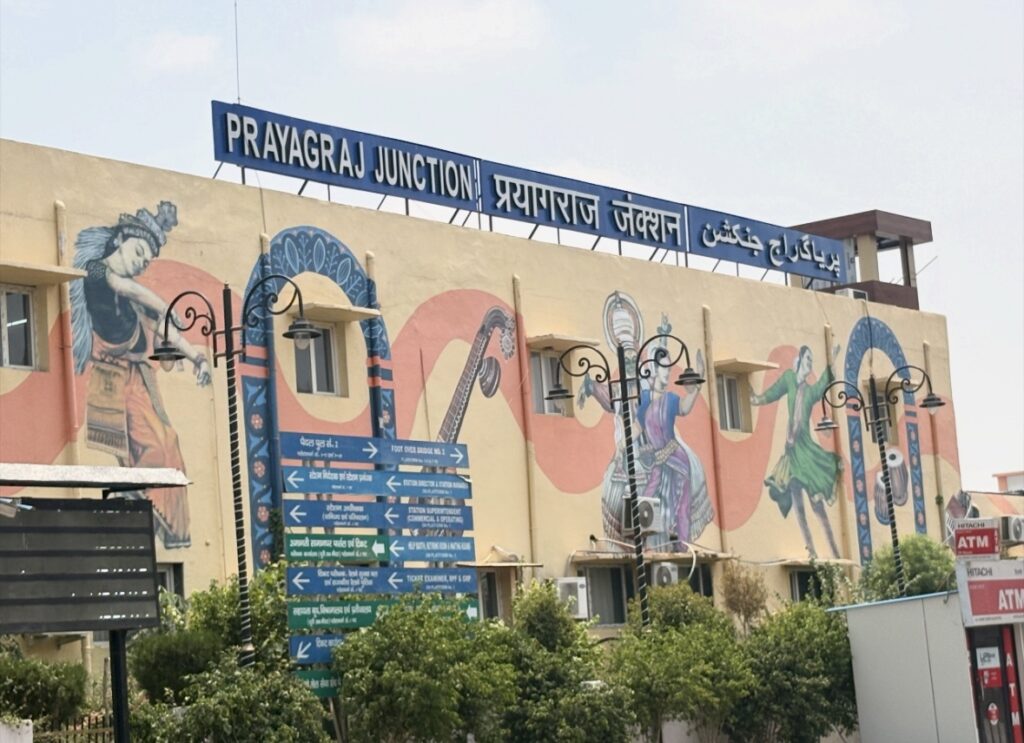
We reached Prayagraj Junction at around 7:00 AM. The station immediately surprised us. It was considerably cleaner than we had expected. The station had air-conditioned restrooms, convenient connectivity with the city and easily available autos outside. Another thing we noticed was the relatively manageable crowd.
After experiencing Varanasi Junction later in the journey, this difference became even more noticeable. Varanasi Junction was extremely crowded, while Prayagraj felt considerably more manageable when we arrived.
🚨 OUR PRACTICAL OBSERVATION
Railway stations can become overwhelming when passengers arrive several hours before their trains.
In our experience, excessive crowding can create safety concerns and make the first impression of a city less welcoming.
Better crowd management around platform access could make busy stations considerably easier to navigate.
Prayagraj Express: Our Experience
| Feature | Our Experience |
|---|---|
| 🚆 Train | Prayagraj Express |
| 🛏️ Class | 2AC |
| 🕙 Departure | 10:00 PM |
| 📍 Arrival | ~7:00 AM |
| ⏱️ Scheduled arrival | ~8:00 AM |
| ⭐ Journey | Comfortable |
| 🚨 Major delay | None |
| 💺 Seat issue | Separate upper berths |
Arriving in Prayagraj: first stop of our Delhi Prayagraj Varanasi trip
We had reached Prayagraj early but we had no hotel booked. Our next train to Varanasi was scheduled for 12:10 PM, leaving us several hours to experience the city.
Rather than paying for a short hotel stay, we decided to use the railway station facilities to freshen up. Then we had breakfast and headed towards the Sangam. That morning would become one of the most spiritually significant parts of our entire journey.
Prayagraj Morning: Triveni Sangam, Holy Dip and Our Temple Trail
After reaching Prayagraj Junction around 7:00 AM, we had several hours before our Vande Bharat to Varanasi. We had deliberately avoided booking a hotel or short-stay accommodation in Prayagraj.
Our train to Varanasi was scheduled for 12:10 PM, so paying for a room for only a few hours didn’t make much sense. Instead, we decided to freshen up at the railway station and use the morning efficiently.
Freshening Up at Prayagraj Junction
We used the air-conditioned restroom at Prayagraj Junction to freshen up after the overnight train journey.
This worked surprisingly well for us.
We were carrying our luggage, but we didn’t have to drag it into another accommodation and then return to the station.
It saved both money and time.
If you’re planning a similar short Prayagraj stop between trains, checking the station facilities can be worthwhile before booking a room purely for a few hours.
💡 OUR TAKEAWAY
If your Prayagraj itinerary is limited to a few hours between trains, you may not need short-term accommodation. We managed our morning using the station facilities instead.
Our Breakfast Before Visiting Sangam
After freshening up, we had a simple breakfast before heading towards the Sangam.Our breakfast included:
| Item | Quantity | Price |
|---|---|---|
| ☕ Hot tea | 2 | ₹20 |
| ☕ Hot coffee | 1 | ₹25 |
| 🥪 Sandwiches | 2 | — |
| 🥜 Namkeen/Aloo Bhujia | 1 | ₹10 |
| 🥔 Aloo Patty | 1 | ₹20 |
The tea cost ₹10 each, while the hot coffee cost ₹25. The aloo bhujia cost ₹10, and the aloo patty cost ₹20. It wasn’t an elaborate breakfast. But after travelling overnight, something hot and quick was exactly what we needed.
Prayagraj Junction to Triveni Sangam
We hired a private electric rickshaw from Prayagraj Junction to Sangam. The ride cost us ₹100. It took approximately 25 minutes. Since it was still early in the morning, traffic wasn’t much of an issue.
The weather was sunny and mildly humid, but the wind made the conditions comfortable enough for us.
Our Journey to Sangam
| Detail | Our Experience |
|---|---|
| 🚉 Starting point | Prayagraj Junction |
| 📍 Destination | Triveni Sangam |
| 🚕 Transport | Private electric rickshaw |
| 💰 Fare | ₹100 |
| ⏱️ Journey time | ~25 minutes |
| 🌤️ Weather | Sunny, mildly humid and windy |
| 🧳 Luggage | 1 trolley + 1 VIP luggage bag |
Our First View of Triveni Sangam
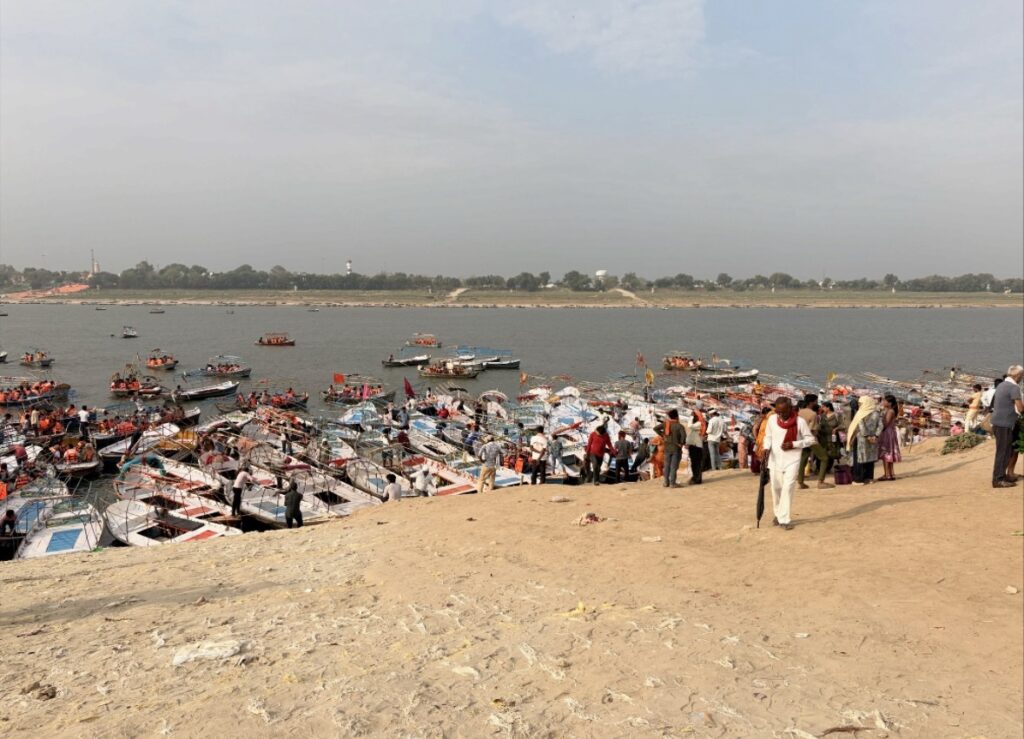
The first glimpse of the river was one of those moments that immediately changed the mood of the journey.We had been travelling through the night. Within a few hours, we were standing near one of India’s most important pilgrimage sites.
- The surroundings felt distinctly spiritual.
- There was also something peaceful about arriving early.
- The crowd was manageable, the weather was comfortable and we didn’t feel rushed.
For anyone visiting Sangam for the first time, early morning can be a particularly comfortable period to consider.
Taking a Private Boat at Sangam
We decided to hire a private boat for all three of us. Shared boats are also available, and they can be considerably cheaper. However, shared boats generally have a larger group of passengers, while we wanted more privacy, flexibility and comfort. Our private boat cost approximately ₹2,000–₹3,500, depending on the arrangement and prevailing rates.
The exact fare can vary, so don’t treat our price as a fixed tariff.
Boat options we encountered:
| Boat Type | Approximate Fare | Best For |
|---|---|---|
| 🚣 Shared boat | ₹200–₹250/person | Budget travellers |
| 🚣 Private boat | ₹2,000–₹3,500 | Families or small groups |
The boatmen, locally referred to as Kewats, provided life jackets to passengers boarding the boats.
The boats we saw at Prayagraj were manually operated.
This was different from many of the motorized boats we later experienced in Varanasi.
💡 PRIVATE OR SHARED BOAT?
A private boat isn’t automatically the “better” option for everyone.
Shared boats make more sense if you’re travelling on a tighter budget.
Private boats offer greater privacy and flexibility when your group values comfort and control over the experience.
Taking the Holy Dip at Triveni Sangam
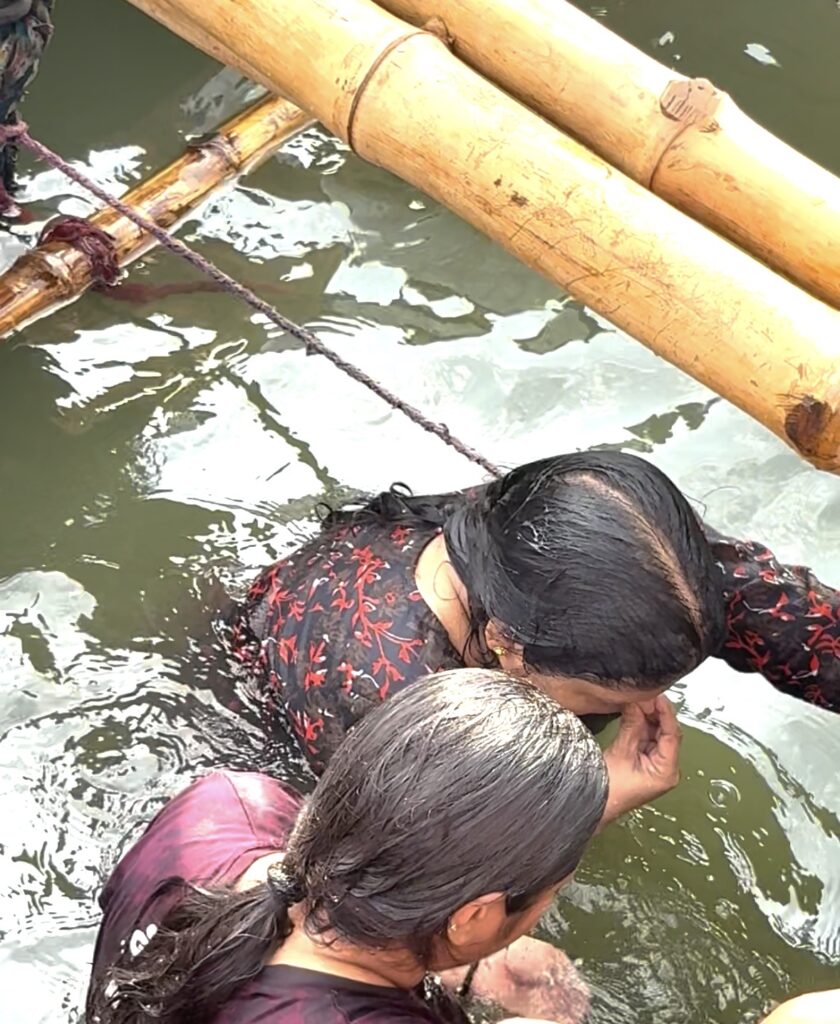
Yes, we took the holy dip at Sangam. This was one of the main reasons we had added Prayagraj to our journey.
The bathing area was organized around dedicated floating platforms. Boats could also be used to manage belongings and changing clothes, which made the experience considerably easier than we had expected.
We had our trolley and another luggage bag with us throughout the Prayagraj portion. Despite carrying them, we didn’t face major difficulties. The river water appeared clean and relatively clutter-free during our visit.
What About Changing Clothes and Luggage?
This was something we had considered before visiting Sangam. After all, we were travelling with luggage and planned to continue directly towards Varanasi. Fortunately, the arrangements around the bathing area made things manageable.
Dedicated areas and floating platforms allowed pilgrims to take their holy dip and change clothes. We were therefore able to continue our journey without needing a hotel room in Prayagraj.
Our Four-Hour Prayagraj Spiritual Trail
We spent approximately four hours exploring Sangam and several nearby religious sites.
Our sequence was:
Triveni Sangam → Shri Akshayavat Temple & Patalpuri → Shri Bade Hanuman Ji Mandir → Shri Veni Madhav Mandir → Nag Vasuki Temple → Alopi Devi Mandir
This sequence worked well for us because we wanted to cover several important spiritual locations before returning for our afternoon train.
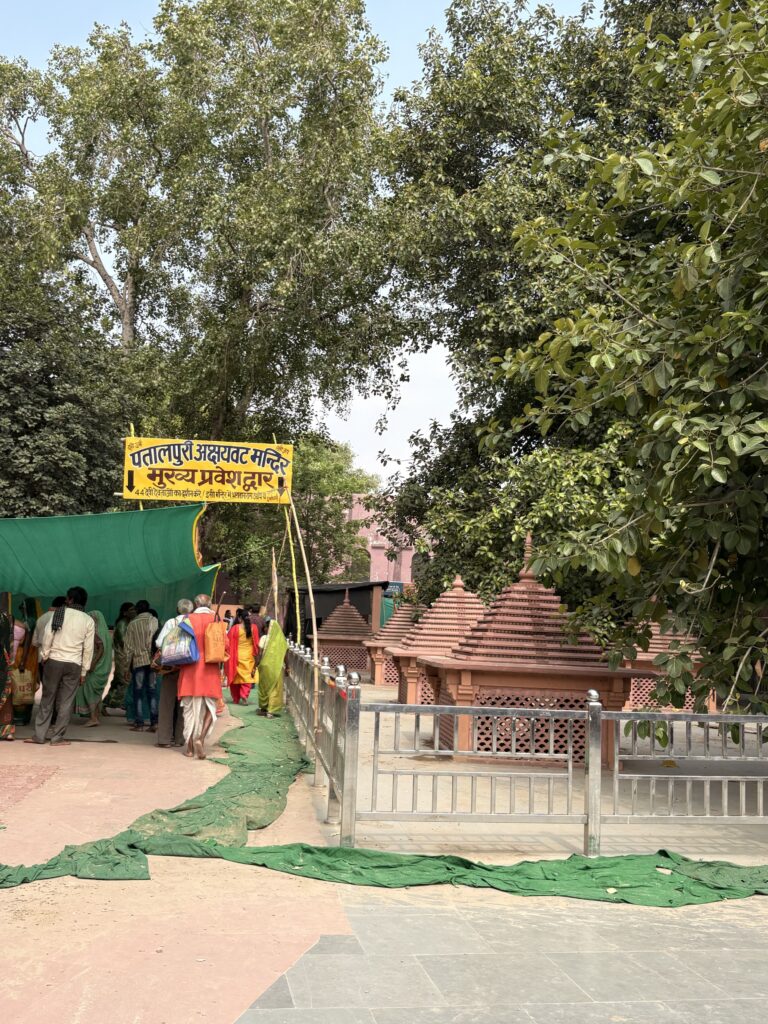
Shri Akshayavat Temple and Patalpuri
Our temple trail continued with Shri Akshayavat Temple and Patalpuri.
This was part of the religious circuit we followed around Prayagraj after our Sangam experience.
Rather than spending excessive time at every location, we kept our visits focused.
That helped us maintain enough time for the remaining temples and our Vande Bharat departure.
Shri Bade Hanuman Ji Mandir
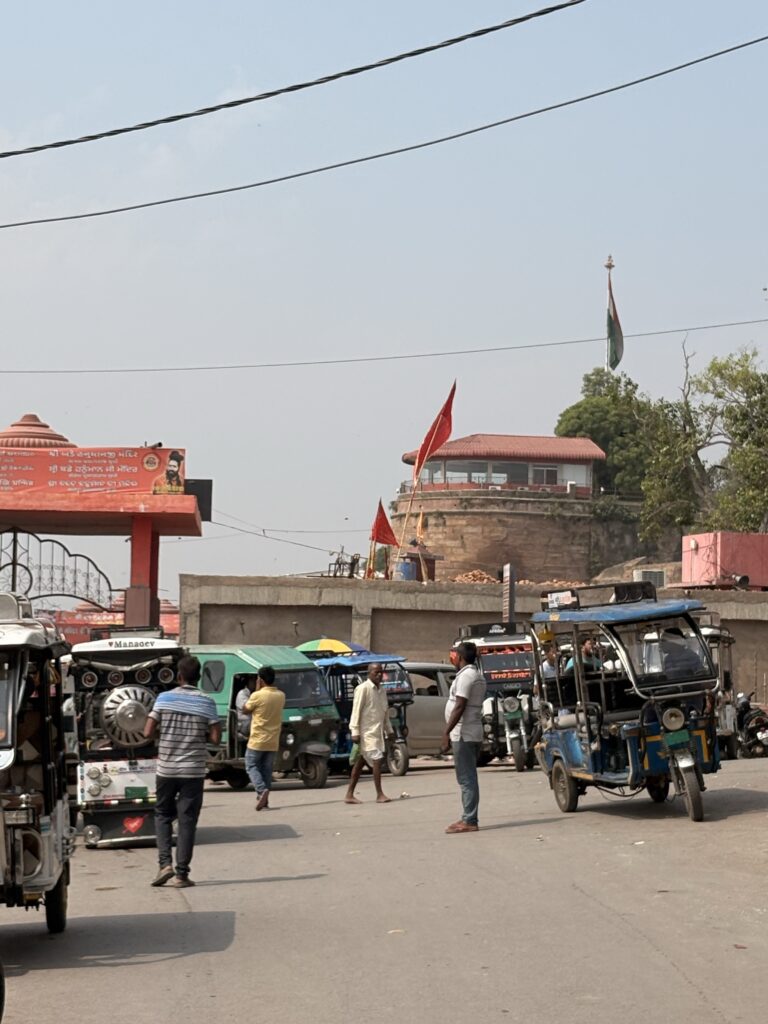
Among the temples we visited, Bade Hanuman Ji Mandir was the place where we spent the most time.
Even though we had arrived relatively early, the temple already had a noticeably heavier crowd.
The wait was still worth it for us. This became one of the places I would prioritize if someone had only limited time in Prayagraj.
⭐OUR PRIORITY
If you’re visiting Prayagraj for only one day, we would prioritize Triveni Sangam and Bade Hanuman Ji Mandir.
You can then select additional temples according to your interests and available time.
Shri Veni Madhav Mandir
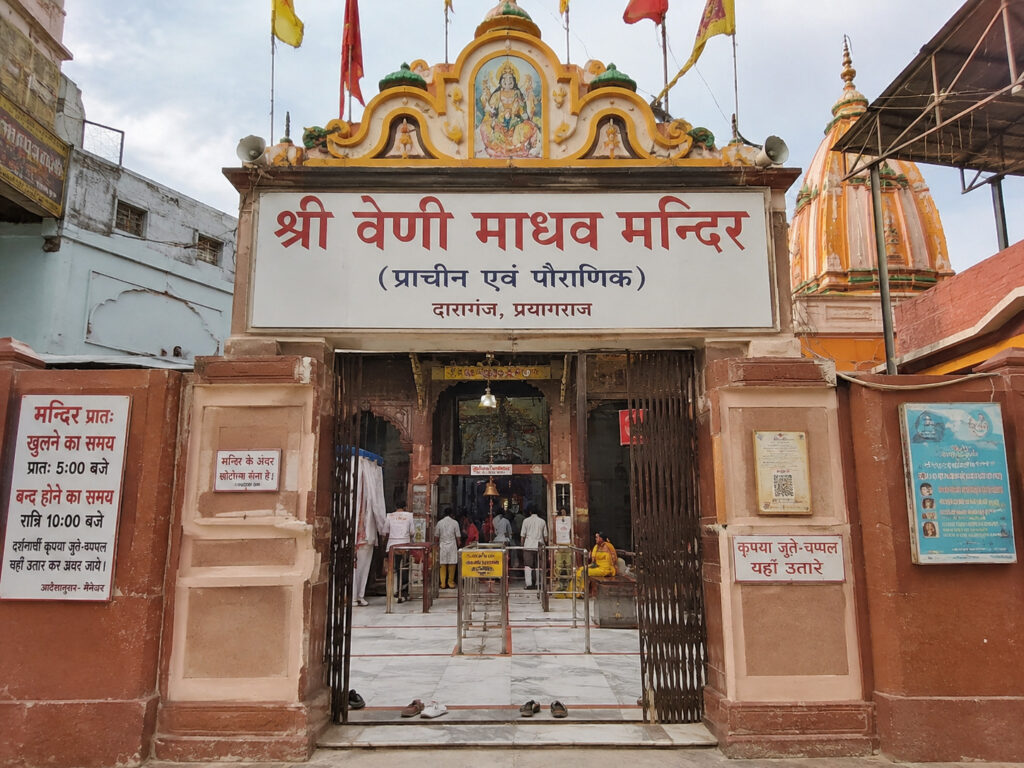
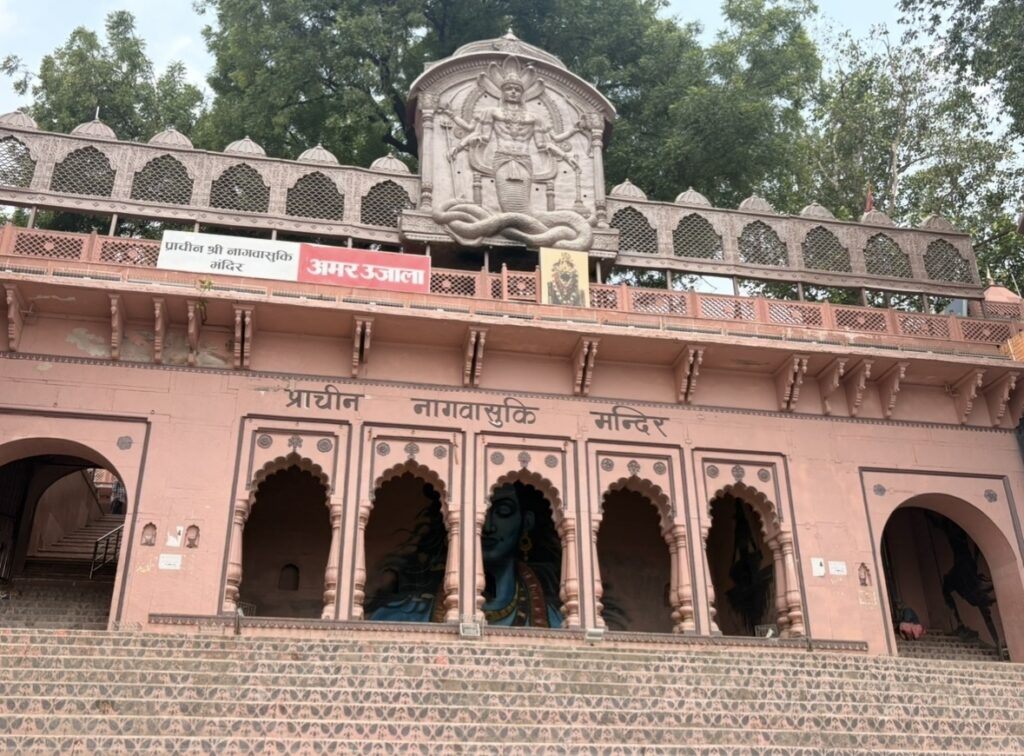
Our next stop was Shri Veni Madhav Mandir. By this point, the morning had developed into a continuous spiritual trail. We weren’t trying to spend hours at every temple. Instead, we focused on experiencing each place before moving towards the next location. We continued to Nag Vasuki Temple, another important religious site included in our Prayagraj itinerary.
Nag Vasuki Temple
The visit was relatively quick compared with our longer stop at Bade Hanuman Ji Mandir. This is one reason I recommend identifying your priority locations beforehand. You may discover that one place naturally deserves more of your time than another.
Alopi Devi Mandir
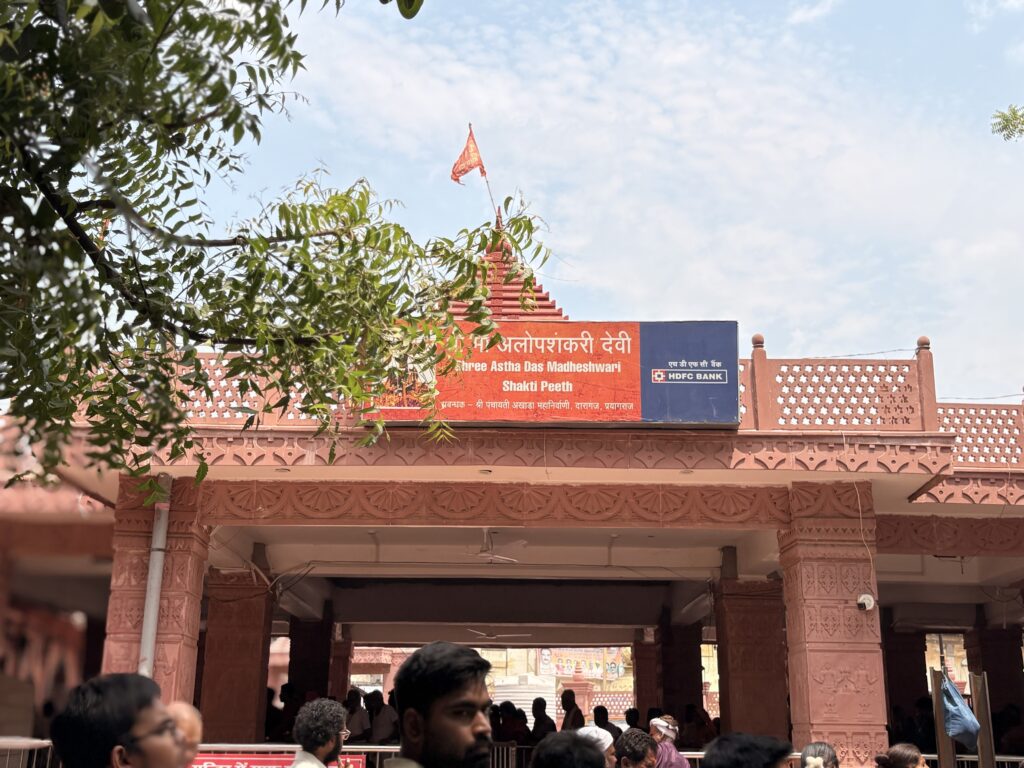
Our temple trail concluded with Alopi Devi Mandir. By this stage, we had already spent several hours moving between Sangam and the city’s spiritual landmarks. It was time to start thinking about our next train. Our Vande Bharat to Varanasi was scheduled for 12:10 PM.
What Prayagraj Felt Like to Us
Prayagraj was more than a collection of temples and a famous river confluence. The entire experience felt deeply religious.
There was a sense that almost every location we passed carried some connection with India’s spiritual traditions. That atmosphere was difficult to capture through photographs alone.
We had initially added Prayagraj because we regretted missing Maha Kumbh 2025. But after spending the morning there, we were glad that we had given the city its own place in our itinerary.
Why Triveni Sangam Is Spiritually Important
The religious significance of Prayagraj is closely associated with Triveni Sangam, traditionally regarded as the confluence of the Ganga, Yamuna and the invisible Saraswati. The site has long been associated with pilgrimage, ritual bathing and major religious gatherings.
The Kumbh Mela tradition is also deeply connected with Prayagraj and the religious significance of the Sangam. For pilgrims, taking a holy dip is traditionally associated with spiritual purification. For us personally, being able to experience that tradition directly was the main reason we wanted to visit.
📌 A NOTE ON RELIGIOUS TRADITIONS
Beliefs surrounding pilgrimage, holy bathing and individual temples can vary between traditions and communities. We are sharing the experience and beliefs relevant to our journey rather than presenting them as universal facts.
How Much Can You Really See in One Day?
Here’s something we learned quickly. You cannot realistically experience all of Prayagraj in a single day.
The city is too large, and its religious and cultural attractions are too numerous. Instead, create a priority list. For a short spiritual visit, we would personally start with:
- Triveni Sangam
- Bade Hanuman Ji Mandir
- Akshayavat and Patalpuri
- Veni Madhav Mandir
- Nag Vasuki Temple
- Alopi Devi Mandir
Then adjust the list according to your available time.
Our Prayagraj Morning at a Glance
| Experience | Our Details |
|---|---|
| 🚉 Arrival | ~7:00 AM |
| 🚿 Freshening up | AC railway station restroom |
| ☕ Breakfast | Tea, coffee, sandwiches, snacks |
| 🚕 Station → Sangam | ₹100 |
| ⏱️ Rickshaw journey | ~25 minutes |
| 🚣 Boat | Private |
| 💰 Private boat | ~₹2,000–₹3,500 |
| 🌊 Holy dip | Yes |
| ⏳ Sangam + temple trail | ~4 hours |
| 🛕 Priority temple | Bade Hanuman Ji Mandir |
| 🚆 Next train | Vande Bharat to Varanasi |
Leaving Prayagraj for Varanasi
After completing our morning around Sangam and the temples, we had to return towards Prayagraj Junction. Our Vande Bharat Express was scheduled for 12:10 PM.
We reached the station around 11:30 AM because we wanted enough time for a hassle-free boarding experience. The train was eventually delayed by around 15 minutes, so there was no real rush. But we did discover something important about Platform 6.
A Useful Tip About Prayagraj Junction Platform 6
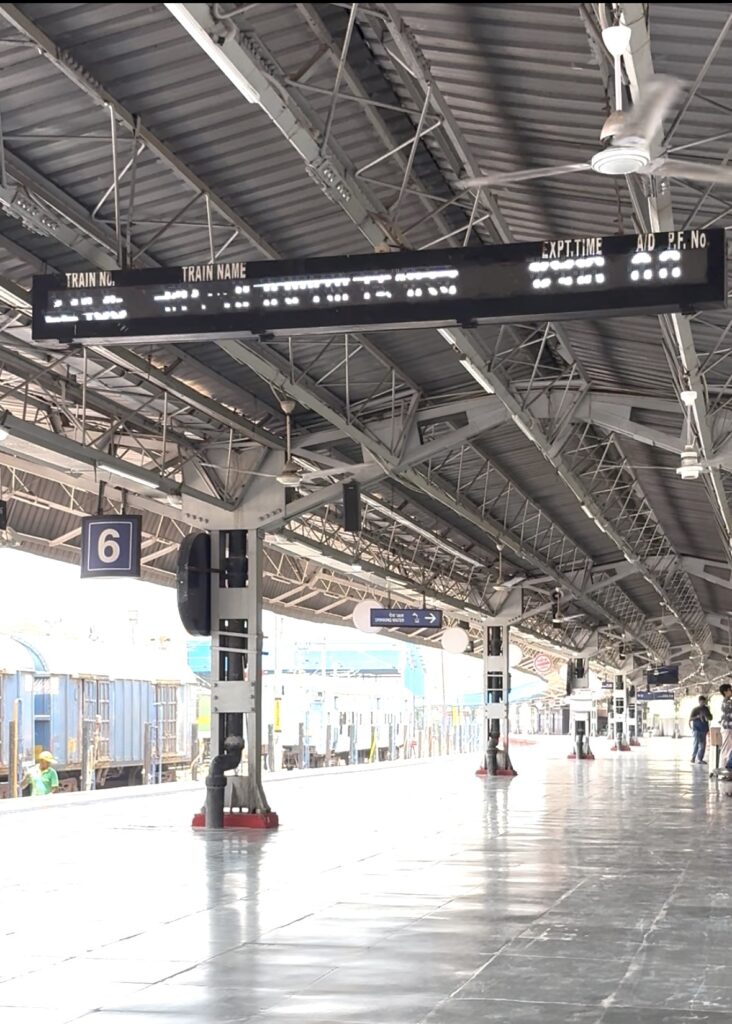
Our Vande Bharat to Varanasi usually boards from Platform 6. The platform isn’t as straightforward to access through the common station entrances. If you’re unfamiliar with the station, ask railway staff or local transport drivers about the direct route to Platform 6.
Platform 6 has its own entrance and exit area. You can also reach it through Foot Over Bridge 4 from the main station side. For convenience, we recommend asking your auto or e-rickshaw driver to drop you near the Platform 6 entrance when possible. Autos and rickshaws were easily available around that area during our visit.
🚆 PRACTICAL BOARDING TIP
Don’t simply follow the main station entrance when you’re travelling from Prayagraj on Vande Bharat.
Confirm the location of Platform 6 before entering the station, especially if you’re carrying luggage or travelling with family.
Varanasi: Next Stop of our Delhi Prayagraj Varanasi trip
By now, our Prayagraj experience had already given us a holy dip, a private boat ride and visits to several temples. But the journey wasn’t slowing down. Our next destination was Varanasi.
We were about to board a Vande Bharat Express for the short journey from Prayagraj to Varanasi. And what happened after reaching Varanasi would be a completely different experience. The calmness of Prayagraj Junction would soon be replaced by something we weren’t quite prepared for:
a sea of people at Varanasi Junction. 😅
Prayagraj to Varanasi by Vande Bharat Express
After spending the morning exploring Prayagraj, we returned to the railway station for the next leg of our journey.
Our destination was Varanasi, the spiritual heart of our trip and the city we had originally planned to visit before adding Prayagraj.
We were scheduled to board the Vande Bharat Express at 12:10 PM from Prayagraj Junction.
Our Vande Bharat Journey at a Glance
| Detail | Our Experience |
|---|---|
| 🚉 Boarding station | Prayagraj Junction |
| 🚉 Destination | Varanasi Junction |
| 🕐 Scheduled departure | 12:10 PM |
| 🕐 Actual departure | 12:25 PM |
| 🕑 Actual arrival | 2:15 PM |
| 💺 Class | Chair Car (CC) |
| 🪑 Seating | 3+2 configuration |
| 🍛 Food | Lunch served onboard |
| 🧹 Cleanliness | 4.5/5 |
| ⭐ Overall coach experience | 4.5/5 |
| ⏱️ Approx. journey | ~1 hour 50 minutes |
Our Seating Experience in Chair Car
We travelled in Chair Car (CC).
The seating configuration was 3+2, while Executive Chair Car uses a more spacious 2+2 arrangement.
Our seats were 16, 17 and 18.
However, there was an interesting seating arrangement within the coach. One member of our group was sitting separately because of how the seats were allocated.
This was another reminder of something that had already bothered us during the trip.
Indian Railways’ current seat allocation system doesn’t always guarantee that a group travelling together will actually receive seats together.
Why Railway Seat Selection Could Be Better
We had actually faced the same problem despite booking our tickets at different times.
- Our Prayagraj-to-Varanasi Vande Bharat tickets were booked on 26 May 2026.
- Our return Vande Bharat tickets from Varanasi to Delhi were also booked that day.
- Both trains had plenty of vacant seats when we booked.
- Yet we still received separate seating arrangements.
This feels unnecessary when passengers are booking together.
💡 OUR SUGGESTION FOR INDIAN RAILWAYS
Allow passengers to manually select their preferred seats, similar to airline booking systems.
It could make group travel more transparent and reduce the need for passengers to depend on others for seat exchanges.
In our case, passengers were kind enough to cooperate. We’re genuinely thankful to the people who understood our situation and helped us sit together. But passengers shouldn’t have to depend on someone else’s willingness to exchange seats.
Vande Bharat Coach Experience
The overall coach experience was excellent.
I’d personally rate the coach 4.5/5.
The interiors felt modern, the seats were comfortable and the journey itself was short enough that we didn’t experience any major discomfort.
The cleanliness was also impressive.
I’d again give it approximately 4.5/5.
The only reason I wouldn’t give it a full score was the occasional issue with passengers using the washrooms without flushing afterward.
That’s less a problem with the train itself and more a reminder that passenger behaviour also determines how clean public facilities remain.
Lunch on the Train
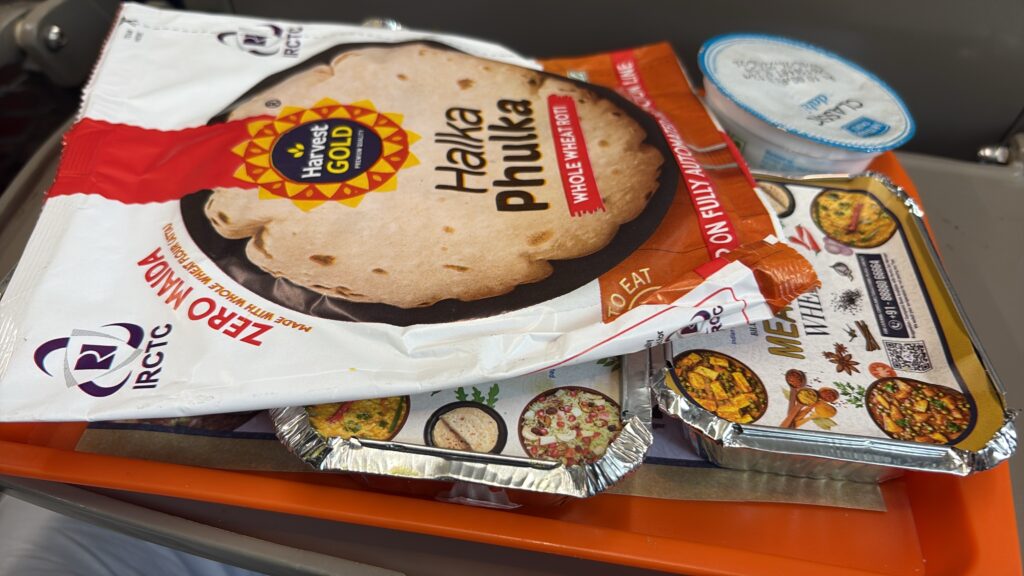
We also had lunch during the journey.
Since the journey from Prayagraj to Varanasi was barely two hours, food wasn’t something we particularly needed.
Still, having lunch onboard made the journey convenient.
We could simply sit back, eat and watch the landscape outside.
After an active morning around Sangam and the temples, that was exactly what we needed.
The View Before Entering Varanasi
One of the interesting moments came towards the end of the journey.
Before reaching Varanasi Junction, the train crosses the famous Varanasi Railway Bridge. The elevated view gives passengers a glimpse of the city and the Ganga landscape.
The route also passes around the area associated with Namo Ghat. If you’re travelling on this route, keep an eye outside the window as you approach Varanasi.
The scenery starts feeling different. You know you’re getting closer to the city.
Arriving at Varanasi Junction
Our Vande Bharat arrived at Varanasi Junction at approximately 2:15 PM. And this is where our experience changed dramatically. The moment we stepped onto the platform, we saw an enormous crowd.
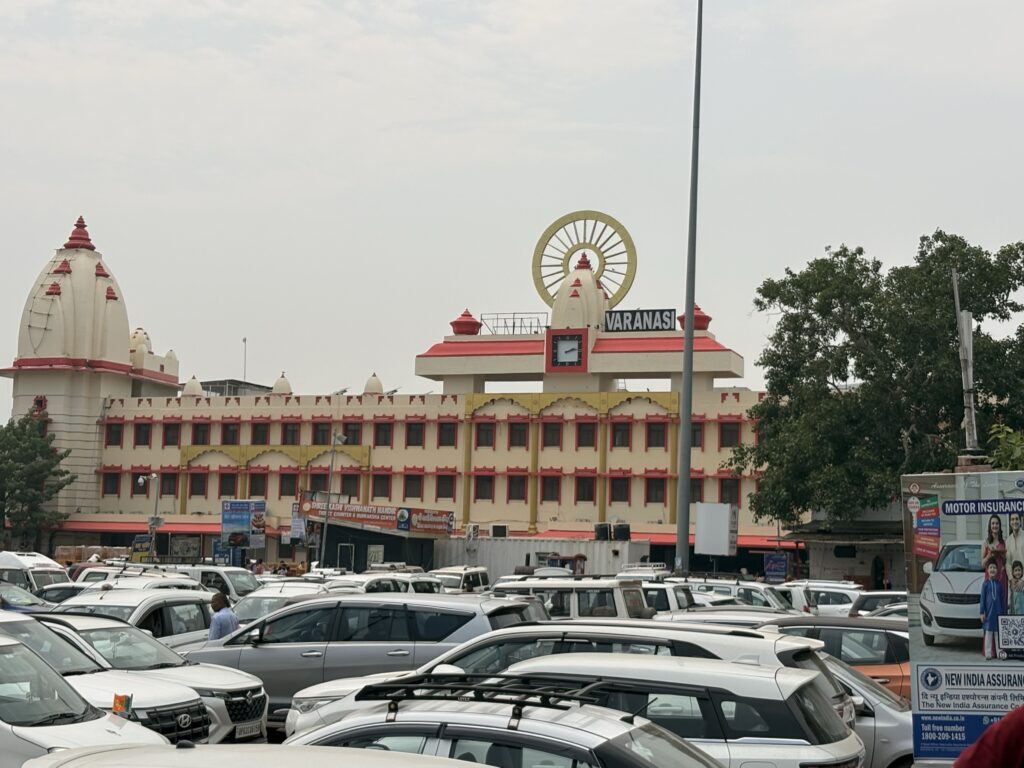
People were waiting for trains.
Some were sitting on the platform.
Others were sitting or lying around different areas of the railway station.
There were hundreds of people across the station premises.
After experiencing the comparatively manageable crowd at Prayagraj Junction earlier that day, the contrast was striking.
Our immediate reaction was basically:
“Okay, so this is what Varanasi is going to be like.” 😅
Our First Impression of Varanasi Junction
The crowd wasn’t necessarily chaotic in the sense of something going wrong.
But the sheer number of people made the station feel extremely packed.
It took us approximately 5–6 minutes just to make our way outside towards the auto and taxi area.
If you’re arriving in Varanasi for the first time, especially with luggage, don’t underestimate the time it can take to exit the station.
Prayagraj vs Varanasi Junction
| Factor | Prayagraj Junction | Varanasi Junction |
|---|---|---|
| 👥 Crowd | Relatively manageable | Extremely crowded |
| 🚶 Exit experience | Easy | Took ~5–6 minutes |
| 🚕 Transport | Easily available | Easily available outside |
| 🧳 With luggage | Comfortable | More challenging |
| 😮 First impression | Calm | Overwhelming |
Varanasi Junction to Sonarpura
Once we finally reached outside the station, we hired an auto.
The auto driver charged us ₹300 for the journey to Sonarpura.
The ride took approximately 30–35 minutes.
Our accommodation was located around Sonarpura Road, which was convenient for accessing the ghats and several important areas of Varanasi.
We deliberately chose this area because we wanted to remain close to the Ganga Ghats without staying directly inside the busiest parts.
Where We Stayed in Varanasi
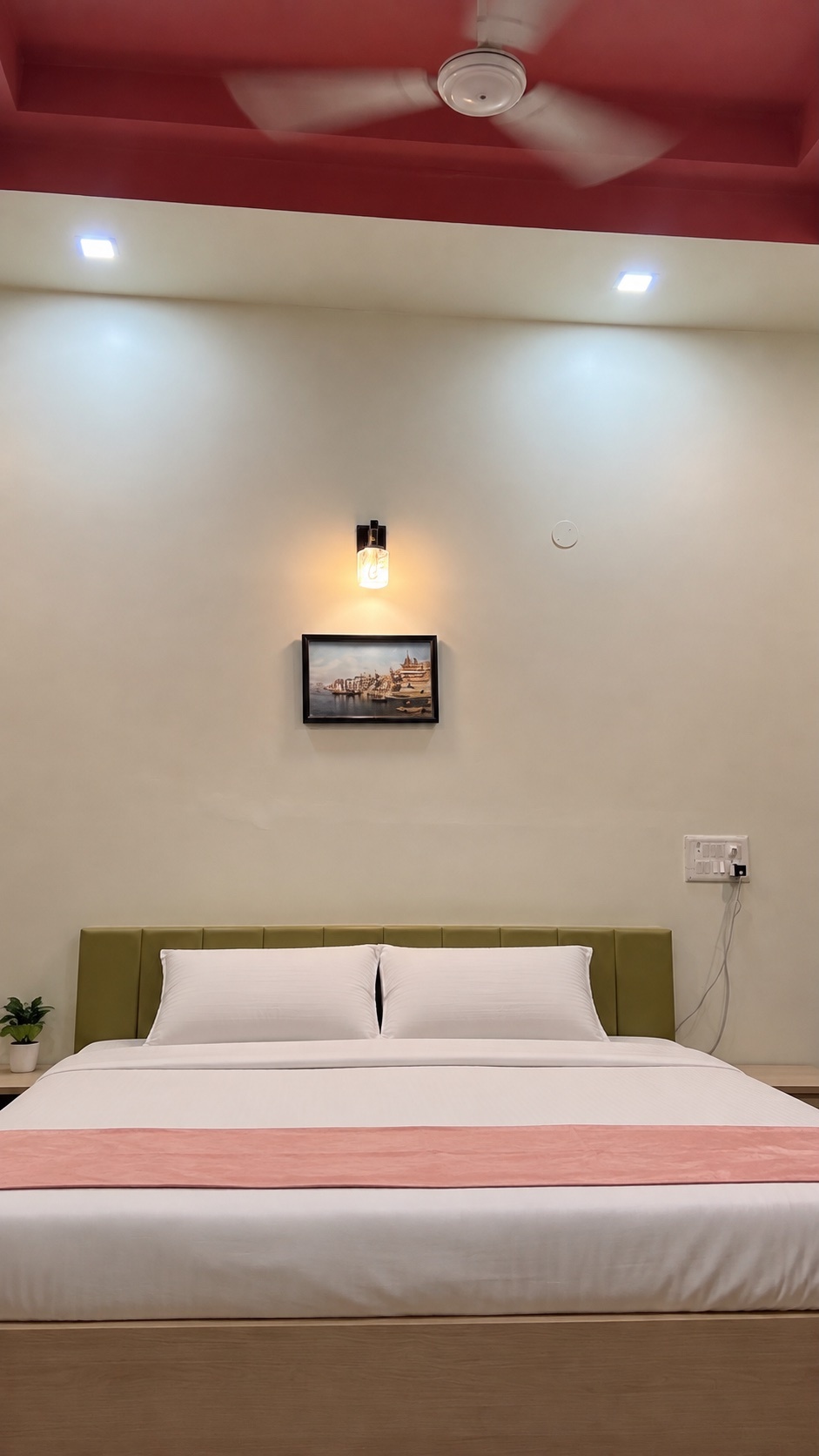
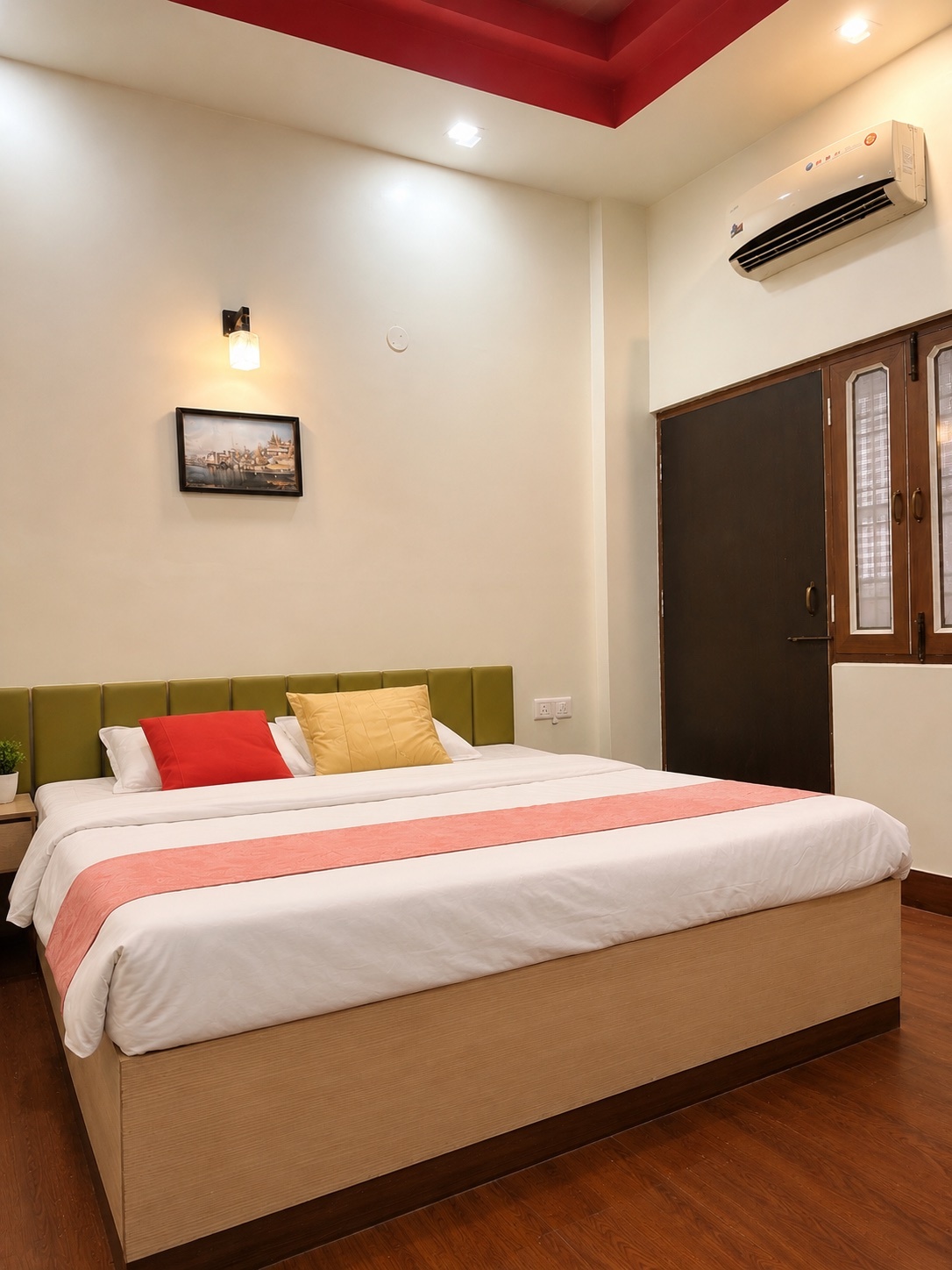
We stayed at Hotel Vishwanath on:
B-10/7, Sonarpura Road, near Vishal Mega Mart, Krim Kund, Shivala, Varanasi – 221001.
We booked the accommodation offline.
This turned out to be one of the most interesting lessons from our Delhi Prayagraj Varanasi trip.
Why We Chose Offline Hotel Booking in Varanasi
Before travelling, I had researched several hotels online.
- I checked Google, ChatGPT, Gemini and other platforms to compare accommodation options.
- We particularly wanted somewhere close to Kashi Vishwanath Temple and the Ganga Ghats.
- But we didn’t finalize an online booking.
- And honestly, I’m glad we didn’t.
- The photographs of several hotels looked impressive online.
- However, when we checked some properties offline, the actual rooms were often much smaller than we expected.
That experience completely changed how I look at hotel photographs.
⚠️ OUR VARANASI ACCOMMODATION LESSON
Don’t judge a Varanasi hotel solely by its online photographs.
If you’re travelling with three or more people, call the property and ask about the actual room dimensions, bed configuration and usable floor space.
Better yet, consider checking suitable offline options after reaching the city.
Our Room at Hotel Vishwanath
Our triple-bed room was actually quite comfortable.
- There was enough space to keep our luggage.
- We also had decent walking space inside the room, which matters considerably when three people are sharing one room.
- The bathroom was reasonably spacious.
- There was also a balcony-like area where we could hang clothes to dry.
For three people, we found the room comfortable and tidy.
What We Paid for Two Nights
The original price quoted for our two-night stay was approximately ₹5,000.
After negotiating offline, we paid ₹4,500.
We additionally spent around ₹300 on water bottles and small room services during our stay. So our accommodation expense came to approximately:
₹4,800 for two nights
That’s roughly ₹800 per person per night for three travellers when including those additional small expenses.
⭐ Our Hotel Rating
Hotel Vishwanath: 4.3/5 ⭐
What we liked:
- Decent triple-bed room
- Good usable space
- Spacious enough bathroom
- Balcony-like drying area
- Convenient Sonarpura location
- Easy access towards the ghats
- Comfortable for three people
What we didn’t like:
- Mattress quality could have been better
Overall, though, we were satisfied with the accommodation.
Why Sonarpura Worked Well for Us
The location turned out to be extremely convenient.
- Sonarpura gave us relatively easy access to several important parts of our Varanasi itinerary.
- Assi Ghat was within walking distance, although we often used battery rickshaws when we wanted to save time.
The location also worked well for reaching the central ghats and temple areas. For our itinerary, that balance between accessibility and accommodation comfort worked nicely.
Our Varanasi Base
Hotel Vishwanath → Sonarpura → Assi Ghat → Dashashwamedh Ghat → Kashi Vishwanath Temple
This became the rough movement pattern for our first day. And after checking into the hotel, we didn’t waste much time.
We had only a few hours before one of the biggest experiences of our Varanasi trip.
Ganga Aarti at Dashashwamedh Ghat.
Next: Our First Evening in Varanasi
We checked into the hotel at around 3:00 PM.
After freshening up and resting for approximately 1.5 hours, we prepared ourselves for the evening.
We were heading towards Dashashwamedh Ghat.
We didn’t know it yet, but the walk along the ghats, the Ganga Aarti and our later visit to Kashi Vishwanath Temple would make our first evening in Varanasi one of the most memorable parts of the entire trip.
Day 1 in Varanasi: Ganga Aarti, Kashi Vishwanath and the Ghats
After reaching Varanasi and checking into our hotel, we finally had some time to slow down.
We checked into Hotel Vishwanath at around 3:00 PM.
After freshening up, we rested for approximately 1.5 hours.
We knew we couldn’t spend the entire evening resting because our first major experience in Varanasi was waiting.
Ganga Aarti at Dashashwamedh Ghat.
Our First Evening Plan
We left the hotel when it was time to head towards the ghats. The obvious option would have been hiring an auto. However, we deliberately avoided road transport during the evening rush. Varanasi’s roads can become extremely congested during peak hours.
Instead, we decided to walk along the ghats.
That turned out to be one of the best decisions of our first evening.
Sonarpura to Dashashwamedh Ghat
Our walk took approximately 30 minutes.
It wasn’t merely transportation. It became our first proper introduction to Varanasi’s atmosphere. The ghats, narrow lanes, religious activity and constant movement gradually made the city feel different from anywhere we’d visited earlier.
We weren’t rushing. We were simply walking towards the Ganga.
💡 OUR TIP
If you’re staying around Sonarpura and visiting the central ghats during peak evening hours, consider walking instead of taking an auto.
It may take longer on paper, but heavy traffic can make road transport surprisingly slow.
Another Way to Reach the Ganga Aarti
Walking isn’t the only option.
You can also consider taking a boat towards the Ganga Aarti area. If you’re already planning a boat ride, ask the boatman whether Ganga Aarti viewing is included in your ride.
This can save you from arranging separate transportation. However, always confirm the exact route, duration and inclusions before paying.
Experiencing Ganga Aarti at Dashashwamedh Ghat
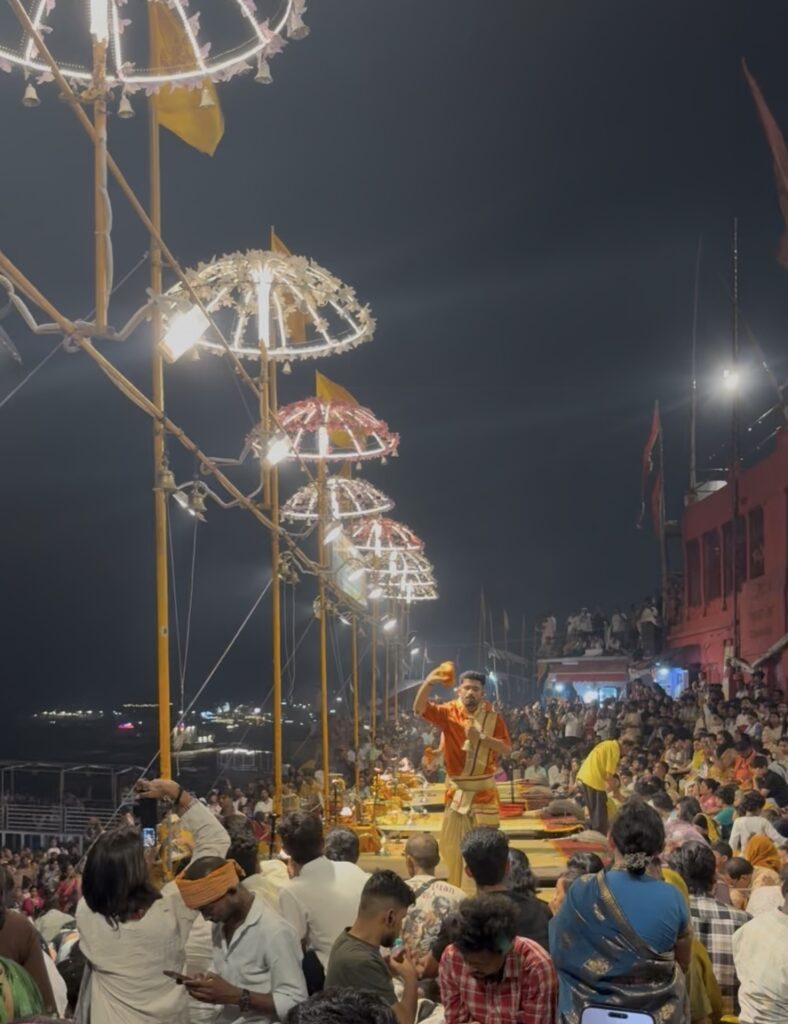
Dashashwamedh Ghat is perhaps the most famous location associated with the evening Ganga Aarti in Varanasi. The atmosphere changes dramatically as the evening approaches.
People begin gathering. The ghats become increasingly busy.
Devotees, tourists, photographers and pilgrims all arrive with different reasons for being there.
For us, it was less about simply watching a famous attraction. We wanted to experience the spiritual atmosphere surrounding the Ganga.
When Should You Reach for Ganga Aarti?
During our visit, the evening Aarti began at approximately 6:30 PM.
Our strongest recommendation is simple:
Reach at least one hour early.
Getting there early gives you more flexibility when choosing where to sit.
It also allows you to settle down before the main ceremony begins. You won’t have to spend the opening moments searching for a place through the crowd.
Ganga Aarti Planning Snapshot
| Detail | Our Experience |
|---|---|
| 📍 Location | Dashashwamedh Ghat |
| 🕡 Aarti start | Around 6:30 PM |
| 🚶 Our route | Walked from Sonarpura |
| ⏱️ Walking time | ~30 minutes |
| 🪑 Recommended arrival | At least 1 hour early |
| 🚣 Alternative | Boat viewing |
What Made the Aarti Special for Us?
The ceremony itself was only one part of the experience.
The atmosphere around the Ganga was equally memorable.
Bhajans were playing around the ghats.
People were finding their places.
The river was flowing quietly alongside the increasingly energetic atmosphere. It created an unusual combination of stillness and movement. You could feel that everyone around you was experiencing Varanasi differently.
Is Ganga Aarti Only at Dashashwamedh Ghat?
No.
This is something many first-time visitors may not realize.
While Dashashwamedh Ghat is the most famous location associated with the ceremony, Ganga Aarti is also performed at other ghats. We chose Dashashwamedh Ghat because of its historical importance and the spiritual atmosphere surrounding the location.
If crowds aren’t your preference, researching other Aarti locations can be worthwhile.
Can You Watch Ganga Aarti From a Boat?
Yes, you can consider watching the ceremony from the river.
However, don’t assume that every boat ride automatically includes Ganga Aarti viewing.
Ask your boatman before boarding.
Confirm whether the Aarti viewing is included in your route and price.
This small question can prevent confusion later.
Leaving the Aarti Before It Ended
The Ganga Aarti continued until approximately 8:00–8:15 PM. We didn’t stay until the very end.
We left at around 7:50 PM.
There was a reason – We had another extremely important place on our Day 1 itinerary.
Kashi Vishwanath Temple
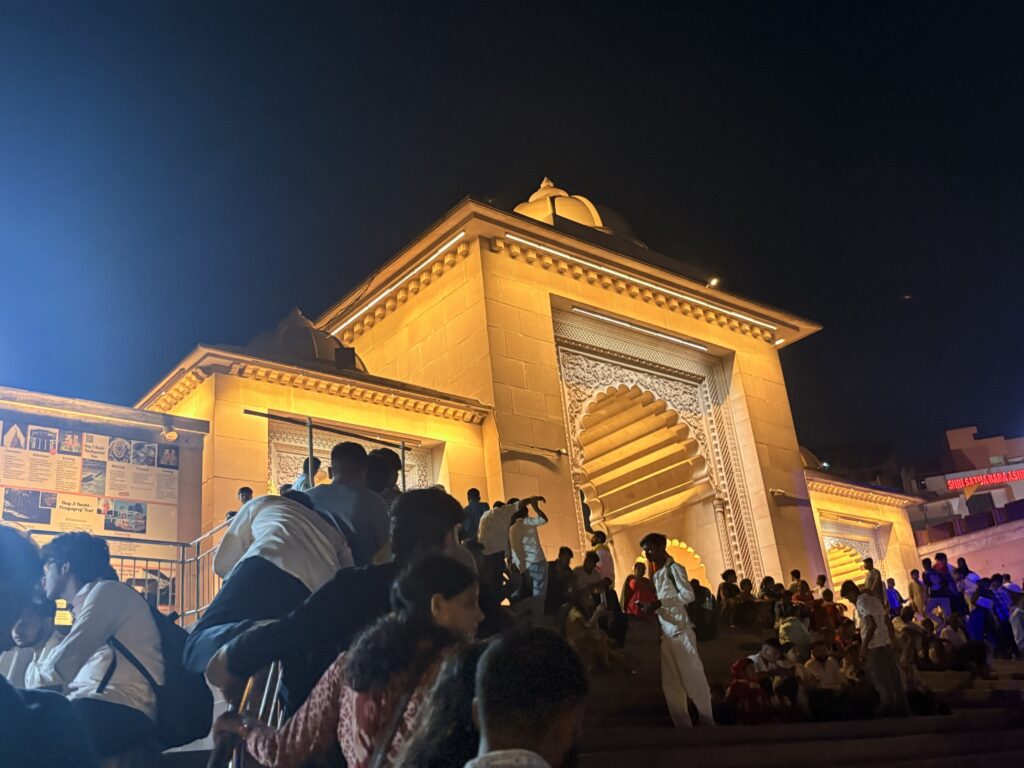
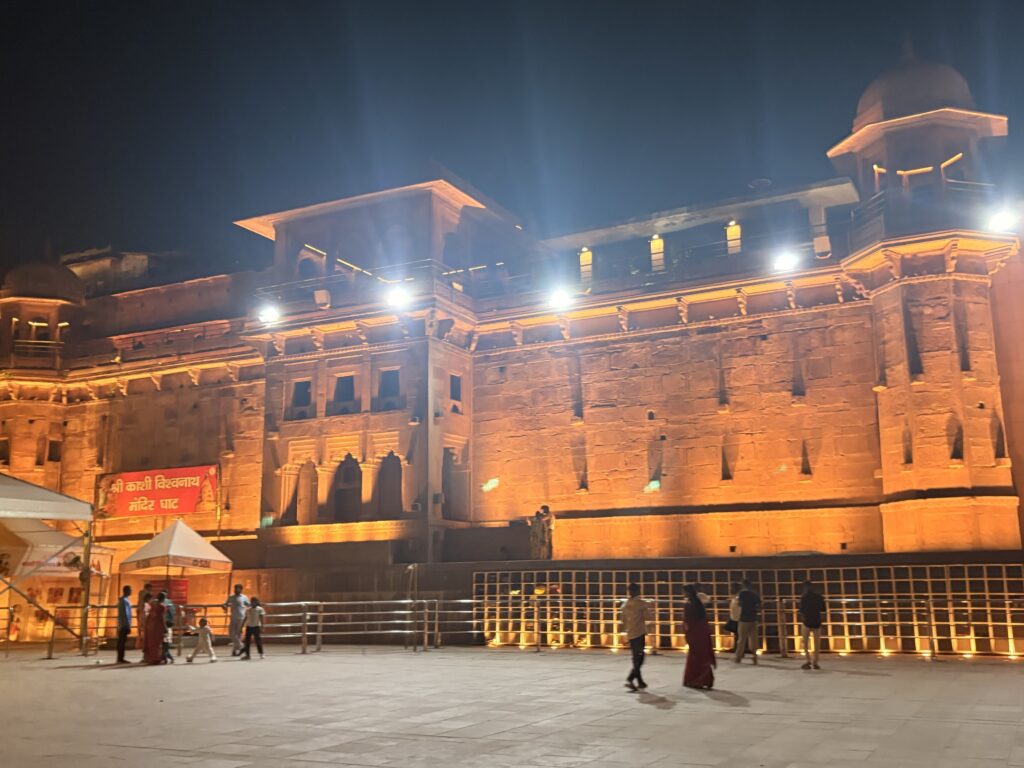
We wanted to visit the temple that same evening.
So, rather than waiting for the entire Aarti to conclude and then dealing with the largest post-Aarti movement of people, we started walking towards the temple slightly earlier.
Dashashwamedh Ghat to Kashi Vishwanath Temple
We continued walking along the ghats and surrounding areas. It took us approximately 20–25 minutes to reach the temple premises.
This was another situation where walking worked better for us than taking an auto. Evening traffic around Varanasi can become intense. A short road distance doesn’t necessarily mean a short journey.
Visiting Kashi Vishwanath Temple in the Evening
Our experience at Kashi Vishwanath Temple was unexpectedly smooth. There was some crowd, of course. But compared with what we had expected, the Darshan experience was relatively comfortable.
The entire process took approximately 1–1.5 hours for us.
One thing we noticed was that some crowd buildup seemed to come from the temple’s own entry management. Visitors enter in different groups or batches, which can create temporary congestion outside. Once inside, however, our experience was much smoother than anticipated.
Our Kashi Vishwanath Visit
The newly renovated temple premises were particularly impressive. The scale and presentation of the complex made the visit feel significant. But for us, the emotional importance went beyond the architecture.
I’m a strong believer in Lord Shiva, so being inside Kashi carried a completely different feeling.
Kashi is traditionally regarded as one of the oldest continuously inhabited cities. Its association with Lord Shiva is one of the reasons the city holds such significance for devotees.
PERSONAL MOMENT
For me, Kashi wasn’t simply another destination on a travel itinerary.
After planning the journey for weeks, finally reaching the city associated so deeply with Lord Shiva felt genuinely special.
Dinner at Godowlia Chowk
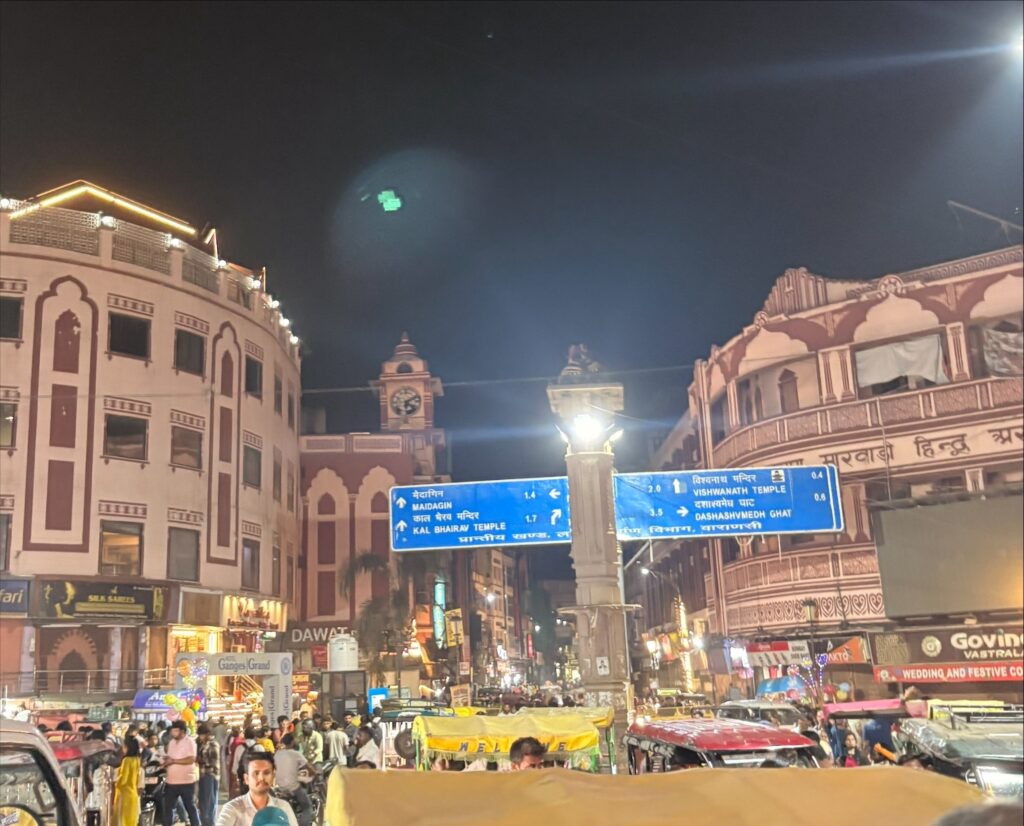
After the Aarti and Darshan, we were exhausted and hungry. We headed towards Godowlia Chowk for dinner. Unfortunately, the food we had there wasn’t particularly impressive. But after such a long evening, we were hungry enough to simply eat and move on.
This is also part of travelling.
Not every meal becomes a memorable culinary experience. Sometimes you simply need something to eat before heading back to the hotel. 😄
Returning to Sonarpura
We left Godowlia Chowk at approximately 10:30 PM.
We hired a manual rickshaw back towards Sonarpura.
The ride took approximately 30 minutes.
We paid ₹150.
For comparison, a battery rickshaw could cost around ₹100, depending on availability and prevailing fares.
Our Day 1 Local Transport
| Journey | Transport | Approx. Cost |
|---|---|---|
| Sonarpura → Dashashwamedh | Walking | ₹0 |
| Dashashwamedh → Kashi Vishwanath | Walking | ₹0 |
| Godowlia → Sonarpura | Manual rickshaw | ₹150 |
Total recorded road transport: ₹150
That’s one of the reasons walking around the central ghats worked so well for us.
Our Day 1 Route
Here’s how our first full evening in Varanasi unfolded:
Hotel → Dashashwamedh Ghat → Ganga Aarti → Kashi Vishwanath Temple → Godowlia Chowk → Sonarpura → Hotel
Visual Route
🏨 Hotel
↓ 30-minute walk
🪔 Dashashwamedh Ghat
↓ ~20–25-minute walk
🕉️ Kashi Vishwanath Temple
↓
🍛 Godowlia Chowk
↓ ~30-minute rickshaw
🏨 Sonarpura
Day 1 in Numbers
| Metric | Our Experience |
|---|---|
| 🕒 Hotel check-in | 3:00 PM |
| 😴 Rest | ~1.5 hours |
| 🚶 Walk to Dashashwamedh | ~30 minutes |
| 🪔 Ganga Aarti | ~6:30 PM onwards |
| 🕉️ Kashi Vishwanath visit | ~1–1.5 hours |
| 🍛 Dinner | Godowlia Chowk |
| 🛺 Return transport | ₹150 |
| 🌙 Back towards hotel | ~10:30 PM |
What We Would Do Differently
If we repeated this evening, we’d keep the same basic structure. However, we’d make sure to reach Dashashwamedh Ghat even earlier if we wanted a particularly good viewing position.
We’d also plan dinner more carefully instead of choosing a restaurant simply because we were hungry. Most importantly, we’d continue using walking routes around the central ghats whenever traffic was heavy.
Day 2 in Varanasi: Assi Ghat, Ganga Boat Ride and the 84 Ghats
Our second day in Varanasi started with a completely different atmosphere.
The previous evening had been about crowds, Ganga Aarti and temple Darshan.
This morning was slower, quieter and much more connected with the river.
We woke up around 7:00 AM because we wanted to experience Varanasi before the city became overwhelmingly busy.
Starting the Morning With a Local Breakfast
Before heading towards the Ganga, we had breakfast near our accommodation.
For the three of us, breakfast included:
- 🥔 3 aloo paranthas
- 🥛 Local lassi
- ☕ Tea
- 🥭 Mango shake
It was a simple but filling breakfast.
We knew we had several hours of walking, boating and temple visits ahead.
So skipping breakfast wasn’t really an option.
Heading Towards Assi Ghat
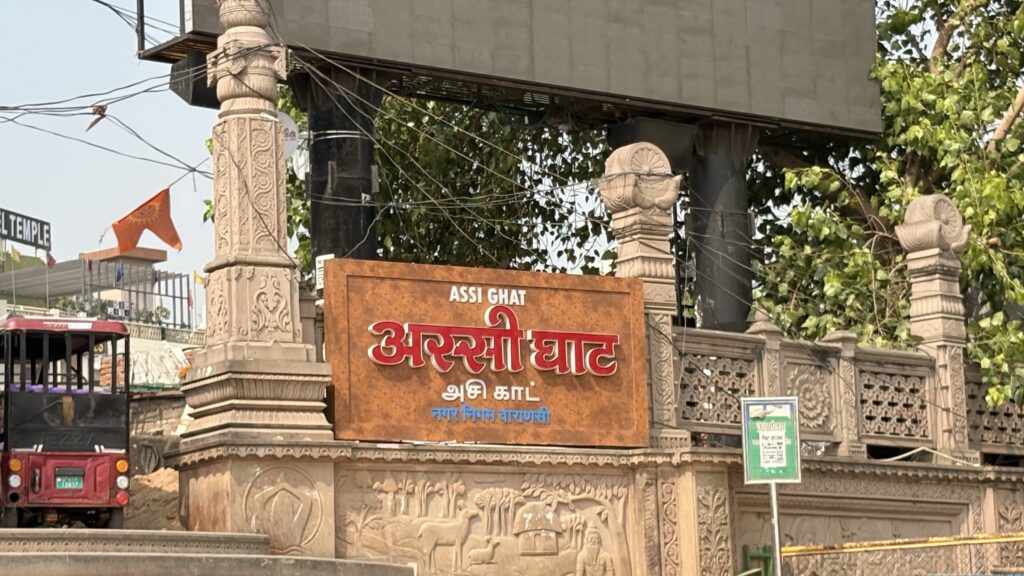
Our hotel in Sonarpura was conveniently located near Assi Ghat.
We hired a battery rickshaw instead of walking because we wanted to reach the Ganga early.
The ride took approximately 10 minutes.
Assi Ghat was our starting point for the day’s biggest experience.
A private boat ride across the Ganga.
Our Private Boat Ride From Assi Ghat
We decided to hire a private boat for three people.
The boat cost us approximately ₹2,200.
This was considerably more expensive than taking a shared boat.
However, having a private boat gave us much greater flexibility.
We could decide the pace, spend more time at particular locations and avoid travelling with a large group.
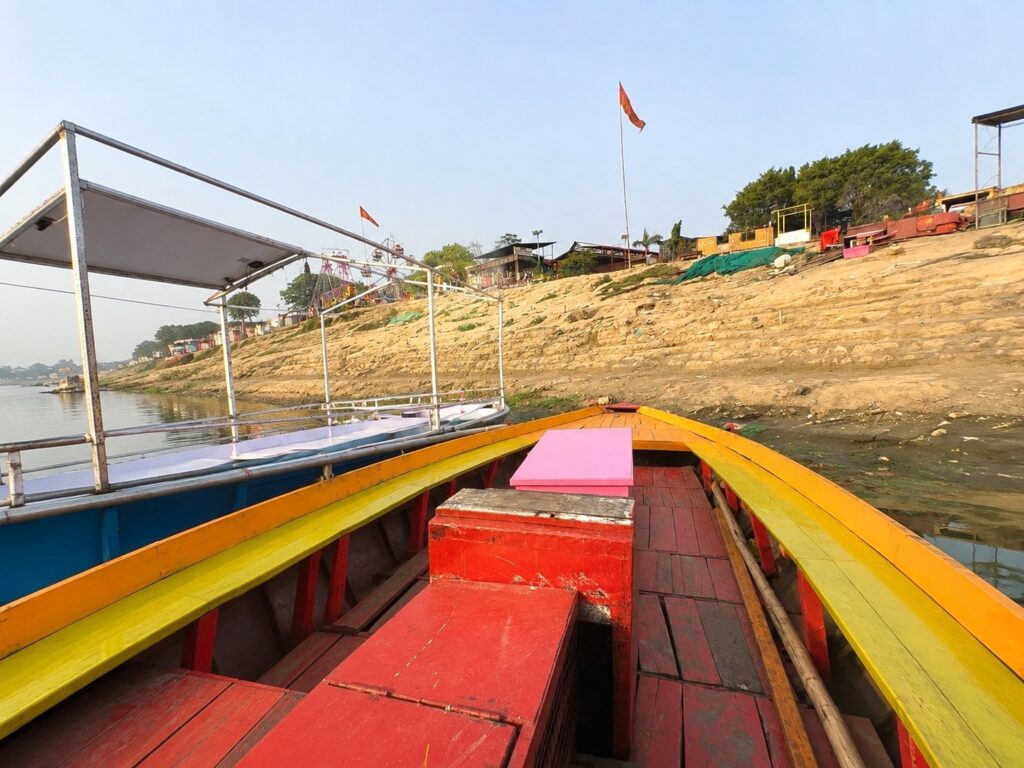
What Our ₹2,200 Boat Ride Included
Our boatman took us along the Ganga to experience the famous ghats of Varanasi.
The route covered approximately 84 ghats, beginning around Adi Keshava Ghat and eventually bringing us back towards Assi Ghat.
The exact experience can vary depending on the boat, route and time available.
You can also choose a shorter ride if you aren’t interested in covering every ghat.
Our Boat Ride at a Glance
| Detail | Our Experience |
|---|---|
| 🚣 Starting point | Assi Ghat |
| 👥 Passengers | 3 |
| 🚤 Boat | Private |
| 💰 Fare | ₹2,200 |
| ⏰ Start | ~8:30 AM |
| 🕙 End | ~10:00 AM |
| ⏱️ Duration | ~1.5 hours |
| 🛕 Ghats | Approx. 84 |
| 🌊 Holy dip | Yes |
| 📍 Return | Assi Ghat |
Seeing Varanasi From the Ganga
The boat ride gave us a completely different perspective of Varanasi. From the road, you see narrow lanes, vehicles, shops and crowds. From the river, the city opens up.
The long stretch of ghats becomes visible almost as one continuous landscape.
Each ghat has its own character. Some are filled with pilgrims. Some feel relatively quiet.
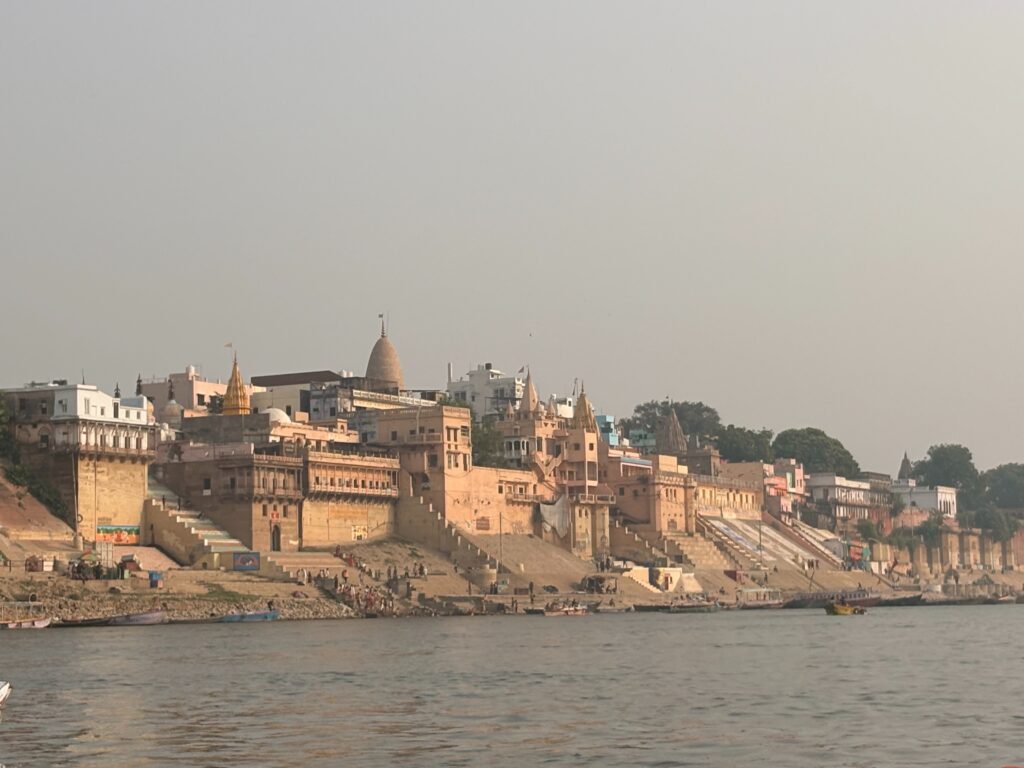
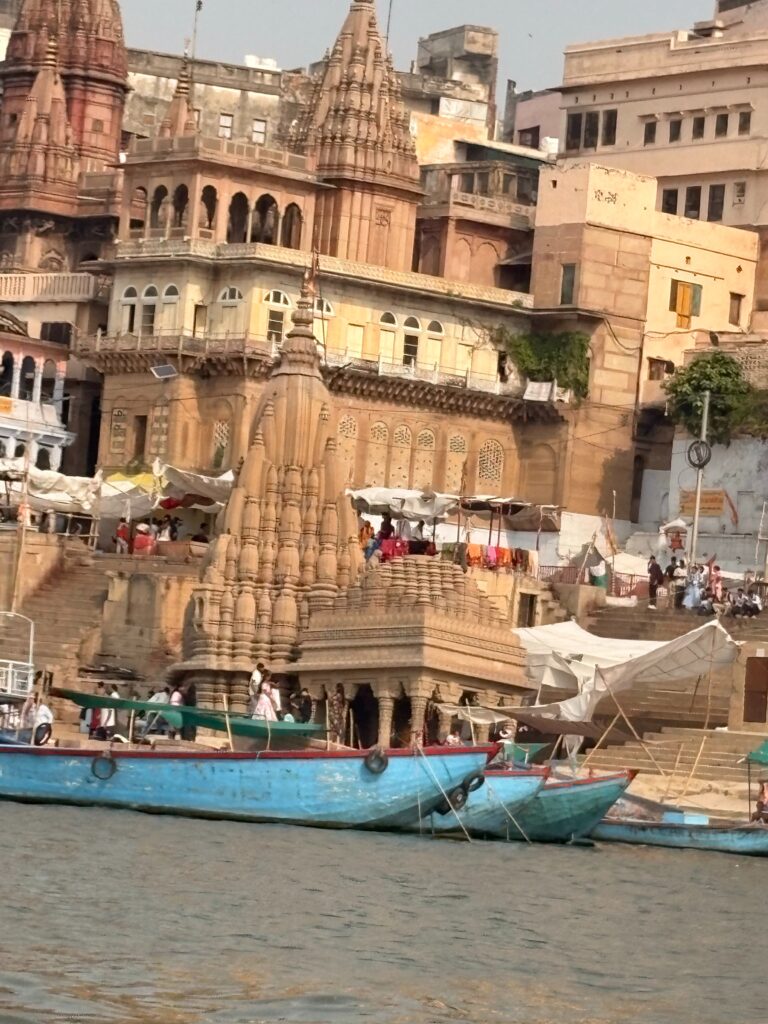
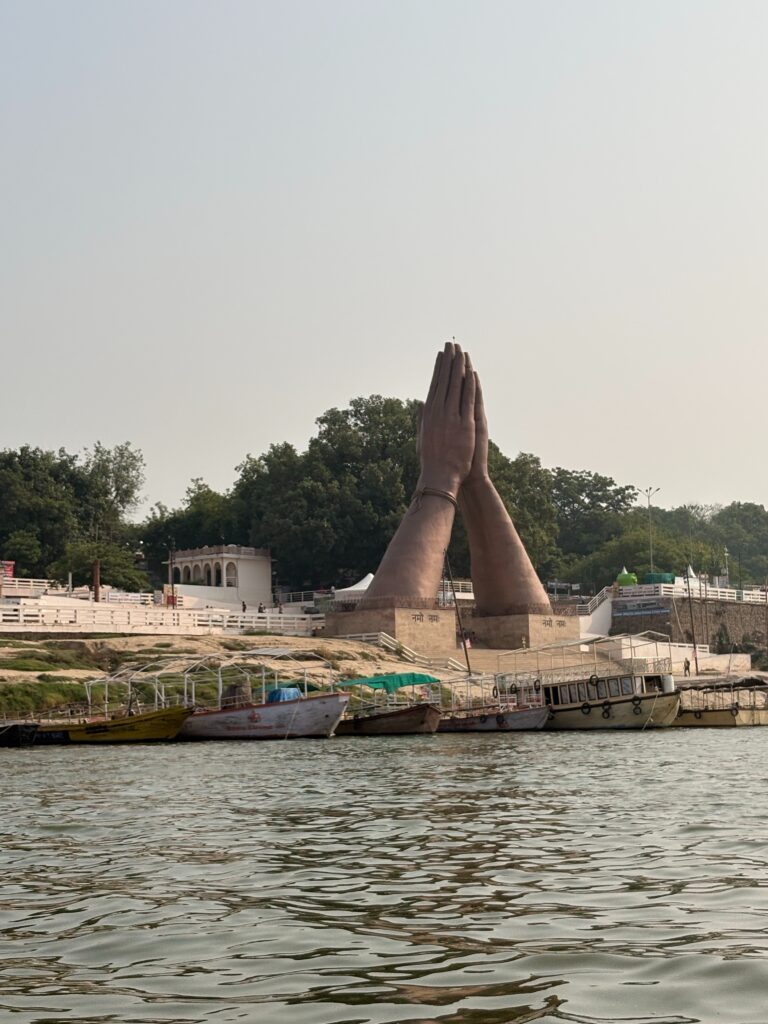
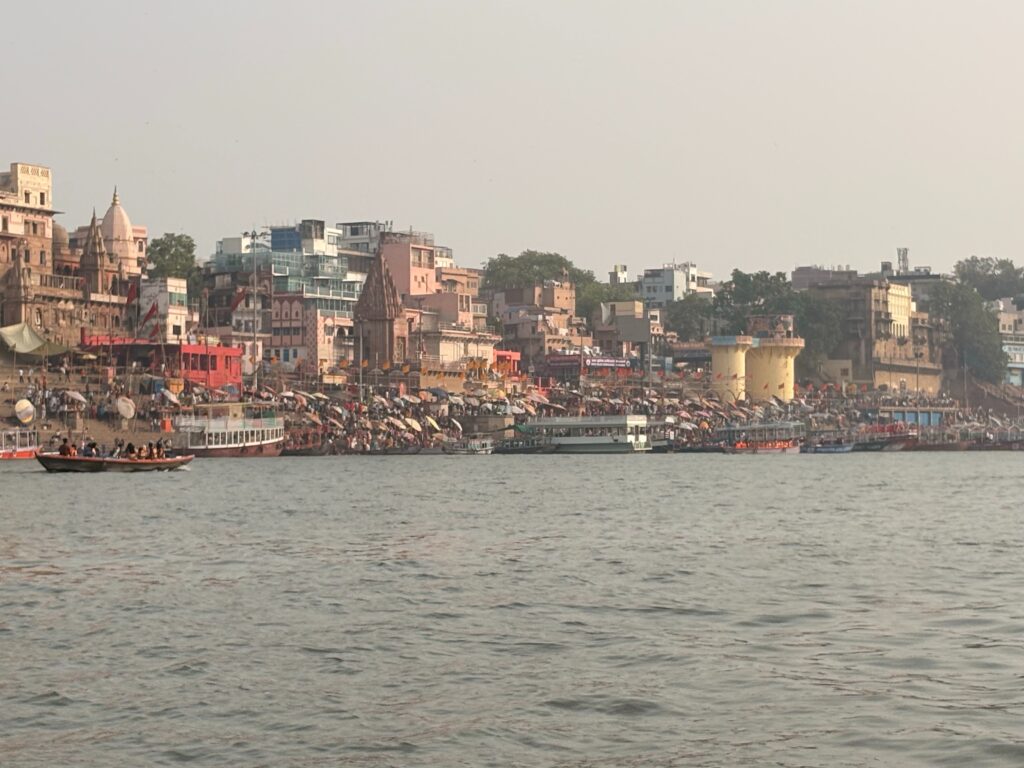
Others are dominated by historic buildings, temples and steps leading directly into the Ganga.
Crossing the Varanasi Railway Bridge Again
One of the interesting moments during our boat ride was passing beneath the Varanasi Railway Bridge. We had already seen this bridge from the Vande Bharat while approaching Varanasi.
Now we were looking at the same structure from the Ganga. That created a fun connection between two completely different parts of our journey.
From the train, we had seen the river and city from above. From the boat, we were experiencing the same landscape from the water.
Exploring the 84 Ghats of Varanasi
Our boat ride allowed us to experience the famous stretch of Varanasi’s ghats from the river.
The traditional count of 84 ghats is deeply associated with Varanasi’s spiritual identity.
You don’t necessarily need to visit every ghat on foot to appreciate their scale.
A boat provides an efficient way to see the riverside landscape in a relatively short period.
For first-time visitors, I found this particularly useful.
Why We Preferred a Private Boat
A private boat wasn’t essential.
A shared boat can be a much more affordable option.
But our priority was flexibility.
We were travelling as three people and wanted to control our route rather than follow someone else’s schedule.
We could also stop for photographs whenever something caught our attention.
That freedom made the extra expense worthwhile for us.
Private vs Shared Boat
| Factor | Private Boat | Shared Boat |
|---|---|---|
| 💰 Cost | Higher | Lower |
| 👥 Group | Your own group | Multiple passengers |
| ⏱️ Flexibility | High | Limited |
| 📸 Photography | Easier | Depends on crowd |
| 🧘 Privacy | Better | Limited |
| 👨👩👧👦 Best for | Families/groups | Budget travellers |
Our choice: Private boat.
Would we recommend it to everyone? Not necessarily.
If you’re travelling on a tight budget, a shared boat is perfectly reasonable.
Taking a Holy Dip in the Ganga
Our boat ride also included a stop for a holy dip in the Ganga. We used a dedicated bathing area on the opposite side of the river. The experience was completely different from our Sangam bath in Prayagraj.
At Prayagraj, we had taken our holy dip at the confluence of the rivers. Here, we were experiencing the sacred Ganga in Varanasi. For us, having both experiences during the same journey made the trip feel even more spiritually meaningful.
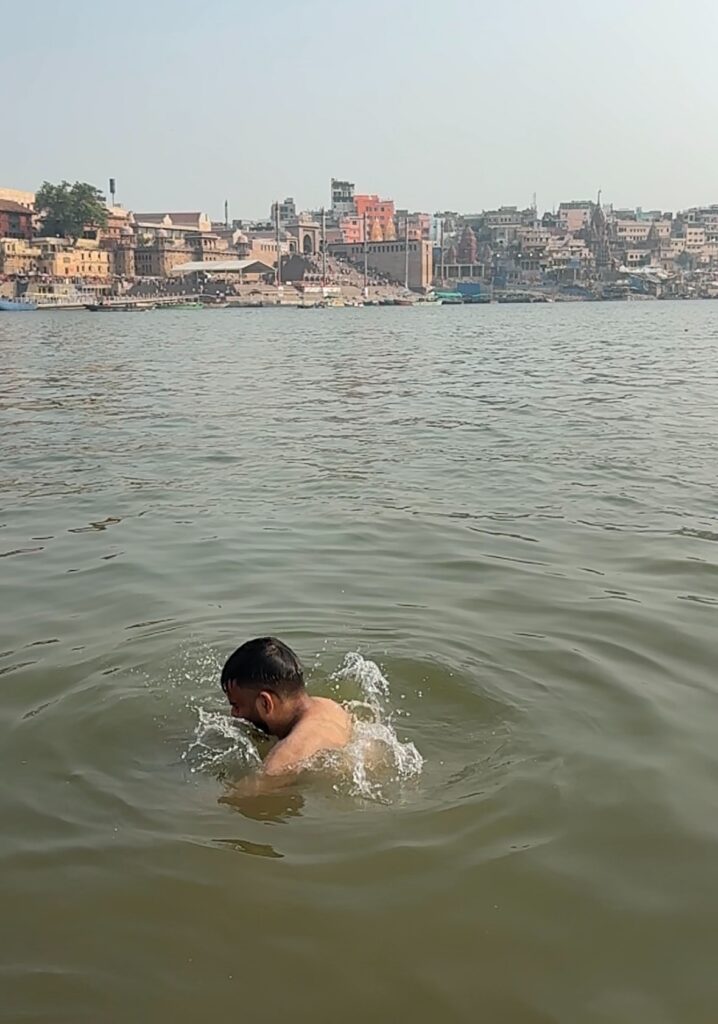
TWO HOLY DIPS, TWO CITIES
Prayagraj: Holy dip at Triveni Sangam.
Varanasi: Holy dip in the Ganga during our private boat ride.
Both experiences were different, but both became important parts of our spiritual journey.
Why We Started Our Boat Ride Early
Our boat ride started around 8:30 AM.
We intentionally chose the morning because we wanted to experience Varanasi before the day became too busy.
Early morning also gave us a more peaceful river experience.
The temperature was easier to handle than the afternoon heat.
And, most importantly, we could fit a large part of our itinerary into the remaining day.
A Practical Tip for First-Time Visitors
Don’t assume that every boat ride follows the same route.
Before boarding, clearly discuss:
- Which ghats you’ll cover
- Whether the ride is private or shared
- Whether a holy dip is included
- How long the ride will last
- Where you’ll return
- The total price
This makes the experience much clearer.
Back to Assi Ghat: Time for Food
We returned to Assi Ghat at around 10:00 AM.
And almost immediately, one thing became obvious.
We were extremely hungry.
After an early breakfast, walking and a boat ride, we needed another meal.
We went to a nearby local restaurant.
Our meal cost approximately ₹530.
What We Ordered
| Food | Quantity |
|---|---|
| 🌶️ Chilli Potato | 1 |
| 🥪 Grilled Sandwich | 1 |
| 🍜 Singapore Chowmein | 1 |
| 🫓 Chhole Bhature | 1 |
The meal filled us up, but I wouldn’t particularly recommend the Chhole Bhature if you’re coming from Delhi.
That’s purely based on personal preference.
Delhi has spoiled me when it comes to Chhole Bhature. 😄
Our Next Plan: Kaal Bhairav Temple
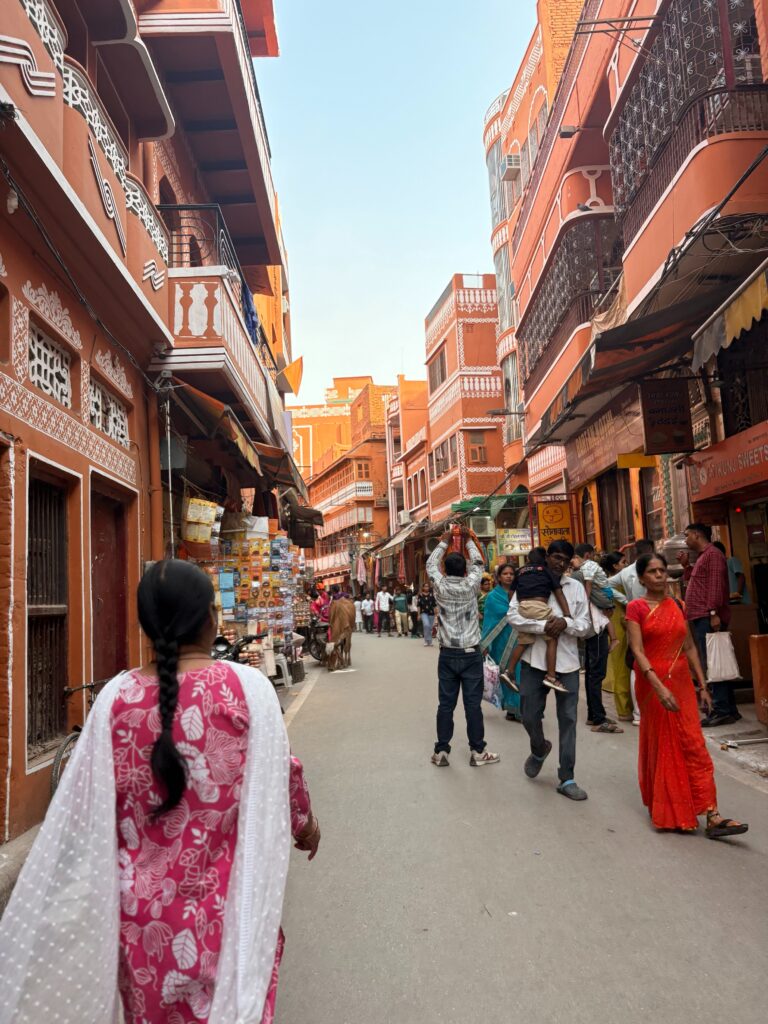
After eating, we wanted to visit Kaal Bhairav Temple.
It was around 11:30 AM.
However, our auto driver suggested that this might not be the best time.
He expected a heavy crowd around the temple.
His suggestion was to visit either in the evening or early the following morning.
Since we had to leave Varanasi the next day, we decided to shift Kaal Bhairav to the evening.
That small change completely rearranged our afternoon.
And surprisingly, it worked out quite well.
An Unexpected Stop: Ashtvinayak Mandir
Instead of immediately going towards Kaal Bhairav, we visited Ashtvinayak Mandir near Godowlia Chowk. This turned out to be one of the quieter temple experiences of our entire Varanasi trip.
There was practically nobody else there when we arrived. That made the visit feel particularly peaceful.
Why We Wanted to Visit Ashtvinayak Mandir
There is a traditional belief associated with this temple that Lord Ganesha marks the attendance of visitors entering the ancient city of Kashi. According to this belief, a pilgrimage to Kashi is considered incomplete without seeking the blessings of Ashtvinayak.
We spent approximately 10 minutes there and offered our prayers.
Whether you visit for religious reasons or simply enjoy discovering lesser-known temples, this was one of the places that stood out to us.
📍 HIDDEN GEM FROM OUR TRIP
Ashtvinayak Mandir
When we visited, there was almost no crowd.
It was a refreshing contrast to the much busier temples and ghats elsewhere in Varanasi.
Annapurna Mandir
From Ashtvinayak Mandir, we walked towards Annapurna Mandir.
The two temples were approximately 10–15 minutes apart on foot.
Our visits to both temples took less than half an hour in total.
Annapurna Mandir was noticeably busier than Ashtvinayak Mandir.
However, the crowd was still manageable. The Darshan experience remained smooth for us.
Exploring Godowlia Chowk
After the temple visits, we spent more than an hour exploring Godowlia Chowk.
This was less about following a strict itinerary.
We simply walked around, looked through shops and experienced the atmosphere. This is one thing I would recommend leaving some room for during a Varanasi trip. If every minute is pre-booked, you miss the spontaneous experiences that make the city interesting.
Lunch and an Afternoon Break
By around 1:00 PM, we were ready for lunch again.
We found a good-sized local restaurant around Godowlia Chowk.
Unfortunately, I don’t remember the restaurant’s name.
But the food and overall experience were good.
After lunch, we returned to our hotel.
We wanted to rest before heading out again in the evening.
Because our itinerary was already packed, this short break was necessary.
Evening Plan: Kaal Bhairav Temple
Our next major destination was Kaal Bhairav Temple.
This was one temple we absolutely didn’t want to miss.
There is a strong traditional belief that Kaal Bhairav acts as the Kotwal or guardian of Kashi.
Many devotees therefore consider seeking his blessings an important part of a Kashi pilgrimage.
Some traditions also recommend visiting Kaal Bhairav before Kashi Vishwanath. We personally visited Kashi Vishwanath first because that worked better with our Day 1 schedule.
Kaal Bhairav Temple: A Long Wait With a Worthwhile Darshan
We left our hotel and hired an auto. The ride to Kaal Bhairav Temple took approximately 25 minutes.
The auto fare was ₹200.
But our driver’s prediction about the crowd turned out to be completely wrong. Despite visiting in the evening, the crowd was still significant.
It took us approximately two hours to complete the temple visit and receive Darshan.
When Should You Visit Kaal Bhairav Temple?
Based on our experience, I would personally consider:
Early morning or after 8:00 PM
These periods may provide a smoother experience than the busier afternoon and evening window.
However, crowd levels can change considerably depending on the day, festivals and local conditions.
Don’t treat our timing as a guarantee.
⚠️ OUR BIGGEST LESSON
Local advice can be extremely useful, but it isn’t always accurate for every situation.
Our driver expected a heavy crowd around 11:30 AM.
We visited later in the evening and still encountered a long wait.
A Delicious Discovery While Waiting
During our temple visit, we found something unexpectedly delicious.
We had grilled green-chilli corn-filled sandwiches.
We ordered four.
Yes, four.
There were three of us.
And the fourth sandwich wasn’t exactly planned. 😂
They were so good that we ordered one extra.
Each sandwich cost approximately ₹40.
Sometimes the most memorable food discoveries happen when you’re simply waiting around somewhere.
Hidden Gem: Pita Maheshwar Mahadev Mandir
After Kaal Bhairav, we visited another temple that became one of the quietest experiences of our entire Varanasi trip.
Pita Maheshwar Mahadev Mandir
We discovered this temple through India Trip Planner. The planner had suggested it as a lesser-known or hidden spiritual attraction. And honestly, we’re glad it did.
Almost Nobody Was There
When we reached the temple, it was almost completely empty.
- There were no crowds.
- No long queues.
- No rush.
- Just a peaceful temple environment.
After spending hours navigating some of Varanasi’s busiest locations, this felt like a completely different side of the city.
This was also one of the strongest examples of why I found the India Trip Planner useful during this journey.
Ending the Day Along the Ghats
By this point, we were exhausted.
We had already covered the Ganga, multiple temples, Godowlia Chowk and several kilometres of movement around Varanasi.
Instead of immediately returning to the hotel, we decided to spend some time around the ghats.
We headed towards Panchganga Ghat.
This became another peaceful pause in an otherwise extremely packed day.
Bundiparkota Ghat and Its Wall Paintings
While walking around the ghats, we came across beautiful wall paintings around Bundiparkota Ghat. We stopped to take photographs which will be some of the best highlights of our Delhi Prayagraj Varanasi trip.
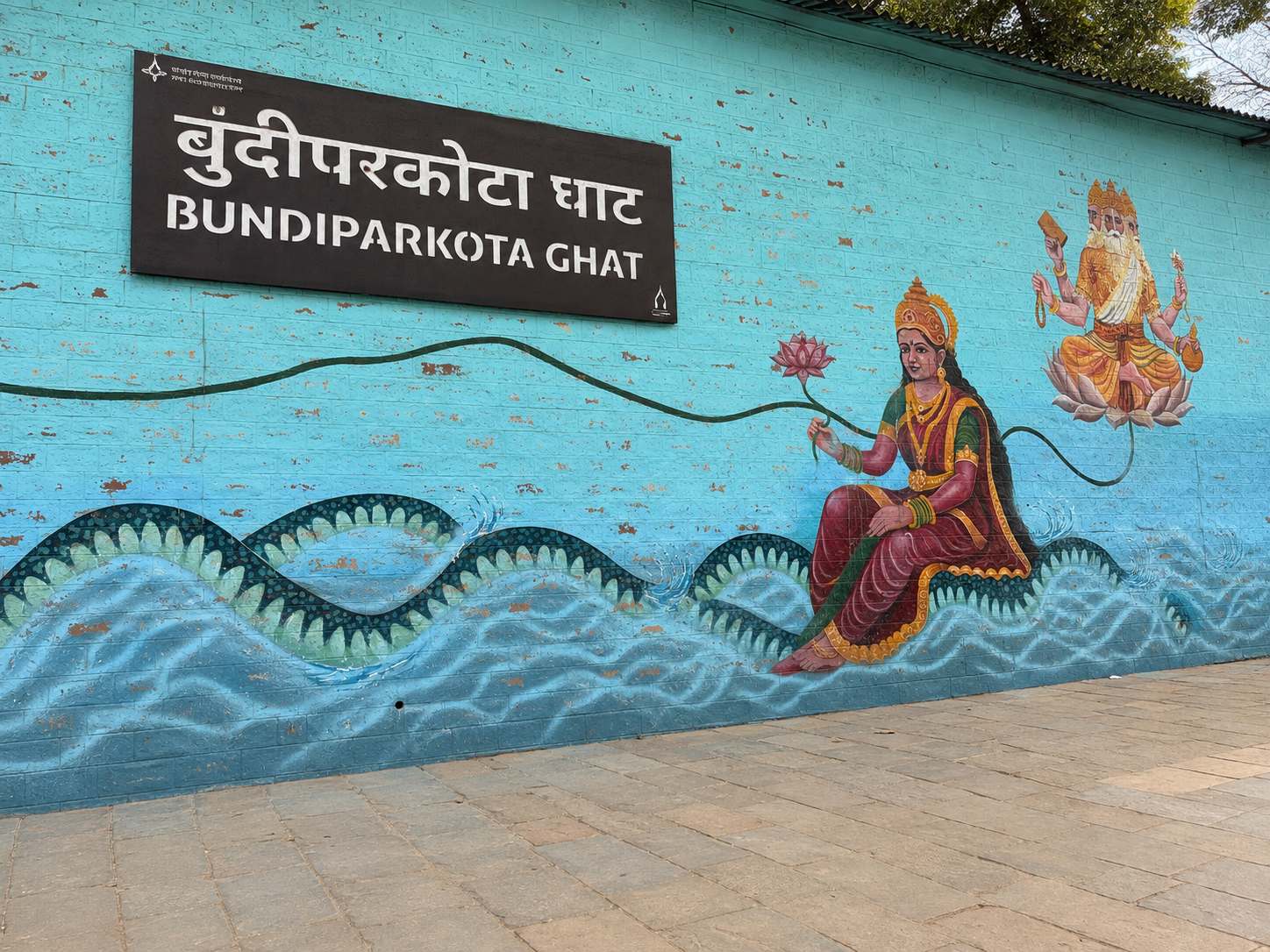
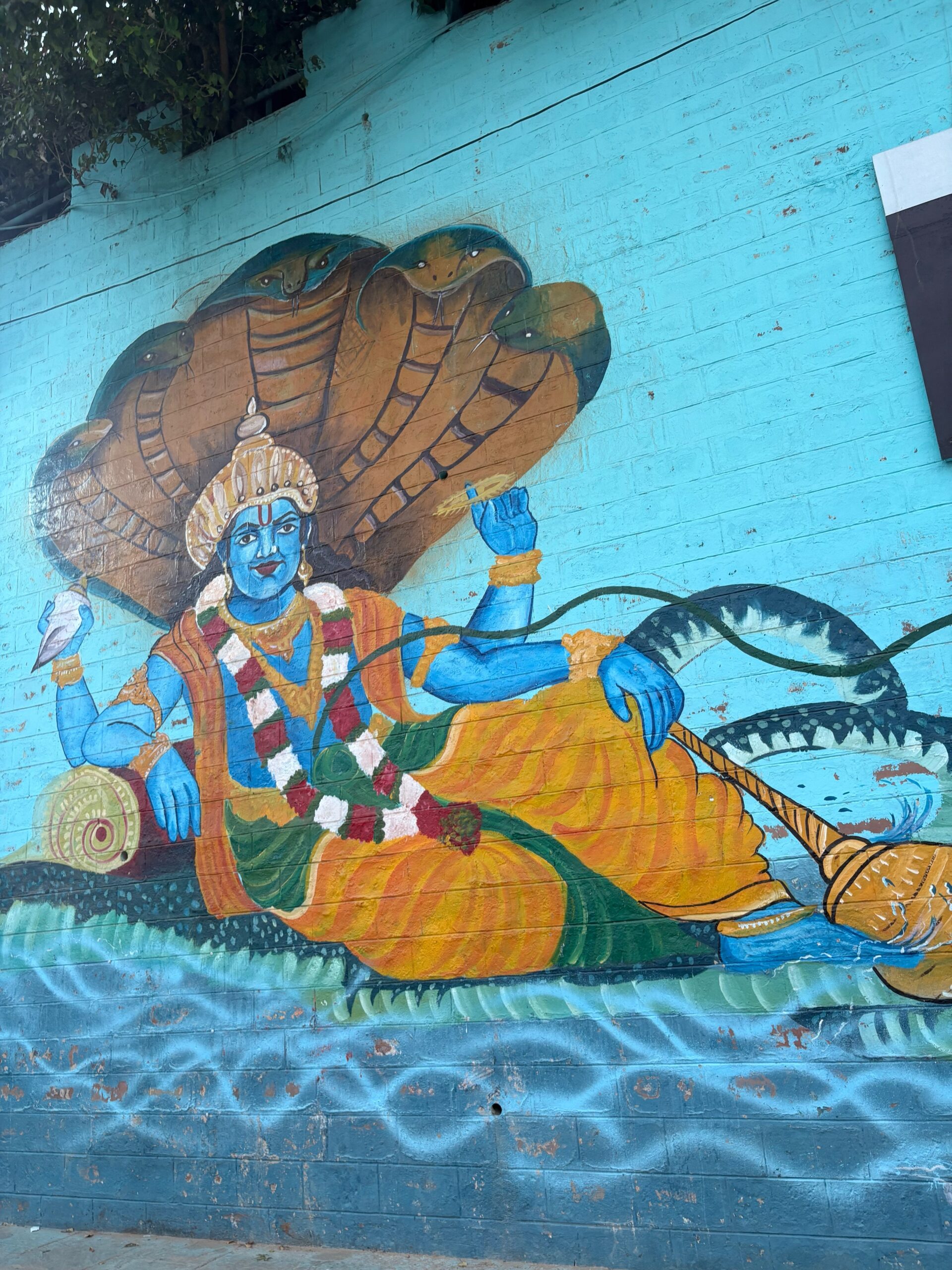
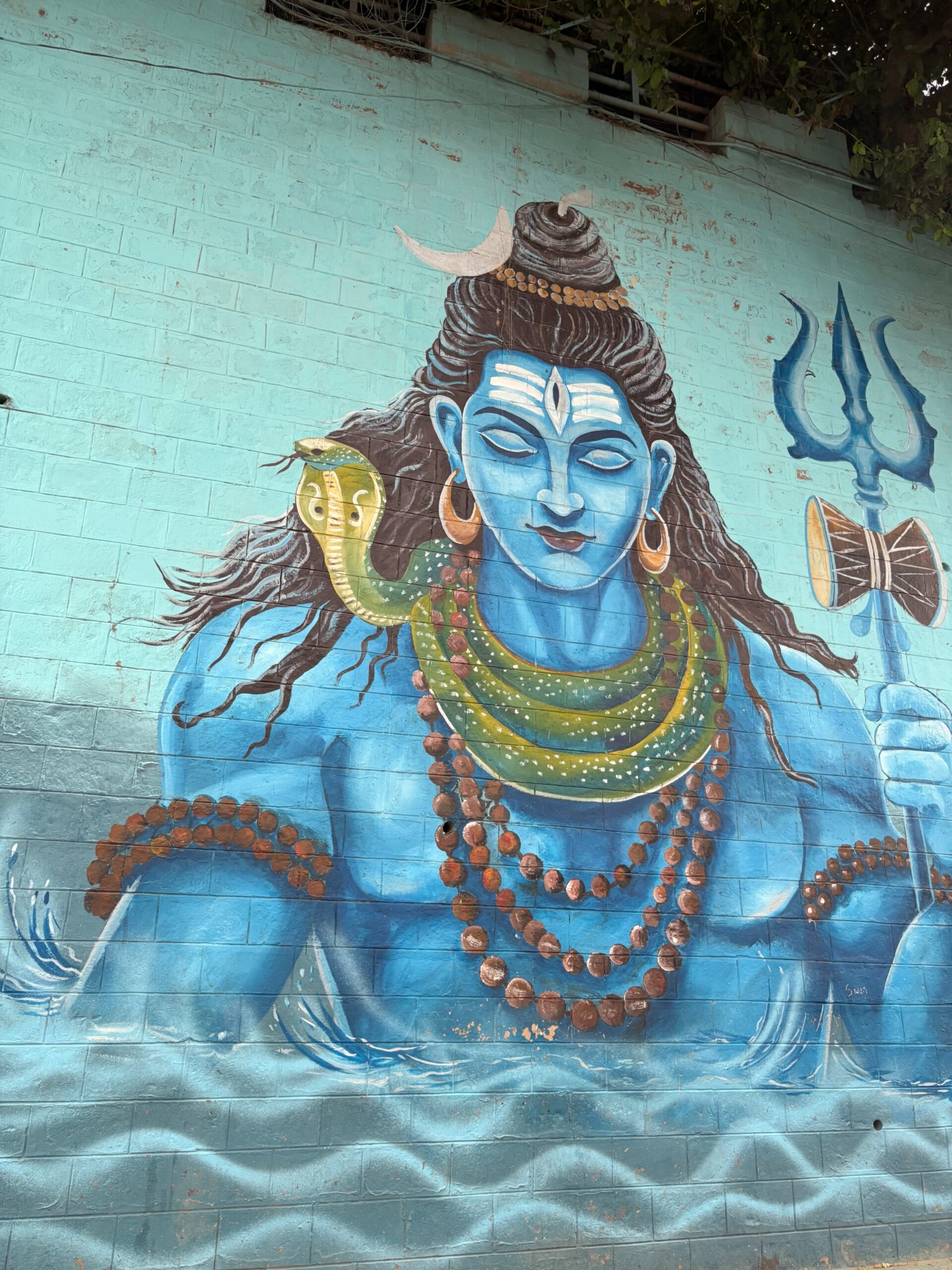
These smaller visual details were one of the things we enjoyed most about walking around Varanasi.
You don’t always need another famous temple or attraction.
Sometimes a wall, a painting or a quiet stretch of steps becomes the photograph you remember most.
Ratneshwar Mahadev Temple
Our walk along the ghats also took us towards the famous Ratneshwar Mahadev Temple, often referred to as the leaning temple.
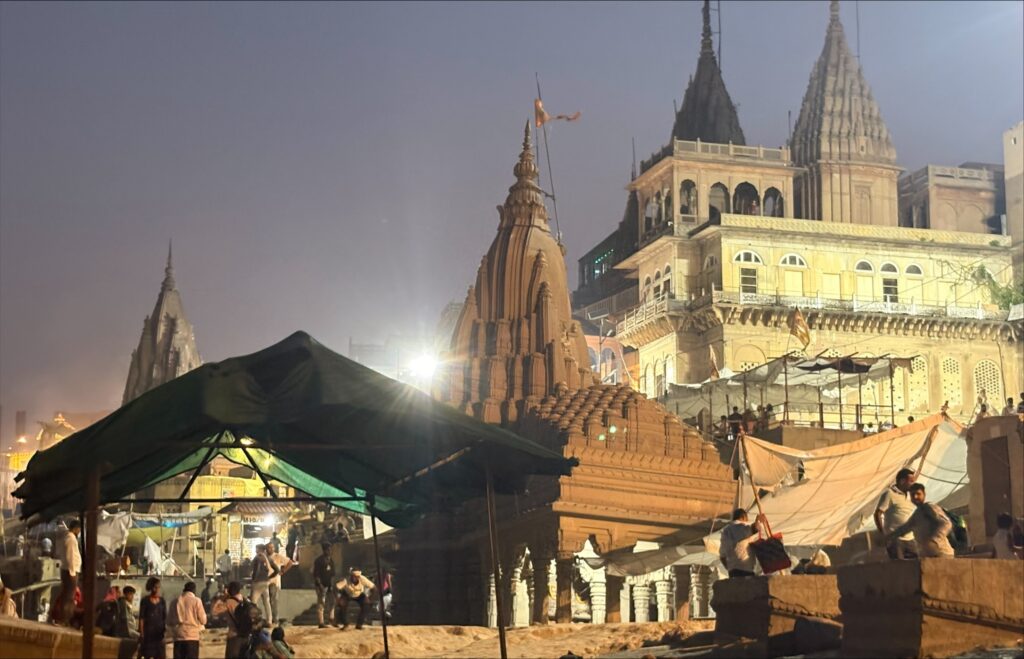
The temple is known for its unusual tilt of approximately 9 degrees. Its appearance immediately catches your attention. But the interesting part isn’t only the architecture. Several local legends attempt to explain why the temple leans.
The Legend of Maternal Debt
One popular story connects the temple’s tilt with the concept of Matri-rin, or a son’s debt towards his mother. According to the legend, a wealthy servant built the temple for his mother, Ratna Bai.
After completing it, he supposedly claimed that he had repaid his debt to his mother.
The belief says that because a mother’s sacrifices cannot truly be repaid, the temple began leaning as a divine reminder.
Another Legend Involving Ahilyabai Holkar
Another version connects the temple with Queen Ahilyabai Holkar of Indore. According to this local tradition, a servant named Ratna Bai constructed the temple and associated it with her own name.
The story says that Ahilyabai considered this an act of pride and cursed the structure to remain tilted.
These are local legends rather than established historical explanations.
The temple’s unusual structure remains one of the reasons visitors are curious about it.
When the Ganga Rises
Another fascinating feature associated with the temple is its relationship with the river.
When the Ganga’s water level rises significantly, the structure can become partially submerged.
This makes the temple even more visually striking during periods of high water.
For photography enthusiasts, the combination of the leaning structure and the Ganga creates an unusual subject.
Avoiding Varanasi Traffic With a Boat
By approximately 7:00 PM, we were thinking about dinner.
But there was another problem.
Varanasi traffic.
Instead of taking road transport, we decided to use the river again.
We boarded a shared boat from the Ratneshwar Mahadev Temple area towards Assi Ghat.
The fare was approximately ₹200 for all three of us.
The journey took around 20 minutes.
Boat vs Road During Evening Traffic
The difference can be substantial.
We estimated that the same journey by road could easily take 40–50 minutes during peak traffic.
The boat took roughly half that time. It also turned transportation into another enjoyable part of the evening.
Our Evening Return
| Option | Our Experience |
|---|---|
| 🚣 Shared boat | ~20 minutes |
| 💰 Fare | ₹200 for 3 |
| 🚕 Estimated road journey | ~40–50 minutes |
| 🚦 Traffic | Heavy around 7 PM |
| 📍 Destination | Assi Ghat |
A Different Twist for Dinner
After so much local food, we decided to change things up. We had already eaten plenty of Indian food throughout the journey.
So we packed:
- 🍕 2 pizzas
- 🍝 1 white cheese pasta
We took them with us and enjoyed our dinner around Assi Ghat. It wasn’t particularly traditional.
But after a day packed with temples, boats and local food, we were craving something completely different. And honestly, sometimes that’s exactly what you need on a long trip.
Day 2 in Varanasi: Our Full Route
Our second day eventually looked like this:
🏨 Hotel
↓
🍳 Breakfast
↓
🌊 Assi Ghat
↓
🚣 Private Ganga Boat Ride
↓
🌊 Holy Dip
↓
🛕 84 Ghats
↓
🍛 Lunch near Assi Ghat
↓
🐘 Ashtvinayak Mandir
↓
🛕 Annapurna Mandir
↓
🛍️ Godowlia Chowk
↓
🍛 Lunch
↓
🏨 Hotel Rest
↓
🕉️ Kaal Bhairav Temple
↓
🛕 Pita Maheshwar Mahadev Mandir
↓
🎨 Bundiparkota Ghat
↓
🛕 Ratneshwar Mahadev Temple
↓
🚣 Shared Boat
↓
🌊 Assi Ghat
↓
🍕 Dinner
Day 2 Was Our Most Packed Day
Looking back, 13 June was easily the busiest day of our entire trip. We covered a huge portion of our Varanasi itinerary in one day.
But there was a reason.
We knew that our return train was scheduled for the following afternoon. So we wanted to complete the major experiences before our final morning. That decision meant Day 2 was tiring. But it also meant that our final day could remain relaxed.
🧭 TRAVEL LESSON
Don’t try to copy our itinerary minute-by-minute.
Use it as a framework and adjust it according to your walking tolerance, temple queues, weather, crowd levels and personal interests.
Back to the Hotel
By the end of the day, we were completely exhausted.
- We had walked through different parts of Varanasi.
- We had travelled by auto, battery rickshaw, private boat and shared boat.
- We had taken a holy dip.
- We had visited multiple temples.
- We had explored the ghats.
And we had somehow managed to squeeze a surprising amount into one day. The next morning was deliberately kept light. Because at 3:00 PM, our Vande Bharat Express was waiting to take us back to Delhi.
last day of our Delhi Prayagraj Varanasi trip
After two packed days of sightseeing, we deliberately kept our final morning slow.
There were no temples left on our itinerary.
No boat ride was planned.
And there was no reason to rush around the city before our afternoon train.
We woke up late and decided to spend the remaining hours resting at the hotel.
A Slow Breakfast Before Checkout
This was probably the most relaxed morning of our entire trip.
We had breakfast late because our Vande Bharat Express was scheduled to depart Varanasi at 3:00 PM.
Instead of forcing another attraction into the itinerary, we chose to enjoy a slower morning.
That turned out to be the right decision.
After two extremely active days, our bodies needed the rest.
Checking Out From Our Hotel
Our checkout time was 12:00 PM.
We packed our luggage, checked the room once again and prepared to leave.
Our accommodation had worked well for three people.
The room had enough space for our luggage, a decent walking area and a reasonably sized bathroom.
The balcony-like space was also useful for drying clothes during our stay.
However, the mattresses weren’t particularly comfortable.
What We Paid for the Stay
The original price for our two-night stay was approximately ₹5,000.
After negotiating offline, we finalized it for:
₹4,500 for two nights
We also spent approximately ₹300 on bottled water and small room-related services.
Our experience strengthened something we had already learned during the planning stage.
Don’t judge a Varanasi hotel only by its online photographs.
Room dimensions can feel very different in person. So, we suggest you to visit and book in person, it helps a lot especially if your Delhi Prayagraj Varanasi trip involves a group. You can book online too but make sure you connect the hotel or property owner well in advance.
One Last Meal Before Leaving
After checking out, we still had several hours before our train.
We decided to have our first proper meal outside the hotel at:
K Shri Shyam Restaurant, Sonarpura
This gave us enough time to eat comfortably before heading towards Varanasi Junction.
We weren’t trying to squeeze in another attraction.
At this point, the trip had already given us more experiences than we had originally planned.
Heading to Varanasi Junction
After our meal, we collected our luggage and left for Varanasi Junction.
We hired an auto.
Fare: ₹300
Journey: Approximately 30–35 minutes
We deliberately left enough time for the station journey.
That is particularly important in Varanasi because road traffic can become unpredictable.
If you’re travelling with luggage and have a fixed train departure, don’t calculate your journey based on the minimum possible travel time.
Give yourself a buffer.
Varanasi Junction: A Completely Different Experience
Our first arrival at Varanasi Junction had already surprised us.
This time, the station felt just as busy.
There were people waiting for trains across the station premises.
Some passengers were sitting on the platforms.
Others were waiting with their luggage.
The contrast with Prayagraj Junction, which we had found comparatively calm, was noticeable.
Our Return Train to Delhi
Our return journey was again by Vande Bharat Express.
Scheduled departure: 3:00 PM
Scheduled arrival in New Delhi: 11:15 PM
We had travelled by Vande Bharat several times before.
So there wasn’t much novelty for us.
But the overall journey experience remained one of the strongest parts of this trip.
Vande Bharat CC: Comfortable, But Not Sleeper-Level
We travelled in Chair Car (CC).
The journey was comfortable for us.
However, there is an important distinction.
CC is excellent for daytime travel.
It isn’t designed to provide the same comfort as a sleeper coach.
Our journey lasted several hours.
So while the seats were perfectly manageable, we definitely noticed the difference compared with travelling overnight in an AC sleeper coach.
The Seat Allocation Problem Happened Again
And here came the one thing that annoyed us throughout this trip.
Once again, the three of us did not receive seats together.
One person was allocated a separate seat.
The other two were seated together on the three-seat side.
So, once again, we had to depend on another passenger’s cooperation.
Thankfully, the passenger was understanding.
We managed to sit together after adjusting the seats.
But this shouldn’t ideally be necessary.
💡 Our Suggestion for Indian Railways
Our experience made us think about the current train seat-allocation system. We believe passengers should eventually have more control over their seat selection. Airline passengers can usually select their seats while booking. A similar option for railway passengers could make group travel significantly easier. If anyone has a similar pain or has gone through this inconvenience, do share this article to Indian Railways and also submit your grievances to the Indian Railways’ Rail Madad Portal.
It could especially benefit:
- 👨👩👧 Families
- 👩👩👧 Groups of friends
- 👴 Senior citizens travelling with family
- 👨👩👧👦 Groups travelling with children
- 🧳 Passengers travelling together for long journeys
Our frustration wasn’t directed towards the passenger who helped us.
Quite the opposite.
We’re genuinely thankful that they cooperated.
The problem is that passengers shouldn’t have to depend on someone’s goodwill simply because the booking system didn’t seat their group together.
The Journey Back to Delhi
Once the train departed, we could finally relax.
There were no sightseeing plans in our Delhi Prayagraj Varanasi trip.
No temple queues.
No decisions about where to go next.
Just the long journey back home.
The train departed on time.
It also reached New Delhi on time at approximately 11:15 PM.
That gave us a satisfying end to the journey.
Our Vande Bharat Experience
If we had to summarize our train experiences during this trip, Vande Bharat consistently delivered what we expected.
Our overall impression:
⭐ 4.5/5
The coaches were clean and comfortable.
The journey was smooth.
Departure and arrival were punctual.
The only minor cleanliness issue we noticed involved passengers using the washrooms without flushing properly.
That’s obviously more about passenger behaviour than the train itself.
Our 4-Day Delhi Prayagraj Varanasi trip at a Glance
By the time we reached Delhi, our entire journey looked something like this:
| Day | Route / Experience | Highlight |
|---|---|---|
| Day 1 | Delhi → Prayagraj → Varanasi | Sangam + temples + Vande Bharat |
| Day 2 | Varanasi | Ganga Aarti + Kashi Vishwanath |
| Day 3 | Varanasi | Boat ride + temples + ghats |
| Day 4 | Varanasi → Delhi | Rest + Vande Bharat |
The reality was obviously more detailed than this table.
We travelled through multiple modes of transport and visited far more places.
But this gives you the broad structure of our journey.
Estimated Cost of Our Delhi Prayagraj Varanasi trip
This was one of the questions I had while planning the journey myself. I didn’t want an unrealistic travel budget based on generic online estimates. I wanted to know what three people could realistically spend on a Delhi–Prayagraj–Varanasi–Delhi trip.
Our actual expenses provide a much better reference.
Major Expenses of our Delhi Prayagraj Varanasi trip
Train Tickets
Our train bookings came to:
- ₹4,543.96
- ₹2,272.87
- ₹5,541.40
These covered our train journeys during the trip.
Accommodation
Our two-night Varanasi stay cost:
₹4,500
Additional water bottles and small room services:
₹300
Local Transportation
We spent approximately:
₹800–₹1,100
This covered autos and battery rickshaws around Prayagraj and Varanasi.
Boat Rides
Boat expenses varied depending on the experience.
Our major rides included:
- Prayagraj private boat: approximately ₹2,000–₹3,500
- Varanasi private boat: ₹2,200
- Varanasi shared boat: ₹200 for three people
Food
Our approximate food expenditure for the entire journey was:
₹2,000–₹3,000
This varied depending on where we ate.
Temple and Puja Expenses
We spent approximately:
₹1,000–₹1,200
This depends heavily on your personal religious practices and offerings.
Approximate Total Budget for Delhi Prayagraj Varanasi trip
After adding the expenses above, along with approximately ₹5,000–₹6,000 for miscellaneous expenses and shopping, our overall trip budget comes to roughly:
₹20,000–₹25,000 for three people
That works out to approximately:
₹6,700–₹8,300 per person
for the entire 3-night, 4-day Delhi–Prayagraj–Varanasi journey.
Your actual budget can be significantly different depending on train class, accommodation, boat selection, food choices, shopping and religious expenses.
Delhi Prayagraj Varanasi trip Budget Breakdown
| Expense | Approx. Cost |
|---|---|
| 🚆 Train tickets | ₹12,358 |
| 🏨 Accommodation + room services | ₹4,800 |
| 🚕 Local transport | ₹800–₹1,100 |
| 🚣 Boat rides | Variable |
| 🍛 Food | ₹2,000–₹3,000 |
| 🛕 Temple/Puja | ₹1,000–₹1,200 |
| 🛍️ Miscellaneous + shopping | ₹5,000–₹6,000 |
| Estimated overall budget | ₹20,000–₹25,000 |
Important: Boat fares and miscellaneous spending can move the final number considerably. Treat this as our real-world reference rather than a fixed package price.
What We Bought During the Trip
We didn’t do extensive shopping.
Most of our purchases were religious souvenirs and Prasad.
We bought Prasad from:
- 🛕 Lete Hue Hanuman Ji Mandir
- 🛕 Annapurna Mata Mandir
- 🛕 Kashi Vishwanath Mandir
- 🛕 Kaal Bhairav Mandir
- 🛕 Ashtvinayak Mandir
We also purchased a Varanasi scenery magnet for ₹100.
There was also a children’s game costing approximately ₹450.
At Kaal Bhairav Temple, we bought three Raksha dhagas at ₹20 each.
These small purchases became useful reminders of the journey.
What We Would Do Differently
Looking back at our four-day journey, several lessons stand out.
1. Book trains early
We booked our train tickets on 26 May 2026.
The earlier you book, the better your chances of getting suitable availability.
However, our experience also showed that early booking doesn’t guarantee adjacent seats for everyone.
2. Don’t blindly trust hotel photographs
This was perhaps our biggest accommodation lesson from our Delhi Prayagraj Varanasi trip. Online photographs can make rooms appear considerably larger. If you’re travelling with three people, call the property and confirm the actual room dimensions and bed configuration.
For our Varanasi stay, offline booking worked better for us.
3. Keep cash and smaller denominations
We found smaller cash denominations useful for:
- Temple offerings
- Rickshaws
- Local food
- Small purchases
- Religious items
Having change can save unnecessary hassle.
4. Don’t overload your itinerary
Our second day of Delhi Prayagraj Varanasi trip was extremely packed. It worked for us because we were comfortable with moving around frequently.
But it won’t suit everyone.
If you prefer slow travel, reduce the number of temples and spend more time at the ghats.
5. Use boats strategically
Boats aren’t only sightseeing experiences.
During Varanasi’s busy hours, they can also become a practical way of moving between riverside locations.
Our evening boat ride saved us considerable time compared with travelling through traffic.
Would We Do This Delhi Prayagraj Varanasi trip Again?
Absolutely—but probably differently.
The biggest lesson from our Delhi Prayagraj Varanasi trip wasn’t about visiting the maximum number of places.
It was about understanding how differently these cities feel.
Prayagraj felt deeply connected with pilgrimage and the sacred Sangam.
Varanasi felt like an entirely different world.
The temples, ghats, narrow lanes, Ganga, rituals and everyday life seemed to exist together without any clear separation.
And somewhere between the early morning boat rides, crowded temples, unexpected hidden shrines and long railway journeys, the trip became much more than another vacation.
It became a journey through some of the most spiritually significant places we had wanted to experience for a long time.
Final Takeaway: What Delhi Prayagraj Varanasi trip Taught Us
If you’re planning your own Delhi to Prayagraj and Varanasi trip, don’t build your itinerary only around famous attractions.
Leave space for unexpected experiences.
Talk to locals.
Walk around the ghats.
Try local food.
Take a boat when it makes sense.
Visit lesser-known temples.
And don’t be afraid to change your plan when circumstances demand it.
Our own itinerary changed several times during these four days.
Some changes were frustrating.
Some saved us time.
And some introduced us to places we wouldn’t have discovered otherwise.
That’s probably what made this journey memorable.
Planning Your Next Delhi Prayagraj Varanasi trip?
I planned much of this journey using the India Trip Planner, which helped me compare destinations, distances, weather, accommodation estimates and itinerary options before travelling.
I selected Standard, Balanced Sightseeing, and interests including Temples & Heritage, Photography, Local Food, and Cafes.
The planner then generated an itinerary based on those preferences.
And if you enjoyed this real-world travel guide, you can explore more travel stories and practical guides on ContentByMayank.
Delhi Prayagraj Varanasi trip: Quick Facts
| Detail | Our Trip |
|---|---|
| 📅 Dates | 11–14 June 2026 |
| ⏱️ Duration | 3 nights / 4 days |
| 👥 Travellers | 3 |
| 🚆 Starting point | New Delhi |
| 🛕 First destination | Prayagraj |
| 🌊 Major highlight | Triveni Sangam |
| 🏙️ Second destination | Varanasi |
| 🛕 Major temple | Kashi Vishwanath |
| 🚣 Major experience | Ganga boat ride |
| 🚆 Main trains | Prayagraj Express + Vande Bharat |
| 🏨 Stay | Sonarpura, Varanasi |
| 💰 Approx. budget | ₹20,000–₹25,000 |
| ❤️ Trip type | Spiritual + cultural journey |
Frequently Asked Questions
How many days are enough for a Prayagraj and Varanasi trip?
Based on our experience, four days can work well for a combined Prayagraj and Varanasi trip if you plan your route carefully. We spent three nights and four days covering the major spiritual experiences in both cities.
How much does a 4-day Prayagraj and Varanasi trip cost?
Our three-person journey cost approximately ₹20,000–₹25,000, including trains, accommodation, food, local transport, temple expenses, boats and miscellaneous spending.
Is it possible to visit Prayagraj and Varanasi together?
Yes. We travelled Delhi → Prayagraj → Varanasi → Delhi within four days. Visiting Prayagraj first also worked well because it allowed us to experience Sangam before continuing to Varanasi.
Is a private boat worth it in Varanasi?
For us, yes. We paid ₹2,200 for a private boat for three people and enjoyed greater flexibility. However, shared boats are considerably cheaper and can be a better choice for budget travellers.
Should you book a hotel online in Varanasi?
Our experience made us prefer offline accommodation hunting for a first Varanasi visit. Online photographs didn’t always represent the actual room size. Calling the property and confirming room dimensions can also help.
What should you not miss in Prayagraj?
If you’re visiting primarily for spiritual reasons, Triveni Sangam and Bade Hanuman Ji Mandir should be high on your list. We also visited several other religious sites, but these two stood out the most for us.
What should you not miss in Varanasi?
For a first visit, we would prioritize Kashi Vishwanath Temple, Ganga Aarti, a Ganga boat ride, Kaal Bhairav Temple and time around the ghats. You can then add lesser-known temples based on your interests.
Is four days enough for Delhi Prayagraj Varanasi trip?
Four days is enough for a focused first trip, but not enough to experience everything. We deliberately prioritized important spiritual and cultural experiences rather than trying to visit every attraction.
Also Read: Is SEO Still Worth It If AI Doesn’t Cite You?
Concluding The Journey, But Not the Experience
Our train reached New Delhi at around 11:15 PM on 14 June 2026.
The journey was officially over. But the photographs, Prasad, souvenirs and memories came back with us.
We had started this journey because we wanted to experience the spiritual side of India. After four days, we returned with a much deeper appreciation for what that actually means.
Prayagraj gave us the Sangam.
Varanasi gave us the Ganga.
And together, they gave us a journey we won’t forget. There’s a famous saying that we can feel personally:
Aap Kashi se jaate hain, par Kashi aap se nahi jaati.
Pingback: 2-DAY RISHIKESH TRIP FROM DELHI: DON'T PLAN BEFORE READING!