
AI impact on content creation has made small businesses develop more authentic information even with limited resources. Ideas can be developed faster, first drafts can be produced in minutes, existing content can be repurposed into different formats, and small teams can experiment with more content than they could manage manually.
But there is another side to this change.
When producing content becomes easier for everyone, producing content itself becomes less distinctive.
That is the bigger AI impact on content creation in 2026. The challenge for small businesses is no longer simply finding ways to create more. It is deciding what is worth creating, what makes the content different, and where human knowledge should remain at the centre of the process.
Also Read: AI Search Visibility: Best AEO Guide for Website
How AI Impact on Content Creation is Changing Small Businesses
AI is changing the production process in several practical ways. For a small business with limited people, time and budget, these changes can remove some of the routine work that previously consumed a large part of the content process.
Faster Ideation and Drafting
AI can help turn a broad idea into possible topics, outlines, headlines, or initial drafts much faster than starting with a blank document.
This can be useful when a business knows its audience but struggles to consistently turn its knowledge into publishable material.
However, faster drafting does not mean every generated idea deserves to become an article. The business still has to decide whether the topic is relevant, whether it answers a genuine customer need and whether it has something meaningful to contribute.
Easier Content Repurposing
A small business may already have useful material sitting inside an old blog, customer presentation, webinar, product explanation or social media post.
AI can help transform that material into different formats.
One substantial piece of content might become a shorter social ipost, email summary, FAQ, video outline or series of related ideas.
This means AI content creation is not necessarily about producing everything from scratch. It can also make existing business knowledge easier to reuse.
Lower Barriers to Different Content Formats
AI-assisted tools have also made it easier for smaller teams to experiment with images, video, audio and other formats that previously required more specialist skills or resources.
That does not mean every business needs to produce content everywhere.
It simply means the production barrier is lower.
The strategic question therefore becomes more important:
Which format actually helps this audience?
More Output With Smaller Teams
This is probably the most obvious benefit.
A business owner or small marketing team can use AI to reduce time spent on repetitive production tasks and devote more resources to other activities.
Current research among Indian SMEs also shows AI moving beyond simple content production into areas such as strategic planning and competitor analysis. In an Amazon-commissioned survey of 300 B2C marketing decision-makers from Indian SMEs, 64% reported using AI for content generation, while 58% reported using it for strategic planning. The study was conducted by Opinium between April 7 and April 23, 2026, so its findings represent that surveyed SME population rather than all Indian small businesses.
But content creation is only one part of content marketing. AI can accelerate the creation and repurposing of marketing content, but it does not automatically determine which audience to prioritize, what message should differentiate the business, where the content should be distributed or what business outcome it should support.
That distinction matters when evaluating the AI impact on content creation: production capacity can increase without strategy automatically improving.
Consider a local service business with one person handling marketing. AI might help turn dozens of customer questions into draft topics, but the business still has to decide which questions are important enough to address, which examples reflect real customer situations and which topics support its wider business goals.
The same applies to a consultant turning a client lesson into a blog, email and social post. AI can accelerate the transformation, but the consultant’s actual experience is what gives the content something distinctive to say.
Also Read: Is SEO Still Worth It If AI Doesn’t Cite You?
Why More AI Impact on Content Creation Doesn’t Automatically Mean Better Content
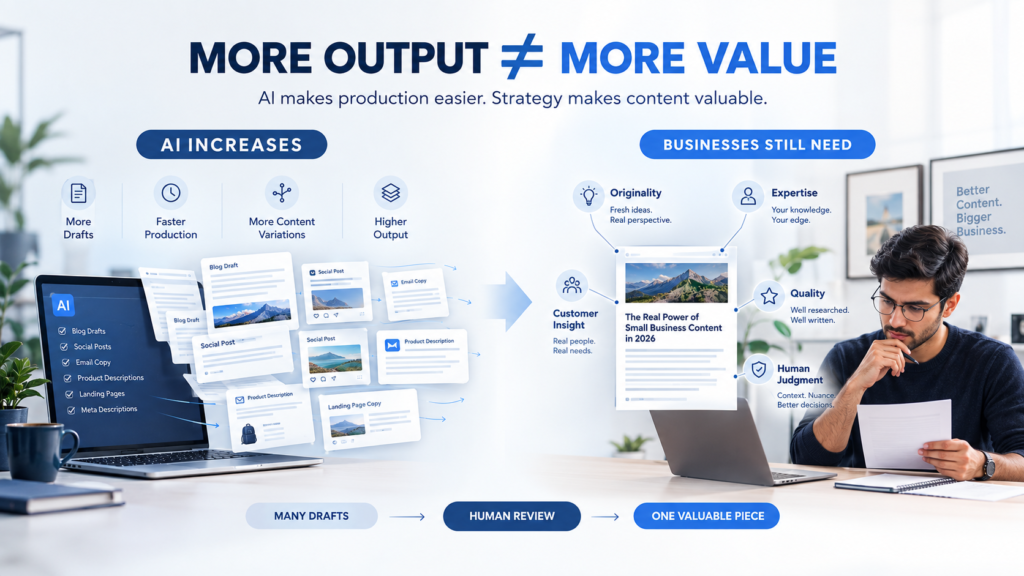
The internet already contains an enormous amount of information. AI makes producing more of it considerably easier.
If two competing businesses can use similar tools to create articles about the same basic subject, simply publishing more articles is unlikely to create a lasting advantage by itself.
There are several reasons.
First, AI can make generic information easier to reproduce. Basic definitions, introductory explanations and commonly available advice can be generated quickly by many businesses.
Second, more output creates more material that needs to be reviewed. Someone still has to determine whether claims are accurate, whether the examples make sense and whether the article actually answers the customer’s question.
Third, content can become visually or verbally similar when businesses rely heavily on the same tools and similar prompts.
This is why the production bottleneck can begin to move.
Previously, the problem might have been:
“We don’t have enough time to create this.”
With AI, it can become:
“We have plenty of drafts. Which ones are actually worth publishing?”
That is a very different content problem.
Google’s current guidance does not treat AI-generated content as automatically problematic. Its scaled-content-abuse policy focuses on producing many pages primarily to manipulate Search rather than help users, including cases where generative AI is used to create large amounts of unoriginal content with little added value.
So the objective should not be maximum AI output. It should be useful output.
Also Read: Independence Day campaign ideas from 2024-25: Learn & Create for 2026
What Becomes More Valuable When AI Makes Content Easier?
If AI impact on content creation and the difficulty of producing content, businesses need to pay greater attention to the things AI cannot automatically know about their particular business.
Original Business Experience
Your business has experiences that aren’t available as generic ready-made answers.
You may know:
- the questions customers repeatedly ask
- mistakes customers commonly make
- problems that occur during real projects
- unexpected lessons from working with clients
- processes you’ve developed over time
- situations that look simple from outside but are difficult in practice
These details can turn an ordinary explanation into something much more useful.
Customer Knowledge
A business owner who regularly talks to customers has information that can be extremely valuable for content planning.
What words do customers use?
What confuses them?
What objections repeatedly appear before purchase?
What do they ask after buying?
These insights can determine whether an AI-assisted article addresses a real problem or merely produces another piece of broadly relevant information.
Also Read: ISRO latest satellite: EOS-05, India’s High-Resolution Eye in Space
Industry Expertise
AI can help process information; it doesn’t automatically know which information is strategically important to your particular business.
Industry expertise provides context, nuance and examples that generic content can lack.
AI Impact on Content Creation in Small Business Across All Industries
When many businesses can generate an acceptable first draft, the perspective behind the content becomes more important.
Two businesses may explain the same subject accurately while offering completely different levels of usefulness because one has stronger examples, clearer opinions, deeper experience or a better understanding of its customers.
Adobe’s 2026 Creators’ Toolkit research illustrates a similar pattern among creators. In its India findings, 44% of creators who said it had become harder to stand out attributed some of that difficulty to AI-generated content, while 77% said human judgment remained essential to creative taste. The survey covered more than 16,000 creators across eight countries, including India, but its respondents were emerging and professional social-first creators rather than small-business marketing teams.
The broader lesson is useful: when production becomes easier, distinctiveness matters more.
Brand Voice
AI can help reproduce a chosen tone, but a business still needs to decide what that voice should communicate.
A brand isn’t distinctive simply because its sentences sound friendly, professional or conversational.
Its voice is also shaped by:
- what it chooses to talk about
- what it believes matters
- how it explains problems
- which examples it uses
- how it responds to customers
- what it refuses to exaggerate
That is difficult to outsource completely.
What’s the Main AI Impact on Content Creation for Small Businesses
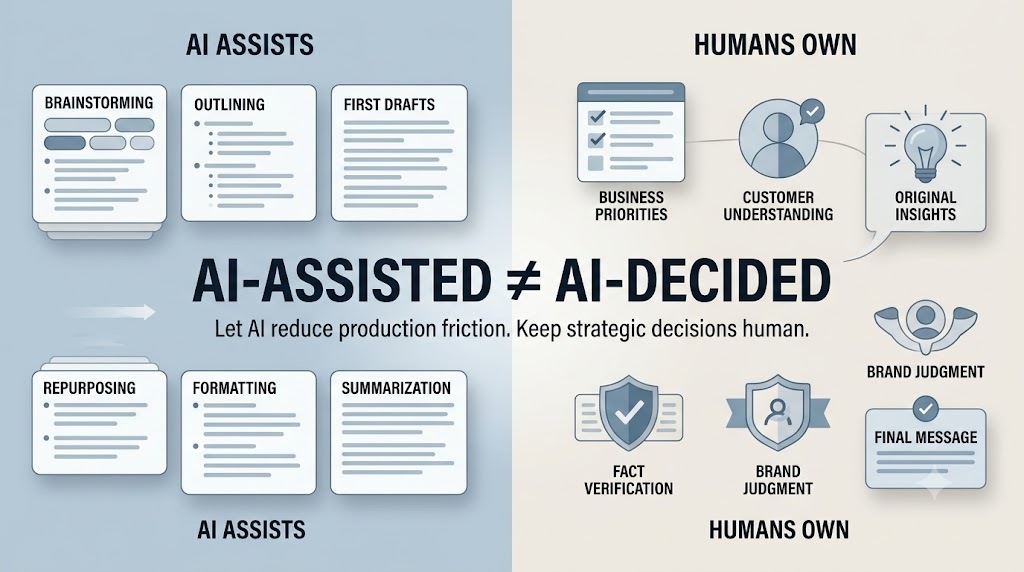
The most useful approach is not to divide work into “AI” and “human” as if one side must replace the other.
Instead, consider who should own each decision.
| AI can assist with | Humans should own |
|---|---|
| Brainstorming | Business priorities |
| Outlining | Topic selection |
| First drafts | Original insights |
| Repurposing | Customer understanding |
| Formatting | Final message |
| Summarization | Fact verification |
| Content variations | Brand judgment |
| Research organization | Source evaluation |
The principle is simple:
AI-assisted does not have to mean AI-decided.
AI can remove friction from production while the business retains control over what it wants to say and why.
Also Read: Delhi Prayagraj Varanasi trip: Our 4-Day Spiritual Journey
Where Human Judgment Still Matters
The human role doesn’t disappear when AI becomes better at generating content. In many cases, the role moves further upstream and downstream.
Choosing What Deserves Publishing
AI can generate dozens of potential topics.
That doesn’t mean all 30 deserve an article.
Someone needs to decide which subject is relevant to the business, useful to customers and worth the resources required to produce it.
Checking Factual Claims
AI-generated information still needs appropriate verification, particularly when content includes statistics, current developments, regulations, technical information, or claims about products and services.
A polished sentence can still contain an incorrect claim.
Adding First-Hand Knowledge
This is one of the strongest opportunities for small businesses with the AI impact on content creation. Instead of asking AI to manufacture expertise, give it the information that already exists inside the business.
Add:
- real examples
- customer questions
- original observations
- actual processes
- lessons learned
- relevant data
- expert commentary
Then AI can help organize or refine that material.
Protecting Brand Credibility
The final question shouldn’t be:
“Does this sound like AI?”
It should be:
“Would we be comfortable putting our business name behind this?”
That changes the review process from simply checking grammar to checking credibility.
Decide Whether AI Impact on Content Creation Helps the Customer or Not
Ultimately, the business has to judge whether the reader gained something useful.
A technically correct article can still be unnecessary, repetitive or disconnected from what customers actually need.
That judgment remains a business responsibility.
Small Businesses Can Rethink the AI Impact on Content Creation in 2026
A practical AI content strategy for small businesses doesn’t need to begin with a collection of AI tools.
It can begin with a better workflow.
Step 1: Start With the Business Problem
Ask:
What business or customer problem are we trying to address?
Not:
What can AI write today?
That small change prevents technology from determining the content strategy.
Step 2: Identify a Genuine Customer Question
Look at customer conversations, sales questions, support requests, reviews and recurring objections. These can provide stronger starting points than generating random topics from a keyword list.
Step 3: Add Business-Specific Information
Before using AI extensively, gather the information that makes the content yours.
This could include an expert’s experience, a customer scenario, an internal process, or an original observation.
For example, an ecommerce business could use AI to create an initial product-description structure, but product-specific use cases, customer objections and actual product experience should come from the business.
Also Read: 2-DAY RISHIKESH TRIP FROM DELHI: COMPLETE TRAVEL GUIDE (2026)
Step 4: Use AI Where It Saves Production Time
Now AI has a useful role.
It can help with:
- organizing research
- creating an outline
- generating a first draft
- rewriting unclear passages
- creating variations
- repurposing existing material
- summarizing longer information
Step 5: Human-Review the Substance
Don’t limit editing to spelling and grammar.
Check:
- accuracy
- relevance
- originality
- examples
- brand voice
- unsupported claims
- customer usefulness
Step 6: Leverage AI impact on content creation for Readers
Remove unnecessary information.
Add missing context.
Make examples clearer.
Answer the questions a customer is likely to have next.
The goal is not to make the AI output look human. The goal is to make the final content useful.
Step 7: Measure the Outcome
Finally, look beyond how much content was produced.
Ask whether the content generated:
- relevant traffic
- engagement
- inquiries
- leads
- sales opportunities
- useful customer interactions
- stronger visibility for important topics
Production efficiency matters, but it is not the final business outcome.
Misjudgments for the AI impact on content creation by Small Businesses
The biggest mistake is confusing content volume with content value.
AI makes it tempting to think:
“If we can publish ten times more, we can grow ten times faster.”
There is no automatic relationship between those two things.
Publishing more can increase the number of opportunities to be discovered, but it can also increase the amount of material that needs to be reviewed, updated, differentiated, and maintained.
A smaller collection of genuinely useful content can be more strategically meaningful than a large collection of generic pages.
The objective should therefore be to use AI to increase productive capacity, not simply the number of URLs on a website.
AI Impact on Content Creation—What Changes and What It Doesn’t
| AI changes | AI doesn’t automatically solve |
|---|---|
| Production speed | Audience understanding |
| Drafting capacity | Original expertise |
| Content variations | Strategic priorities |
| Repurposing | Trust |
| Routine editing | Differentiation |
| Research organization | Business judgment |
| Production efficiency | Accountability |
This distinction is becoming increasingly important.
Adobe’s 2026 research found that 72% of surveyed Indian creators who use or have tried creative AI said their outputs typically require moderate or extensive editing before they are ready to share, while 87% said the final creative decision should remain with the creator. These are creator findings rather than direct evidence about small-business marketing teams, but they illustrate the continuing role of human review and control in AI-assisted creative work.
For small businesses, that suggests a useful way to think about AI:
Let AI handle more of the production friction. Keep humans responsible for the decisions that determine whether the work deserves to exist.
When content creation connects with search visibility, the same principle applies: producing content is only one part of being discoverable. For a broader look at how content can be considered in AI-powered search environments, see AI Search Visibility: Best AEO Guide for Website.
Search strategy also remains relevant even as AI changes the production process. Our earlier discussion of whether SEO is still worth it if AI doesn’t cite you explores that relationship from the search-visibility side.
Conclusion
The AI impact on content creation is not simply that small businesses can now create content faster.
The deeper change is that content production is becoming easier and less scarce.
That shifts attention toward what is harder to automate: understanding customers, knowing the business, developing original ideas, making strategic choices, maintaining credibility, and deciding what is genuinely worth publishing.
For a small business, the goal in 2026 should not be to create the maximum amount of AI-assisted content.
It should be to use AI to reduce low-value production work while putting more human attention into the information, experience and judgment that make the content valuable in the first place.