For years, getting your website discovered meant one thing: rank on Google. Now, someone can ask the same question directly to ChatGPT, Google AI Overviews, AI Mode, Perplexity, Gemini, or another AI-powered search experience and get an answer without ever opening a traditional search result. And, here’s what AI search visibility changes the game.
Also Read: Is SEO Still Worth It If AI Doesn’t Cite You?
But it does not mean you need to abandon SEO and chase some mysterious new “AI ranking trick.” In fact, the foundation is surprisingly familiar:
Create useful information → make it discoverable → build topical authority → demonstrate credibility → give search and AI systems something genuinely worth using.
The difference is that your content now has to compete for AI search visibility inside answers, not just blue links. And there is one uncomfortable truth website owners should understand early:
You cannot expect even your most genuine piece of content to become highly visible in Google or AI search simply because it is well written. Authority is something you build cumulatively.
That is where SEO, AEO, GEO, topical coverage, and long-term authority all come together. Read and find more such latest blogs on ContentbyMayank.
What Does “AI search visibility” Actually Mean?
Before trying to optimize for AI search, it helps to understand what you’re actually trying to achieve.
There are several different stages:
1. Crawled
A search engine or AI crawler can access your page.
↓
2. Indexed / discoverable
The system knows your page exists and can potentially retrieve it.
↓
3. Retrieved
Your page becomes relevant enough to be considered for a particular question.
↓
4. Cited or linked
The system uses your page as a supporting source and gives users access to it.
↓
5. Mentioned
Your brand, website, research, or viewpoint may be referenced in the answer.
↓
6. Visited
The user actually clicks through to your website. These are not the same thing-A page can be indexed without being cited.
- It can be cited without generating significant traffic.
- It can generate traffic without ranking #1.
- And a brand can become familiar to an audience even when every AI response does not include a direct citation.
That distinction is crucial when measuring AI search visibility.
SEO, AEO, and GEO: Key Difference for AI search visibility?
You’ve probably encountered three terms everywhere lately:
SEO — Search Engine Optimization
AEO — Answer Engine Optimization
GEO — Generative Engine Optimization
The internet sometimes makes these sound like three completely separate disciplines.
They aren’t.
Think of them as different layers of the same AI search visibility strategy.
SEO
The foundation.
It helps search engines discover, crawl, understand and rank your website.
AEO
The answer-focused layer.
It encourages you to structure useful information around questions people actually ask and provide clear, direct answers.
GEO
The broader generative-search layer.
It focuses on making your information useful and discoverable within AI-generated search experiences.
The important part?
You don’t replace SEO with AEO or GEO.
Google’s current documentation explicitly says that SEO best practices remain relevant to its generative AI search experiences.
So don’t throw away your technical SEO, internal linking, content quality, crawlability and authority-building strategy because somebody on LinkedIn announced that “SEO is dead.”
It isn’t.
The search interface is changing.
Also Read: Independence Day campaign ideas from 2024-25: Learn & Create for 2026
The New AI search visibility Journey
Traditional search was relatively straightforward.
User searches
↓
Google shows results
↓
User chooses a result
↓
User visits website
AI search introduces another layer.
User asks a question
↓
AI searches or retrieves information
↓
AI synthesizes an answer
↓
Sources may be cited
↓
The user decides whether to investigate further
That means your website isn’t competing only for a position on a results page anymore. It may be competing to become one of the sources behind the answer.
So How Does Your Content Target AI search visibility?
This is where many AEO articles become unnecessarily complicated.
There isn’t a magic “AI indexing” button you can press.
For web-connected AI search systems, the basic problem is still discoverability.
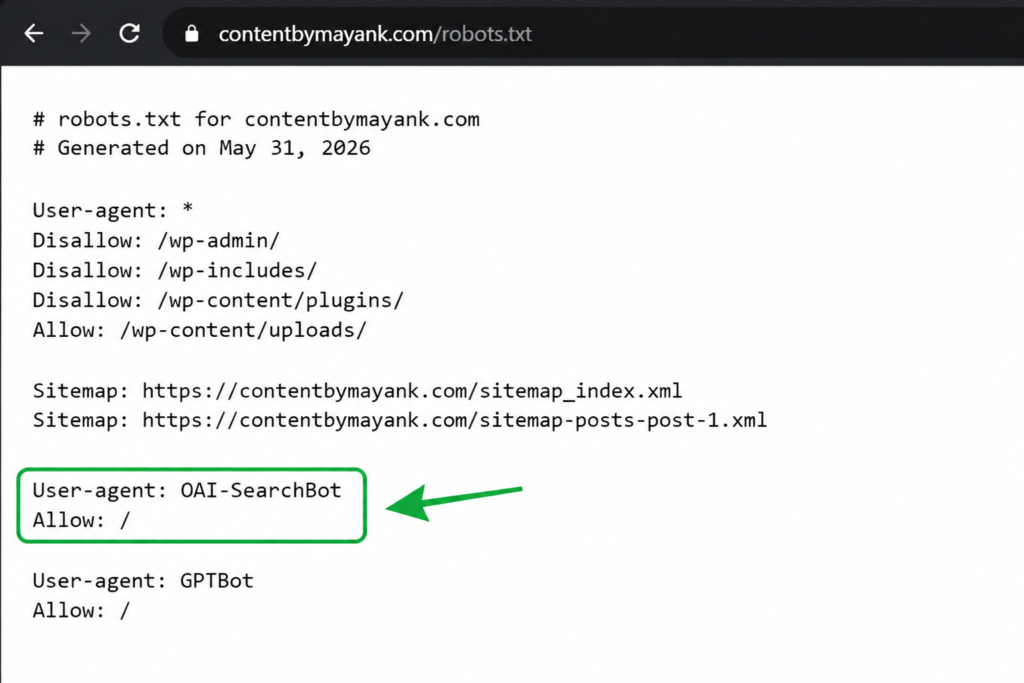
For example, OpenAI says that public websites can appear in ChatGPT Search. It specifically recommends allowing OAI-SearchBot to crawl your website if you want your content to be discovered, surfaced, and potentially cited or linked.
And Google says its generative search experiences are built on its existing search systems.
So your first job isn’t
“How do I make ChatGPT love my article?”
Your first job is:
“Can the systems I want to reach actually discover and understand my content?”
That takes us back to fundamentals.
Step 1: Make Sure Search Engines Can Actually Access Your Website
Before worrying about AEO, GEO or AI citations, check the boring stuff.
Because boring stuff can kill an otherwise excellent content strategy.
Your website should have:
- Crawlable pages
- Correct robots.txt settings
- No accidental noindex directives
- A functioning XML sitemap
- Proper internal links
- Accessible page content
- A stable website structure
- Fast enough and usable pages
- Clear canonicalization where necessary
For ChatGPT Search specifically, OpenAI says website owners should ensure that OAI-SearchBot isn’t blocked and that their hosting/CDN allows the relevant crawler traffic.
This doesn’t guarantee that your article will be cited.
That’s an important distinction.
Crawlability creates eligibility.
It does not create authority.
Step 2: Stop Thinking About One Article — Think About Topical Coverage
This is one of the biggest lessons for a new website.
You publish one fantastic article→ You spend three days researching it→ You make the design beautiful→ You optimize the title→You add internal links. And then…
Nothing.
- Maybe a few impressions.
- Maybe no ranking.
- Maybe no AI citation.
It’s tempting to conclude the following:
“The content isn’t working.”
But there is another possibility.
The website hasn’t built enough evidence around the topic yet. This is what topical coverage is about.
Imagine you want ContentbyMayank to become known for SEO and AI search. One article about AEO isn’t much evidence.
But imagine your website eventually covers the following:
- What is AEO?
- How AEO differs from SEO
- What is GEO?
- How ChatGPT Search finds websites
- How to check whether ChatGPT cites your website
- How Google AI Overviews affect SEO
- How AI Mode changes search behavior
- Zero-click searches
- Entity SEO
- Topical authority
- First-party content
- Original research for SEO
- AI search visibility
- Content credibility
- Internal linking for topical coverage
- How to measure AI referral traffic
- How to build an AI-search-ready website
Now the website isn’t just publishing an article about AEO. It is building a body of knowledge around AI search.
That is topical coverage.
Why Topical Coverage Takes Time for AI search visibility
Here’s something I would strongly emphasize to anyone building a new website:
You can’t expect even your most genuine content to become highly trusted overnight.
Time itself isn’t necessarily a direct ranking requirement or a prerequisite for AI citation. A three-year-old website isn’t automatically better than a three-month-old website.
But many signals associated with trust and authority are cumulative. A website that has spent years consistently publishing useful information may have accumulated the following:
- Relevant backlinks
- Mentions
- Brand recognition
- AI search visibility
- Topical coverage
- Historical performance
- Returning audiences
- References from other websites
- First-party experience
- Evidence of consistent expertise
That creates an advantage. But newer websites aren’t helpless. They can create something established websites sometimes lack—genuine and original information.
Two Types of Authority for AI search visibility
I would divide website authority into two broad categories.
1. Accumulated Authority
Think of it as:
Time → links → mentions → reputation → historical evidence → authority
This is where established websites have a major advantage. They have had years to accumulate evidence that they consistently publish useful information.
2. Information Authority
This is different.
Think:
Original research → first-party data → unique experience → primary evidence → information authority
A new website can potentially accelerate its credibility by publishing information that isn’t simply rewritten from ten other websites.
For example:
Instead of writing another generic article saying the following:
“SEO is important in 2026.”
You could publish:
“We Tracked Our Website’s Search Performance for 12 Months: What Actually Changed After Publishing 100 Articles.”
Now you have something original.
- You have observations.
- You have evidence.
- You have experience.
- You have information other websites can reference.
That’s much harder to replace with generic AI-generated content.
Think About Authority Like This
Month 1
Content + technical foundation + almost no accumulated authority
You are essentially introducing yourself to the search ecosystem.
Year 1
Content + rankings + backlinks + mentions + search history + topical coverage + audience signals
Now your website has started accumulating evidence.
Year 3
Established content library + stronger rankings + backlinks + mentions + topical depth + brand/entity recognition + years of evidence
The website potentially has something extremely valuable:
history.
And that leads to one of the most important ideas in SEO:
The work you’re doing today becomes part of the evidence that can make your website stronger tomorrow.
But What If You’re a New Website?
Also Read : 2-DAY RISHIKESH TRIP FROM DELHI: COMPLETE TRAVEL GUIDE (2026)
Don’t use “my website is new” as an excuse to publish generic content. Use it as a reason to become more original.
A new website cannot manufacture ten years of history but it can produce something genuinely useful today.
For example:
Weak approach
“10 Benefits of SEO in 2026”
Generic information.
Stronger approach
We Published 50 SEO Articles on a New Website: Here’s What Happened
First-party experience.
Even stronger
We Analyzed Search Console Data From Our First 50 Articles: Which Topics Generated Impressions, Clicks, and Rankings?
Now you’re producing evidence.
That’s information authority and that is exactly the kind of content a website should build if it wants to stand out in an increasingly AI-mediated search environment.
Step 3: Answer Real Questions, Not Just AI search visibility
Traditional keyword research often starts with:
“What keyword has search volume?”
AEO encourages another question:
“What does the person actually want to know?”
Consider the keyword:
AEO
A shallow article might define it and stop. A useful AEO resource would answer:
- What is AEO?
- How does AEO work?
- Is AEO different from SEO?
- Does Google require special AEO markup?
- Does AEO help with AI Overviews?
- How does ChatGPT find websites?
- How can you test AI visibility?
- Can a new website appear in AI search?
- Does topical authority affect AI citations?
- How should a business measure AI search visibility?
Now you’re not simply targeting one keyword. You’re covering the information journey around the topic. That’s much more useful for humans and search systems.
Step 4: Give the Answer Before the Essay
This is one of the simplest changes you can make. Don’t force readers to dig through 700 words before finding the answer. If someone asks:
“Does ChatGPT cite websites?”
Start with the answer. Then explain it.
For example:
Yes. When ChatGPT uses web search, its responses can include citations and links to sources. However, being crawlable does not guarantee that a particular page will be cited for every query.
Then explain the mechanics.
This makes your content easier to consume.
It also creates clean, understandable information blocks.
But don’t turn the entire article into dozens of two-sentence fragments.
Answer clearly, then explain like a human.
Step 5: Build Content AI Can’t Easily Replace
This may become one of the most important principles of future SEO.
If your article contains information that exists on 500 other websites, why should an AI system prefer yours?
That’s the challenge. Consider two pages.
Page A
SEO is important because it helps websites get traffic from search engines.
Page B
We tracked our website’s organic performance after publishing 10 articles and found that impressions began increasing before meaningful traffic appeared. Here’s what happened month by month.
Page B contains something different.
It contains:
experience + evidence + specificity.
That’s valuable.
Your strongest content should increasingly contain things such as:
- First-party observations
- Original research
- Screenshots
- Data
- Experiments
- Case studies
- Expert commentary
- Unique frameworks
- Proprietary examples
- Real mistakes and lessons
- Comparisons based on actual testing
This is where a smaller website can sometimes compete with a much larger publisher.
Step 6: Create Content Clusters Instead of Random Articles
Imagine your website publishes:
Article 1: What is SEO?
Then three weeks later:
Article 2: Best travel destinations in India
Then:
Article 3: How to write product descriptions
Then:
Article 4: What is GEO?
Then:
Article 5: Best phones under ₹40,000
There may be nothing inherently wrong with these individual articles. But you’re making it harder to build a strong topical identity.
Instead, create clusters.
AI Search Cluster
Pillar:
How to Make Your Website Visible in AI Search Results
Supporting content:
- What Is AEO?
- What Is GEO?
- AEO vs GEO vs SEO
- How ChatGPT Search Finds Websites
- How to Check ChatGPT Citations
- Google AI Overviews and SEO
- AI Mode and SEO
- Zero-Click Search
- Topical Authority for AI Search
- First-Party Content and AI search visibility
Now your internal linking becomes much more meaningful.
Each article strengthens the surrounding topic.
Step 7: Don’t Chase “AI Hacks” for AI search visibility
This deserves its own warning. There are countless claims online about:
- Special AI schemas
- Secret prompt structures
- Magic AEO formatting
- Hidden GEO tricks
- “Guaranteed ChatGPT citations”
- Special AI keywords
- Writing specifically for one AI crawler
- Adding dozens of FAQs solely to manipulate AI
Be skeptical.
Google’s current guidance explicitly pushes back against the idea that there are special AI-only requirements that replace normal SEO. Its guidance emphasizes existing SEO fundamentals and useful, non-commodity content instead.
And OpenAI does not promise that allowing OAI-SearchBot will make a website rank or be cited. It says allowing the crawler helps make content eligible for discovery, while search placement itself is not guaranteed.
So:
Don’t optimize for a supposed loophole.
Optimize for usefulness, accessibility, relevance, and evidence.
Also Read: Delhi Prayagraj Varanasi trip: Our 4-Day Spiritual Journey
Step 8: Understand the Difference Between Being Indexed and Being Cited
This is one of the most misunderstood parts of AI SEO. Suppose Google has indexed your article. That doesn’t mean Google will show it for every relevant query.
Likewise, suppose ChatGPT can access your website. That doesn’t mean ChatGPT will cite it every time someone asks about your topic.
Think of it as a funnel:
Accessible
↓
Discoverable
↓
Relevant
↓
Retrievable
↓
Selected
↓
Cited
↓
Clicked
Every stage becomes more selective.
That’s why saying
“My page is indexed, so why isn’t ChatGPT citing it?”
is similar to saying
“Google indexed my page, so why isn’t it ranking #1?”
Indexing is an eligibility milestone, not a guarantee of visibility.
Step 9: How to Check Whether ChatGPT Is Using Your Content
This is where you can actually test your AI search visibility. Open ChatGPT and use web search.
Then test real questions related to your article, rather than simply searching your exact title. For example, if you published an article about AEO, test questions such as:
“What is AEO, and how is it different from SEO?”
Then:
“How can a new website improve AI search visibility?”
Then:
“What factors make a website more likely to be cited by AI search engines?”
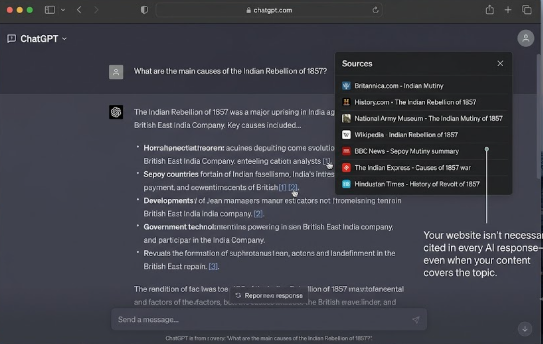
Look at the sources/citations accompanying the response.
Open the cited sources and see which websites are being used. ChatGPT’s current search documentation confirms that web-search responses may include inline citations and a Sources panel containing cited sources and other relevant links.
But don’t test only once. AI search results can change depending on the following:
- The exact wording of the question
- Current information
- Search providers
- Location
- Query context
- The model’s retrieval process
So one failed test doesn’t prove your website is invisible. Likewise, one citation doesn’t prove you have permanently “won AI SEO.”
Citations aren’t the only measurable outcome. If someone discovers your website through ChatGPT Search and clicks through, you may be able to see that referral traffic in analytics.
Step 10: Track AI search visibility Traffic Separately
OpenAI currently says ChatGPT referral URLs include the utm_source=chatgpt.com parameter, which can help publishers identify traffic originating from ChatGPT search.
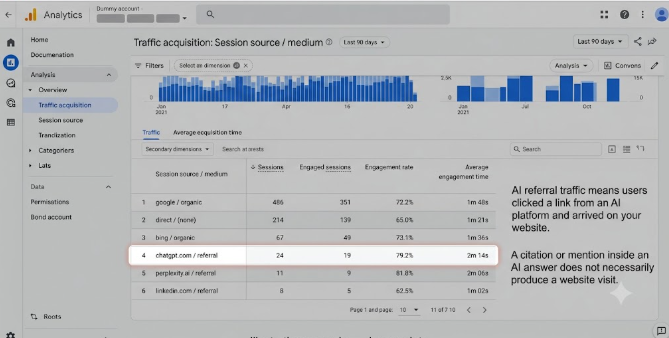
That gives you another useful metric:
Did AI search visibility actually bring someone to my website?
Because ultimately, visibility is valuable when it contributes to something meaningful:
- Awareness
- Brand discovery
- Website visits
- Leads
- Sales
- Subscribers
- Returning users
- Business inquiries
Step 11: Measure More Than Rankings
Traditional SEO reporting often focuses heavily on:
Rankings → impressions → clicks → traffic
Keep tracking those.
But add another layer.
Traditional visibility
- Rankings
- Impressions
- CTR
- Organic traffic
- Backlinks
- Indexed pages
- Conversions
AI search visibility
- AI citations
- Brand mentions
- AI referral traffic
- Pages appearing as sources
- Questions where your brand appears
- Search visibility across AI platforms
- Branded search growth
Google has also been expanding its documentation around generative AI search features, including AI Overviews and AI Mode. The important thing isn’t to create a ridiculous dashboard containing 50 vanity metrics.
It’s to understand the entire discovery journey.
The Biggest Mistake: Instant Authority for AI search visibility
This is probably the hardest lesson for a new website owner.
- You can do everything correctly and still not see immediate results.
- You can publish something genuinely useful and receive almost no traffic.
- You can create a better article than a competitor and still rank below them.
- You can write an original piece of research and have an AI system fail to cite it today.
That doesn’t automatically mean the content failed—search visibility is often cumulative. Your content becomes part of your website’s larger body of evidence.
Think about it like this:
One article
→ useful page
Twenty related articles
→ emerging topical coverage
Fifty strong articles
→ substantial knowledge base
Years of consistent publishing + references + experience
→ potentially significant accumulated authority
That’s why SEO is not simply a publishing game.
It is an accumulation game.
Also Read:
The Two-Authority Advantage
Here’s the framework worth remembering.
Established Website
Time
↓
Content
↓
Links
↓
Mentions
↓
Historical evidence
↓
Reputation
↓
Authority
New Website
It can’t instantly manufacture the first chain.
But it can build the second:
Original research
↓
First-party data
↓
Unique experience
↓
Primary evidence
↓
Useful information
↓
References and mentions
↓
Information authority
The smartest strategy isn’t to pretend the first advantage doesn’t exist.
It’s to build the second while gradually accumulating the first.
What Should You Do Starting Today to Get the AI search visibility?
If you’re building a website and want it to become visible in both traditional and AI search, don’t start by asking:
“What trick will get ChatGPT to cite me?”
Ask these questions instead.
1. Can search engines crawl my website?
Fix the technical foundation first.
2. Can AI search systems access the content?
Check crawler access where relevant.
3. Do I have genuine topical coverage?
One article isn’t a topic strategy.
4. Am I answering real user questions?
Don’t write solely for keywords.
5. Does my content contain something original?
Experience, data, research, examples or insights.
6. Does my website demonstrate expertise?
Make the author, business and experience understandable.
7. Am I building connected content?
Use clusters and meaningful internal links.
8. Am I measuring AI search visibility?
Test actual questions and monitor citations and referrals.
9. Am I giving the strategy enough time?
Authority compounds.
10. Am I creating something worth citing?
This is the biggest one.
A Practical AEO + GEO Framework
If you want a simple framework to remember, use this:
Crawl → Cover → Clarify → Prove → Connect → Measure
Crawl
Make your website accessible to search engines and relevant AI crawlers.
Cover
Build comprehensive topical coverage rather than publishing disconnected articles.
Clarify
Answer questions directly and structure information clearly.
Prove
Add first-party experience, original research, evidence and useful examples.
Connect
Build internal links between related content and establish a coherent topical ecosystem.
Measure
Track rankings, impressions, traffic, citations, mentions and AI referrals.
That’s a much more sustainable approach than trying to reverse-engineer every AI system individually.
What is AI search visibility for the Future SEO
AI search doesn’t eliminate the need for websites. It changes why a website needs to be valuable.
If an AI system can summarize a generic article in two seconds, merely rewriting information that already exists becomes less defensible.
But if your website contains:
original research
first-party data
real experience
unique analysis
useful tools
strong examples
credible opinions
proprietary information
Then your website has something much harder to replace. This is why the future of SEO may actually reward better information, not simply more content.
The websites that survive the shift won’t necessarily be the ones publishing the most. They’ll be the ones building the strongest information ecosystems.
Conclusion
You don’t need to choose between SEO and AI search. You need to understand how they now fit together.
- SEO gives your content a foundation.
- AEO helps you think in terms of questions and answers.
- GEO expands that thinking into generative search environments.
- Topical coverage builds depth.
- Original information builds differentiation.
- Time allows authority to accumulate.
And AI citations?
They’re valuable, but they’re only one visible outcome of a much larger process. So don’t build your website around the hope that ChatGPT will mention you tomorrow.
Build it so that, over time, when people ask important questions about your subject, your website has something genuinely useful to contribute to the answer.
Because the real objective isn’t
“How do I get AI to cite my website?”
It’s:
“How do I build a website that becomes difficult to ignore when my topic comes up?”
That’s the long game of SEO, AEO, and GEO.
And unlike the latest AI-search hack, that strategy can keep working even when the search interface changes again.
FAQs
1. How can I tell if ChatGPT is using my website content?
The most practical way is to test ChatGPT with specific questions that your website directly answers and check whether your page is cited or linked when ChatGPT searches the web. You can repeat these tests across different queries and dates because AI responses can change. However, not being cited does not prove that ChatGPT has never encountered or learned from your content.
2. How can I improve my website’s AI search visibility in ChatGPT?
Start with strong SEO fundamentals: make your important pages crawlable and indexable, publish genuinely useful content, build topical coverage, demonstrate expertise, and provide original information. If you want your public website to be discoverable through ChatGPT search, make sure your site also allows OpenAI’s search crawler to access the relevant content.
3. Does SEO still matter for AI search engines?
Yes. SEO remains the foundation for AI search visibility because search systems still need to discover, crawl, understand, and evaluate web content. Technical SEO, content quality, topical relevance, internal linking, authority, and a strong user experience continue to matter even though AI search changes how users consume information.
4. What is the difference between SEO, AEO, and GEO?
SEO focuses broadly on improving a website’s visibility in search engines. AEO, or Answer Engine Optimization, focuses on making content easy for answer engines to understand and use when responding to questions. GEO, or Generative Engine Optimization, focuses more broadly on visibility within generative AI experiences. These approaches overlap significantly, so AEO and GEO should generally complement strong SEO rather than replace it.
5. What is topical coverage and why is it important for SEO and AI search visibility?
Topical coverage means consistently and comprehensively covering the important questions, subtopics, entities, and problems within a particular subject. Strong topical coverage helps establish your website as a relevant source rather than a site publishing isolated articles. It can also give search engines and AI systems more context about the subjects your website genuinely specializes in.
6. Does a new website need years before it can rank on Google or get cited by AI?
No. Time itself is not a direct requirement for Google rankings or AI citations. However, many authority signals are cumulative, including links, mentions, reputation, historical evidence, and topical coverage. A new website can reduce this disadvantage by publishing original research, first-party data, unique experiences, and genuinely valuable information while consistently building authority over time.
7. What type of content is most likely to be cited by AI search engines?
Content with original, useful information can have a stronger opportunity to stand out than generic summaries. First-party data, original research, case studies, firsthand experience, unique examples, expert analysis, and clearly supported conclusions give AI systems information that may be more valuable than another rewritten version of what is already widely available online.
8. Will SEO still be worth it if AI search reduces website clicks?
Yes, but the definition of SEO success is changing. Traditional SEO focused heavily on rankings and organic clicks, while modern AI search visibility also includes AI citations, brand mentions, discovery, qualified traffic, and conversions. A website can therefore benefit from strong search visibility even when every AI interaction does not result in a direct click.