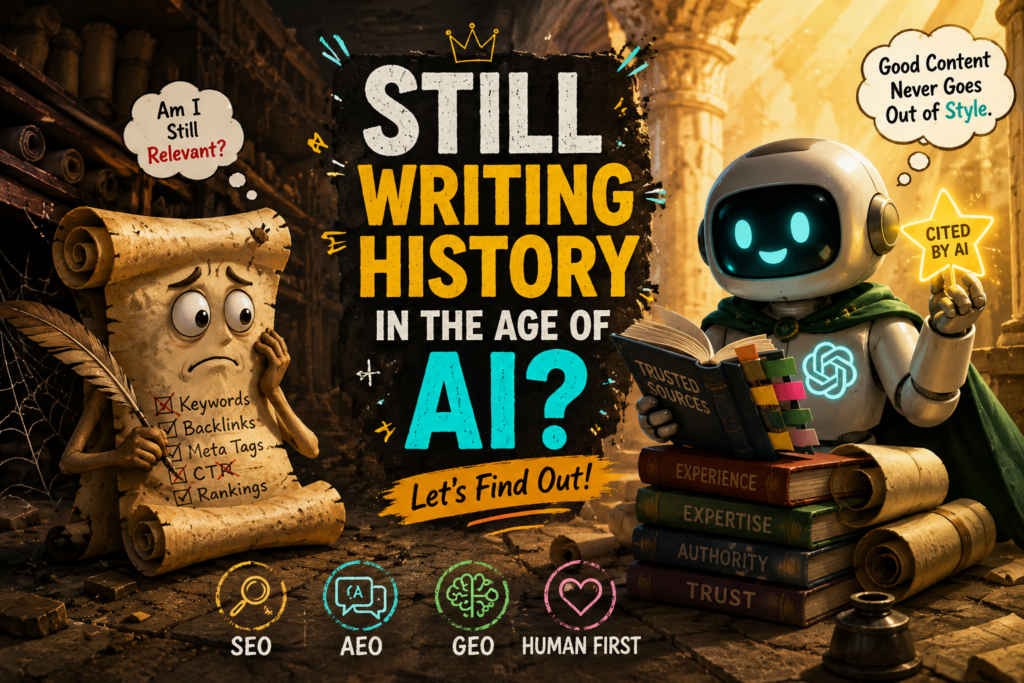
Yes, SEO is still worth it in the age of AI—but its role is changing. SEO isn’t only about ranking blue links anymore. It also helps search engines and AI systems discover, understand, evaluate, and surface your content.
“AI can answer questions in seconds. But where does it find the answers—and what does that mean for businesses investing in content?”
For nearly two decades, businesses have followed a familiar formula to grow online. Build a website:
- Optimize it for search engines.
- Publish helpful content.
- Earn backlinks.
- Rank on Google.
- Get visitors.
- Generate customers.
Simple. That’s it. At least, that’s how it used to work. Today, the internet feels very different.
Search for almost any informational question on Google, and before you even reach the first website, you’ll often see an AI-generated answer summarizing everything you wanted to know.
Do this: Open ChatGPT.
Ask the same question.
You’ll receive another complete answer.
Next, try Gemini.
Another answer.
Now Perplexity?
Another answer—with citations.
Suddenly, a question that would’ve required visiting five different websites a few years ago is answered within seconds.
For users, this is incredible.
For businesses, it raises an uncomfortable question.
If AI answers everything, who will visit my website?

That single question became the reason this article exists:
- Not because I believe SEO is dying.
- Not because AI is replacing Google.
But because I wanted to understand what is actually happening before jumping to conclusions.
This wasn’t theoretical research. It started while building my own website—ContentByMayank.
Also Read: 2-DAY RISHIKESH TRIP FROM DELHI: COMPLETE TRAVEL GUIDE
It Started With a Completely Different Question
When I launched ContentByMayank, my goal wasn’t to study artificial intelligence. I simply wanted to build the best content writing website I possibly could.
Like every website owner, I started researching.
I searched questions such as the following:
- Are FAQs still worth adding?
- Does schema markup still help?
- Is EEAT becoming more important?
- Should articles answer questions directly or gradually?
- How should content be written for AI Overviews?
- What exactly is Generative Engine Optimization (GEO)?
- How important is Answer Engine Optimization (AEO)?
- Can a brand-new website compete with established websites?
Initially, I expected dozens of articles from different websites. Instead, Google answered most of my questions itself.
Sometimes the answer appeared before any organic search result. Sometimes the answer was so complete that I didn’t even feel the need to open another website.
Out of curiosity, I repeated those same questions across ChatGPT, Gemini, and Perplexity. Each platform answered confidently.
Each platform approached the problem differently:
- Some cited websites.
- Some cited research papers.
- Some linked to forums like Reddit.
- Some referenced YouTube videos.
And sometimes…
They cited no one at all. That observation immediately made me think beyond my own website. Imagine spending months creating original content.
- Paying designers.
- Building topical authority.
- Publishing detailed guides.
- Earning backlinks.
- Optimizing every page.
Only for an AI model to summarize your work into a few paragraphs without consistently directing users back to your website. Wouldn’t every business owner eventually ask the same question?
Is SEO still worth investing in?
Google AI Overview Appearing Above Traditional Search Results
“Google increasingly answers informational queries directly through AI Overviews before users reach traditional organic listings.”
The Wrong Question Everyone Is Asking
Since AI became mainstream, the internet has been flooded with dramatic headlines.
“SEO is Dead.”
“AI Will Replace Search.”
“Stop Writing Blogs.”
“Only GEO Matters Now.”
While these headlines generate clicks, they rarely explain what’s actually changing. The real debate isn’t SEO versus AI—it’s visibility versus invisibility.
Businesses have never invested in SEO simply because they wanted higher rankings. They invested because rankings created visibility.
- Visibility generated traffic.
- Traffic created leads.
- Leads became customers.
- Customers built businesses.
That fundamental relationship hasn’t disappeared. The path users take has simply evolved. Instead of moving directly from Google to your website, today’s journey often looks like this:
Question
↓
AI Assistant / AI Overview
↓
Quick Answer
↓
Decision
↓
Website (Maybe)
That single word—maybe—is what has businesses worried. Because if users never reach your website, how do you build authority? How do you generate leads? How do you sell products? How do you grow?
Those concerns are completely valid. But they’re also incomplete. Because they assume AI exists independently—it doesn’t. And understanding that changes the entire conversation.
Also Read: Delhi Prayagraj Varanasi trip: Our 4-Day Spiritual Journey
AI Didn’t Replace the Internet
It depends!
One of the biggest misconceptions surrounding AI is the belief that large language models (LLMs) somehow “know everything.”
They don’t.
Modern AI systems generate responses by learning patterns from enormous amounts of publicly available and licensed information, and many systems also retrieve fresh information from external sources when appropriate.
- Without original research…
- Without expert insights…
- Without businesses publishing useful resources…
- Without journalists…
- Without educators…
- Without developers…
- Without creators…
- Without websites…
There would be no ecosystem rich enough to support high-quality AI answers. AI is extraordinarily powerful. But it doesn’t create human experience.
- It organizes.
- It summarizes.
- It explains.
Sometimes it synthesizes multiple viewpoints into one response.
Yet somewhere behind almost every trustworthy answer is a human who first researched, experienced, tested, documented, or explained that information.
That realization led me to a much bigger conclusion.
- Maybe SEO isn’t disappearing.
- Maybe its purpose is evolving.
The Modern Information Ecosystem
Real Experience
↓
Research
↓
Original Content
↓
Website
↓
Google Indexing
↓
Search Engines
↓
AI Models
↓
Users
“AI-generated answers ultimately depend on an ecosystem built by original creators, researchers, businesses, publishers, and websites.”
Search Has Quietly Undergone Its Biggest Transformation
Many people compare AI to previous technological shifts.
- Mobile phones.
- Voice search.
- Social media.
- Video content.
While all of those changed user behavior, none fundamentally altered how information was discovered quite like generative AI has.
Traditional search engines were designed to help users discover information. Generative AI is designed to deliver information—that difference seems subtle.
In reality, it changes almost everything. For years, businesses competed for one of ten blue links on Google’s first page.
Today, they compete for something much more valuable: being trusted enough to become part of the answer itself.
- That doesn’t eliminate SEO.
- It expands it.
- Search optimization is no longer only about ranking pages.
It’s about building enough credibility, clarity, and authority that both search engines and AI systems consider your content worth surfacing.
In other words, the goal isn’t just to rank. The goal is to become a trusted source. And that distinction will define the next generation of digital marketing.
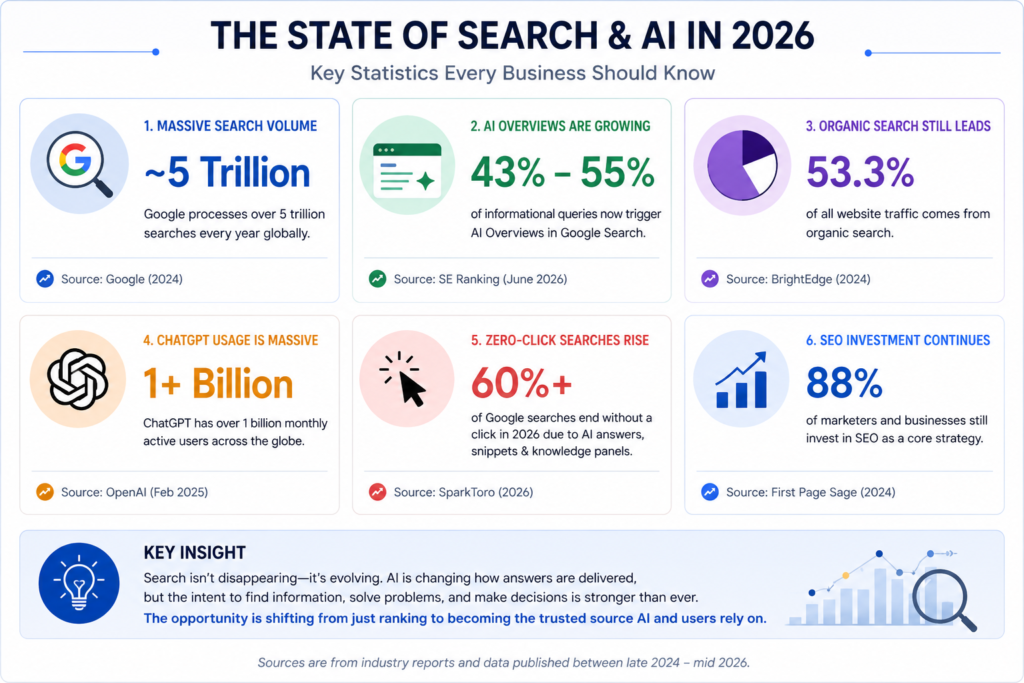
Search Is Changing—But Not Disappearing
Include a professionally designed statistics panel featuring:
- Google processes trillions of searches annually.
- AI Overviews now appear for a substantial share of informational queries.
- Organic search remains one of the largest drivers of website traffic across industries.
- ChatGPT serves more than a billion monthly active users.
- Zero-click searches are increasing, particularly for informational queries.
- Businesses continue investing heavily in SEO while adapting for AI-driven discovery.
The Search Landscape Has Quietly Changed

For years, digital marketing followed a relatively predictable playbook.
If your website ranked on the first page of Google, your chances of receiving visitors increased dramatically. Businesses focused on keyword research, backlinks, technical SEO, page speed, and content quality because these factors directly influenced visibility.
That strategy still works. But it no longer tells the complete story.
Today’s search ecosystem is far more complex than simply “ranking on Google.” Search has evolved into a network of interconnected discovery systems where users may encounter your content through a traditional search result, an AI-generated summary, a conversational assistant, a video recommendation, a discussion forum, or even a voice assistant.
In other words, people are no longer searching in one place.
They’re searching everywhere.
Also Read: AI Search Visibility: Best AEO Guide for Website
From Search Engines to Answer Engines
The biggest transformation isn’t that Google has introduced AI. The biggest transformation is that users have started expecting answers instead of links.
Think about your own behavior.
A few years ago, if you wanted to know whether FAQs still mattered for SEO, you would probably do the following:
- Search Google.
- Open three or four articles.
- Compare opinions.
- Read for ten or fifteen minutes.
- Form your own conclusion.
Today, many people simply ask the following:
“Are FAQs still worth adding in 2026?”
Within seconds, they receive a complete explanation.
- No scrolling.
- No opening multiple tabs.
- No comparing articles.
That convenience explains why AI adoption has accelerated so quickly.
- It isn’t replacing curiosity.
- It’s reducing the time required to satisfy it.
Traditional Search vs AI Search Journey
- Traditional Search
Question
│
Google Search
│
10 Blue Links
│
Website
│
Answer
- AI Search
Question
│
AI Platform
│
Generated Answer
│
├────────► User Satisfied
│
Citation (Sometimes)
│
Website (Optional)
“The user journey has become significantly shorter. Businesses are now competing not only for clicks but also for inclusion within AI-generated answers.”
Google Didn’t Stop Being a Search Engine
One misconception I encountered repeatedly during my research was the idea that Google has become “just another AI chatbot.”
It hasn’t.
Google is still fundamentally a search engine. Its primary objective remains connecting users with reliable information across the web.
What has changed is how it delivers that information.
Instead of immediately presenting a list of websites, Google increasingly attempts to answer informational queries itself through AI Overviews while still providing supporting sources.
For businesses, this creates a new layer of competition. Previously, success meant appearing among the top organic listings.
Today, success may also mean becoming one of the sources Google chooses to summarize.
These aren’t identical goals. A page can rank well organically but not appear within an AI Overview.
Likewise, content that clearly answers a specific question may be selected for an AI overview even if it isn’t the first organic result.
That distinction has given rise to Answer Engine Optimization (AEO) and Generative Engine Optimization (GEO), which we’ll explore later in this guide.
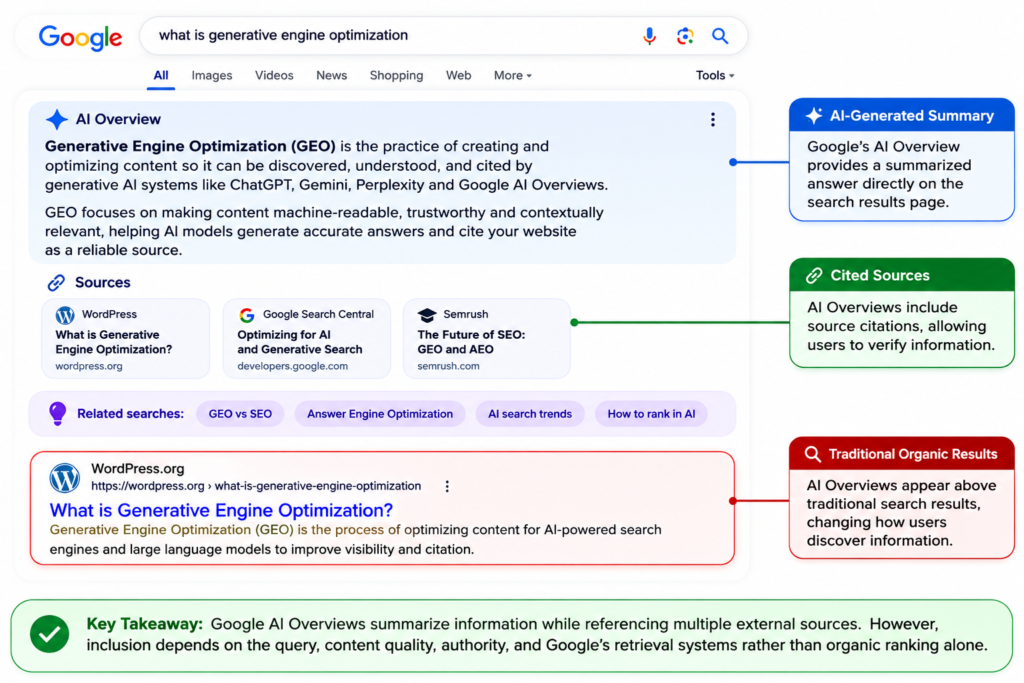
Google AI Overview with Multiple Source Citations
Purpose
Display a Google AI Overview showing:
- AI-generated summary
- Linked citations
- Source cards
- Organic listings below
“Google AI Overviews typically summarize information while referencing multiple external sources, although selection criteria vary by query.”
ChatGPT, Gemini and Perplexity Are Not Search Engines—But They Influence Search
One of the biggest mistakes businesses make is treating every AI platform as though it works the same way.
They don’t.
Each platform has different strengths, retrieval methods, update cycles, interface designs, and citation behaviors.
Understanding these differences helps businesses create content that performs across multiple discovery channels rather than optimizing exclusively for Google.
ChatGPT
ChatGPT has become one of the world’s most widely used AI assistants because of its conversational experience.
Rather than simply returning information, it often explains concepts step by step, asks clarifying questions when needed, and helps users complete tasks.
For many users, it has become a research assistant, writing partner, brainstorming tool, coding companion, tutor, and business advisor all in one.
However, one characteristic frequently surprises publishers. ChatGPT doesn’t always include citations in every response.
Depending on the question, available information, and the model’s retrieval process, answers may include multiple references, a few references, or none at all.
From a publisher’s perspective, this creates uncertainty.
Even if your content contributes to the broader knowledge ecosystem, users may not always discover your website directly through the response.
That doesn’t necessarily mean your content lacks value. It simply highlights how AI discovery differs from traditional search.
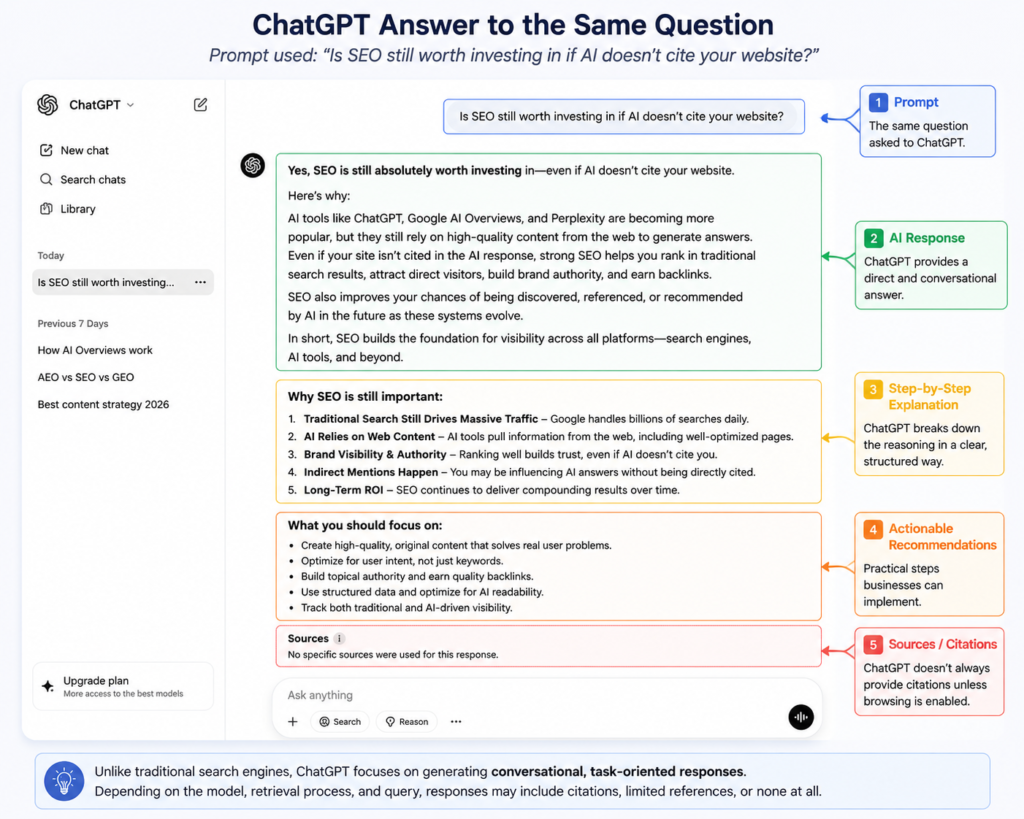
ChatGPT Answer to the Same Question
Use exactly the same prompt asked of Google.
Highlight:
- Answer quality
- Structure
- Presence or absence of citations
- Recommendations
- Follow-up capabilities
Google Gemini
Gemini benefits from Google’s broader ecosystem.
Its integration with Google Search, Workspace, Android, and other Google services allows it to deliver highly contextual responses, especially when current information is important.
In many cases, Gemini provides richer integration with Google’s search infrastructure than standalone AI assistants.
Businesses already investing in structured, authoritative, and well-organized content may naturally benefit as Google’s AI systems become more deeply connected with the search ecosystem.
Gemini Responding to the Same Query
Compare:
- Depth
- Sources
- Citations
- User interface
- Additional recommendations
Perplexity
Among all the platforms I explored during this research, Perplexity stood out for one particular reason.
It consistently emphasized citations.
Instead of presenting answers in isolation, Perplexity frequently links individual statements back to their original sources through inline references.
For researchers, journalists, students, and professionals, this significantly improves transparency. Rather than asking users to trust the AI blindly, it encourages verification.
That approach aligns closely with one of the core principles of modern information literacy:
The easier it is to verify information, the more trustworthy it becomes.
For businesses hoping to earn visibility through AI systems, citation-focused platforms like Perplexity demonstrate why publishing credible, well-structured, evidence-based content matters more than ever.
Perplexity Answer with Inline Citations
Highlight:
- Numbered citations
- Source links
- Reading suggestions
- Research depth
The Rise of Zero-Click Searches
One phrase appears repeatedly in discussions about AI and search:
Zero-click search.
A zero-click search occurs when a user’s question is answered directly on the search results page without requiring them to visit another website.
This behavior isn’t entirely new.
Featured snippets, knowledge panels, weather widgets, sports scores, maps, calculators, and currency converters have all produced zero-click experiences for years.
AI Overviews simply extend that concept.
Instead of answering one simple question, they attempt to satisfy much broader informational needs. For businesses that depend heavily on informational traffic, this naturally creates concern.
If users receive answers immediately, why would they continue clicking?
The answer lies in understanding intent.
Simple questions increasingly end on the search page.
Complex decisions rarely do.
Someone asking,
“What is SEO?”
may never leave Google.
Someone asking,
“Which SEO agency should I hire for a SaaS company with a $10,000 monthly marketing budget?”
still requires comparison, expertise, trust, testimonials, pricing, methodology, and human judgment.
Note – AI can accelerate research, but it cannot eliminate decision-making.
Growth of Zero-Click Searches
Use a clean line chart illustrating:
- Traditional click-through behaviour
- Increasing zero-click searches
- Continued importance of high-intent transactional queries
(Based on SparkToro, Similarweb, and other referenced studies.)
Search Intent Has Become More Important Than Keywords
For years, SEO conversations revolved around keywords. Today, search engines have become remarkably good at understanding intent.
Consider these two searches.
“Content writing”
and
“Best content writing agency for SaaS startups”
Although both contain similar keywords, they represent entirely different user goals.
- The first user wants information.
- The second user wants to hire someone.
Modern search engines—and increasingly AI systems—understand this difference. This means businesses can no longer optimize solely around keyword density.
Instead, they must create content that genuinely satisfies the user’s underlying objective. That observation aligns perfectly with one of the principles I’ve adopted while building ContentByMayank:
Write for the user’s intent—not the writer’s assumptions.
We’ll revisit this concept later when discussing the “10 Golden Rules” for creating content that performs across SEO, AEO, and GEO.
The Biggest Misunderstanding About AI Search
“AI isn’t replacing the internet. It’s reorganizing it.”
If there’s one misconception I would like every business owner, marketer, writer, and website owner to stop believing after reading this article, it’s this:
AI knows everything. It doesn’t. In fact, this misunderstanding is responsible for most of the panic surrounding SEO today.
Whenever someone receives a detailed answer from ChatGPT, Gemini, Google AI Overview, or Perplexity, it creates the illusion that the AI somehow possesses unlimited knowledge stored inside it.
From a user’s perspective, that’s understandable.
- You ask a question.
- Within seconds, you receive a well-written answer.
- No websites.
- No endless scrolling.
- No opening fifteen browser tabs.
It feels like magic.
But behind every high-quality AI response lies something much less mysterious.
Information.
And more importantly… Someone had to create that information first.
Every AI Answer Starts With Someone’s Work
Imagine asking ChatGPT:
“How do I optimize my website for AI search?”
The response might explain:
- structured content
- schema markup
- EEAT
- topical authority
- citations
- user intent
- conversational writing
To the average reader, it appears as though ChatGPT invented that knowledge–It didn’t. Those concepts were:
- researched…
- tested…
- debated…
- documented…
- published…
- improved…
and refined by thousands of SEO professionals, engineers, researchers, businesses, universities, documentation teams, journalists, developers, and publishers over many years.
Long before AI summarized them into one response.
That is one of the most important realities of the AI era.
AI excels at organizing knowledge.
Humans still create most of it.
The Information Creation Cycle
Human Experience
│
Research & Testing
│
Original Content
│
Publishing
│
Search Engine Indexing
│
Knowledge Graphs & Web Signals
│
AI Retrieval & Reasoning
│
AI-Generated Answer
│
User
Key Insight: Without original human knowledge entering this cycle, AI has nothing meaningful to organize or explain.
AI Rewards Useful Information, not Content
This distinction matters.
Businesses often believe AI is searching for:
- blogs
- articles
- websites
- keywords
Not exactly.
AI systems are trying to answer a user’s question as accurately as possible.
That means they look for information that demonstrates the following:
- expertise
- clarity
- consistency
- factual accuracy
- structured organization
- corroboration across multiple trustworthy sources
Notice something? None of those qualities require “SEO tricks.” They require genuinely useful content.
Ironically, this is exactly what Google has encouraged since its earliest days.
- Helpful content.
- Useful information.
- Original insights.
- Strong user experience.
The language has evolved. The objective hasn’t.
SEO Was Never About Ranking.
It Was About Discoverability. One of the biggest mindset shifts businesses need to make is redefining what SEO actually means.
Ask ten people what SEO is, and many will answer:
“Ranking 1 on Google.”
That isn’t SEO. That’s merely one possible outcome. At its core, search engine optimization has always been about one thing:
Helping search systems understand your content well enough to present it to the right audience.
Twenty years ago, that audience discovered your website through blue links.
Today…they may discover it through the following:
Google Search
↓
Google AI Overview
↓
ChatGPT
↓
Gemini
↓
Perplexity
↓
Voice Assistants
↓
AI Agents
↓
Future search interfaces that haven’t even been invented yet.
Note – The destination changes. The need for discoverability doesn’t.
Key Insight: SEO Has Quietly Become Information Optimization
Many businesses still optimize pages as though they’re writing exclusively for Google’s ranking algorithm. Increasingly, that’s no longer enough.
Modern content also needs to be understandable by the following:
- AI summarization systems
- entity recognition models
- knowledge graphs
- conversational retrieval systems
- semantic indexing systems
- retrieval-augmented generation (RAG) pipelines
In other words…
- You’re no longer writing for one search engine.
- You’re publishing to an entire information ecosystem.
If AI Needs Information?
Where Does That Information Come From?
This is where things become fascinating.
Different AI systems use different methods for producing answers.
Some rely primarily on:
- Patterns learned during training.
- Some retrieve current information from the web.
- Some combine multiple retrieval systems.
- Some reference search indexes.
- Some maintain proprietary knowledge graphs.
- Some prioritize trusted domains.
- Others prioritize recent discussions.
The technical implementation differs across platforms.
However,
They all depend on one fundamental reality:
- Someone has to publish reliable information first.
- Without publishers, there is no journalism.
- Without journalism, there is no documentation.
- Without documentation, there are no trustworthy references.
- Without trustworthy references, AI quality rapidly deteriorates.
This creates an interesting relationship.
Businesses often think AI is competing against websites. In reality – AI depends on websites.
The Modern Knowledge Ecosystem
“Artificial intelligence doesn’t replace knowledge creators—it depends on them.”
Why Original Experience Is Becoming More Valuable
When Google’s Helpful Content updates first appeared, many people believed they were simply another algorithm update.
Looking back now, they seem more like preparation for the AI era.
Think about it:
If millions of articles repeat identical information, how does an AI determine which version is genuinely useful?
Increasingly, it looks for signals that indicate originality.
Examples include
Researchers
↓
Publishers
↓
Businesses
↓
Creators
↓
Universities
↓
Government Resources
↓
Search Engines
↓
AI Platforms
↓
Users
- First-hand experience.
- Case studies.
- Original data.
- Independent research.
- Unique frameworks.
- Practical testing.
- Real examples.
- Expert observations.
Notice something interesting? Every one of those qualities is difficult to fake.
That’s precisely why businesses that continue investing in genuine expertise may gain an advantage over those publishing generic AI-generated articles.
AI can summarize common knowledge. It struggles to invent authentic experience. Experience remains uniquely human.
This Is Exactly Why I Decided To Include My Own Website
While researching this topic, I could have written a completely theoretical article. Many websites already have.
Instead,
- I wanted something different.
- I wanted to test my own assumptions.
- So rather than relying only on research papers.
I analyzed:
- my Search Console
- my Google Analytics 4
- indexing behaviour
- impressions
- CTR
- AI responses
- Google’s AI Overviews
- my India Trip Planner
- my Rishikesh travel guide
Some observations confirmed industry research. Others surprised me.
One page dramatically outperformed everything else on my website despite being published on a completely new domain.
Another page gained impressions—yet almost no clicks.
Those findings helped me understand something important. Success in modern search isn’t determined by one ranking factor.
It’s determined by how well your content satisfies real human intent across multiple discovery systems.
We’ll examine those real-world results in the next chapter.
Research Insight
The AI era isn’t reducing the value of original content.
It’s increasing the value of content that cannot easily be replicated.
That includes:
- personal experience
- original research
- proprietary data
- interactive tools
- calculators
- templates
- first-hand testing
- expert analysis
- unique opinions supported by evidence
These assets don’t just help with SEO. They strengthen your visibility across search engines, AI assistants, and future retrieval systems.
SEO vs AEO vs GEO
Stop Choosing Between Them. Start Understanding How They Work Together.
Ask ten marketers what businesses should focus on in 2026, and you’ll probably hear three different answers.
Some will confidently say the following:
“SEO is dead. GEO is the future.”
Others insist:
“Forget blogs. Just optimize for AI.”
Then there are those who believe nothing has changed and that traditional SEO is enough.
In my opinion, all three perspectives miss the bigger picture.
They’re treating SEO, AEO, and GEO as competitors.
They’re not. They’re three different layers of the same visibility strategy.
The businesses that dominate the next decade won’t choose one over the others. They’ll understand how each one complements the rest.
Before We Compare Them…
Let’s Define Them Properly
One of the biggest problems in today’s marketing discussions is that people use these terms interchangeably. They shouldn’t, each solves a different problem.
What is SEO?
Search Engine Optimization (SEO) is the practice of helping search engines discover, understand, index, evaluate, and rank your content for relevant user searches.
Its primary objective is simple:
Increase your visibility within traditional search results.
SEO focuses on signals such as:
- Content quality
- Search intent
- Technical website health
- Core Web Vitals
- Internal linking
- External backlinks
- Topical authority
- Page experience
- Crawlability
- Indexability
- EEAT (Experience, Expertise, Authoritativeness, Trustworthiness)
Notice something interesting.
None of these exist because Google likes technical checklists.
They exist because they help search engines identify trustworthy content that genuinely helps users.
SEO has always been user-centric.
The algorithms simply evolved to reward that.
What is AEO?
Answer Engine Optimization (AEO) focuses on increasing the likelihood that answer engines provide your information directly when responding to user questions.
Instead of optimizing for a list of search results, you’re optimizing for concise, accurate, and structured answers.
AEO emphasizes content such as the following:
- Frequently Asked Questions
- Definitions
- Step-by-step guides
- Comparison tables
- Short answer blocks
- Question-based headings
- Structured formatting
- Schema markup
- Clear language
- Semantic organization
AEO exists because user behavior has changed.
People increasingly ask complete questions instead of typing fragmented keywords.
Instead of searching:
“SEO content”
Users now ask:
“Is SEO still worth investing in if AI answers everything?”
Answer engines need content structured in a way that allows them to understand and summarize it efficiently.
What is GEO?
Generative Engine Optimization (GEO) refers to optimizing content so that generative AI systems can better discover, understand, trust, and potentially reference it while generating responses.
Notice the wording carefully. GEO isn’t simply about getting cited. It’s about becoming citation-worthy.
That’s a huge difference.
Many businesses currently believe GEO means: “How do I force ChatGPT to mention my website?”
That’s the wrong objective, but the better question is “How do I publish content that AI systems naturally trust enough to use?”
Those are two completely different mindsets.
- The first searches for shortcuts.
- The second builds authority.
- Authority scales.
You can’t expect success with shortcuts because they rarely achieve long term results.
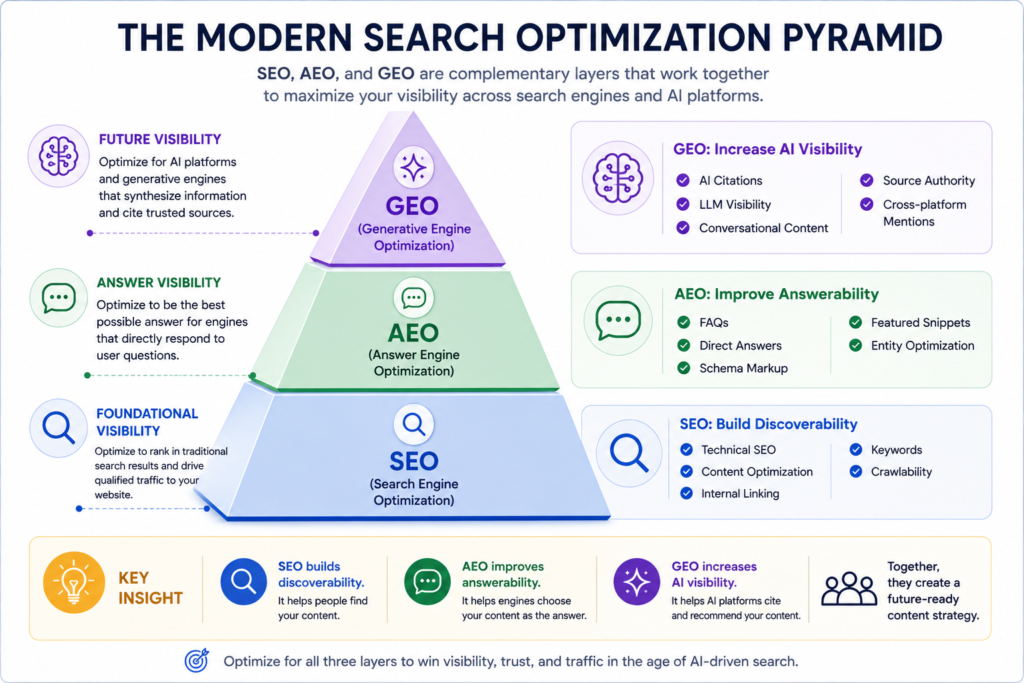
SEO, AEO & GEO: Three Layers of Modern Visibility
USER
↑
AI Assistants (GEO)
↑
Answer Engines (AEO)
↑
Search Engines (SEO)
↑
Original Website
Key Insight
SEO makes your content discoverable.
AEO makes your answers understandable.
GEO makes your information usable by generative AI.
None of these replace each other.
Each one strengthens the next layer.
Here’s Why I Believe SEO Is Still the Foundation
This may surprise people expecting another “SEO is dead” article.
I don’t believe SEO is disappearing, but I believe it’s becoming more important than ever. Here’s why.
Imagine AI suddenly stopped receiving new information.
- No new research.
- No new websites.
- No new documentation.
- No new businesses.
- No new case studies.
- No new government reports.
- No new scientific papers.
What would happen? Eventually, every AI system would begin recycling outdated information.
- Innovation would slow.
- Accuracy would decline.
- Fresh insights would disappear.
- The internet cannot continue evolving without people publishing original work.
And that work still needs to be discovered.
That’s exactly what SEO enables. Search engines remain one of the primary ways new information enters the broader digital ecosystem.
AI doesn’t eliminate that process, but it builds upon it.
Why AEO Is Growing Faster Than Ever
People are busier than they’ve ever been.
When someone asks:
“How do I improve page speed?” they usually don’t want to read 7,000 words before reaching the answer.
They want:
- the answer
- why it matters
- what to do next
That’s exactly why answer engines have become so popular. They’re reducing friction.
Instead of forcing users to gather information from multiple pages, they consolidate it into one coherent response.
Businesses that organize their content around genuine questions naturally become stronger candidates for answer-based discovery.
That’s why every article on ContentByMayank includes FAQs. Not because FAQs magically improve rankings but because real users genuinely ask questions. And good content should answer them.
GEO Is Not a Replacement for SEO
One trend I’ve noticed across LinkedIn, YouTube, and marketing communities is the growing obsession with GEO.
That’s understandable. Everyone wants to appear inside AI-generated responses.
But many discussions unintentionally frame GEO as though businesses should abandon traditional SEO.
I disagree.
Here’s why.
- Generative AI still relies on trustworthy information.
- Trustworthy information usually originates from credible websites.
- Credible websites rarely appear overnight.
They’re built through:
- consistent publishing
- backlinks
- topical authority
- technical quality
- citations
- user engagement
- expertise
- trust
Notice something?
Those are classic SEO principles. GEO doesn’t replace them but it inherits them.
SEO vs AEO vs GEO
| Factor | SEO | AEO | GEO |
| Primary Goal | Rank in Search | Answer Questions | Become AI Reference |
| Audience | Search Engines | Answer Engines | Generative AI |
| Content Style | Comprehensive | Concise & Structured | Evidence-Based & Contextual |
| Success Metric | Rankings & Traffic | Featured Answers | AI Visibility & Citations |
| Technical Focus | Crawlability, Speed, Links | Structured Data, FAQs | Entities, Authority, Semantic Clarity |
| Time Horizon | Long-Term | Medium-Term | Long-Term |
(Design this professionally as an infographic rather than a plain table.)
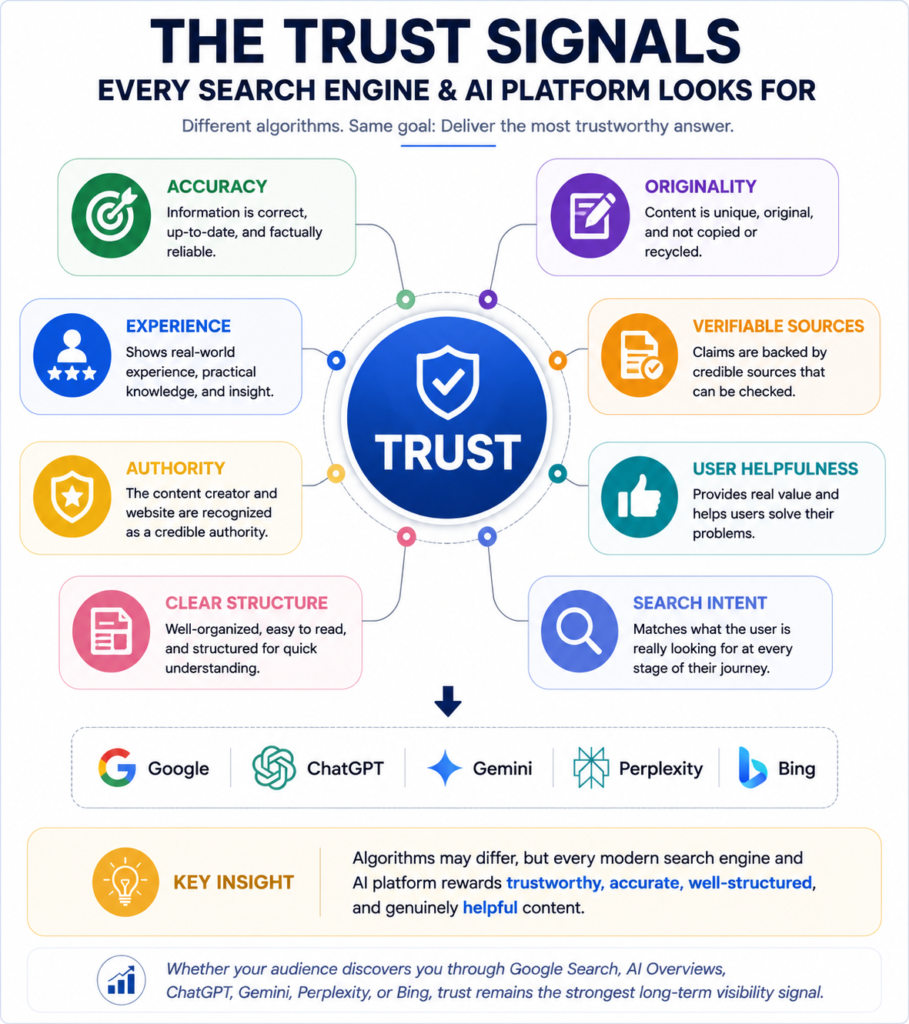
Don’t Optimize for Algorithms. Optimize for Trust.
Throughout this research, one conclusion became impossible to ignore.
Every major platform—
- Google.
- ChatGPT.
- Gemini.
- Perplexity.
- Bing.
—May use different algorithms, but they’re all trying to solve the same problem.
How do we provide users with the most trustworthy answer?
That’s why chasing loopholes rarely works for long.
Algorithms change.
Trust doesn’t.
Whether a human reads your article or an AI summarizes it, the underlying quality signals remain remarkably similar.
- Is it accurate?
- Is it original?
- Is it well structured?
- Is it helpful?
- Can the claims be verified?
- Does it demonstrate experience?
- Can users trust it?
Those questions matter far more than whether your keyword density is 1.8% or 2.3%.
My Marketing Investment Strategy (₹100,000 Example)
Earlier, I asked myself a practical question:
If I had ₹100,000 to market a brand-new business today, where would I invest it?
After everything I’ve researched, this would be my allocation.
Recommended Digital Marketing Budget Allocation
SEO → 35%
AEO → 20%
GEO → 20%
Social Media → 10%
Paid Advertising → 10%
Innovation & Experimentation → 5%
Why This Distribution?
SEO (35%)
SEO remains the foundation.
Without discoverable, technically sound, authoritative content, everything else becomes harder.
Good SEO compounds over time.
A well-written article can generate qualified traffic for years.
AEO (20%)
Answer-based search is growing rapidly.
Optimizing for direct answers improves your visibility across featured snippets, AI summaries, and voice search.
GEO (20%)
Generative AI isn’t replacing search.
It’s becoming another discovery channel.
Businesses should prepare now rather than react later.
Creating citation-worthy content today may provide long-term advantages as AI adoption continues to grow.
Social Media (10%)
Your audience doesn’t live exclusively on search engines.
High-quality content deserves redistribution across LinkedIn, X, Instagram, YouTube, and emerging platforms.
Content should travel.
Not remain hidden inside your website.
Paid Advertising (10%)
SEO is a marathon.
Advertising accelerates visibility while organic authority develops.
Both strategies complement one another.
Innovation Reserve (5%)
The digital landscape changes rapidly.
Keeping a small experimentation budget allows businesses to adapt without disrupting their primary strategy.
Key insight: The future doesn’t belong to businesses that choose SEO, AEO, or GEO. It belongs to businesses that understand how each one strengthens the others
What Contentbymayank Taught Me About Modern Search
A Real-World Case Study Instead of Another Theory
Everything we’ve discussed so far has been backed by industry research, search trends, and my own observations.
But I didn’t want this article to become another collection of statistics copied from reports.I wanted to test these ideas in the real world.Fortunately, I already had the perfect opportunity. My own website.
ContentByMayank.com
At the time of writing this article, the website is still relatively new. It doesn’t have years of domain authority.
It doesn’t have thousands of backlinks. It doesn’t receive millions of monthly visitors.In other words, it’s exactly the kind of website many business owners can relate to.
A brand-new website trying to earn visibility in one of the most competitive industries on the internet. That makes every observation much more valuable.
Because if something works here, it provides useful direction for businesses starting from scratch.
My Goal Was Never Just Rankings
When I started building ContentByMayank, my objective wasn’t simply to rank for keywords. I wanted to answer one question.
Can a completely new website build authority in the AI era by genuinely helping users?
That question shaped almost every decision. Instead of publishing dozens of thin articles, I focused on creating structured, detailed, experience-based resources.
Every page included:
- Clear headings
- Question-based sections
- Internal links
- Frequently Asked Questions
- Schema markup
- Helpful navigation
- Fast loading pages
- Human-first writing
- Actionable advice
None of this guaranteed rankings. But it created a strong foundation. And that’s exactly what SEO should do.
Google Search Console – Overall Performance
Include:
- Total Clicks
- Total Impressions
- Average CTR
- Average Position
- Date Range
Caption
“Performance data from ContentByMayank showing the early growth pattern of a brand-new website.”
One Page Completely Changed My Thinking
If you had asked me which page would become the best-performing page on my website, I would’ve guessed one of my blog posts. I would’ve been wrong. Instead, one interactive tool quietly outperformed almost everything else.
India Trip Planner

Initially, I built it simply because I thought it would improve user experience. The idea was straightforward. Instead of forcing people to read thousands of words before planning a trip, why not allow them to generate a personalized travel plan based on:
- destination
- budget
- travel dates
- interests
- accommodation preferences
- pace
- transportation
It wasn’t designed primarily for SEO. It was designed to solve a real problem. That difference mattered. Because users didn’t just consume information. They interacted with it.
Google Analytics 4 – India Trip Planner Performance
Include:
- Views
- Active Users
- Average Engagement Time
- Event Count
- Engagement Rate
The India Trip Planner became the highest-performing page despite the website being relatively new.”
Why Did India Trip Planner Perform Better?
I spent a long time thinking about this. Eventually, I realized something important. Traditional blogs answer questions. Interactive tools solve problems. Those aren’t the same thing.
Suppose someone searches:
“Plan my India trip.”
Reading ten different blogs requires effort. Using a planner requires interaction. The planner immediately delivers personalized value. Google increasingly rewards experiences that satisfy user intent.
AI systems also prefer resources that provide practical utility. That explains why interactive experiences may become increasingly important as search evolves.
Users don’t always want more information. Sometimes they simply want the solution
Information vs Utility
Traditional Blog
Question
↓
Information
↓
Understanding
↓
Action
Interactive Tool
Question
↓
Interaction
↓
Personalized Solution
↓
Immediate Value
Key Insight
Information teaches. Tools assist. The future of search increasingly rewards both.
Then Came Another Surprise
Not every page performed equally. One article in particular taught me a completely different lesson. My detailed Rishikesh travel guide.
I invested significant time into creating it. It included:
- transportation details
- accommodation
- food recommendations
- budgeting
- local experiences
- FAQs
- original observations
- practical travel tips
Everything seemed right. Google indexed it. Search Console started showing impressions. Then, almost no clicks.
Initially, I wondered whether something was technically wrong. The page speed was good.
The structure was good. The SEO was solid. Eventually I realized something much more important.
Impressions don’t automatically create clicks.
Rankings Are Only One Part of Visibility
The Rishikesh article reminded me that modern search is much more competitive than simply appearing in results.
Users now encounter:
- AI Overviews
- Featured Snippets
- Maps
- Videos
- Reddit discussions
- YouTube
- Image packs
- Travel widgets
- Hotel listings
before they even reach many traditional blog posts. That doesn’t necessarily mean the article failed. It means visibility has become fragmented.
Businesses should measure success using multiple indicators rather than rankings alone.
For example:
- impressions
- engagement
- branded searches
- returning visitors
- newsletter signups
- conversions
- assisted conversions
- AI referrals
- direct traffic growth
Modern SEO isn’t just about getting clicked. It’s about becoming discoverable across multiple digital touchpoints.Think of technical SEO as constructing the roads before inviting traffic.
Internal Linking Quietly Became One of My Biggest Advantages
One practice I followed from the beginning was building strong internal connections between pages.
- Every important article linked naturally to relevant services.
- Every service page connected back to supporting resources.
- Every blog strengthened another part of the website.
Instead of isolated pages, I built a connected ecosystem.
Like this:
Homepage
↓
Content Writing
↓
SEO Content Writing
↓
AI Content Writing
↓
Copywriting
↓
Website Content
↓
Latest Blogs
↓
Relevant Articles
That structure helps in several ways.
Search engines discover pages more efficiently. Users navigate naturally. Authority flows throughout the website.
AI systems also receive clearer contextual relationships between topics. Instead of publishing disconnected articles, you’re publishing a knowledge network.
And knowledge networks are significantly easier for both humans and machines to understand.
Internal Linking Architecture
Create a clean website flow diagram illustrating the complete hierarchy.
Highlight:
- Homepage
- Service Pages
- Category Pages
- Blog Articles
- Cross-links
“Strong internal linking improves crawlability, user navigation, topical authority, and contextual understanding.”
The Biggest Lesson I Learned
Looking back at everything that happened on my website, one conclusion stands above everything else.
The pages that genuinely solved problems consistently performed better than pages created solely around keywords.
That doesn’t mean keywords don’t matter. They absolutely do. But keywords should lead you toward user problems.
Not become the goal themselves. The moment businesses begin writing only for search engines, they usually become less helpful for actual people.
Ironically, that’s exactly when both rankings and engagement begin declining.
Personal Observation
If I could go back and give myself one piece of advice before launching ContentByMayank, it would be this:
Don’t chase rankings. Chase usefulness.
- Rankings are a consequence.
- Usefulness is the cause.
- Search engines change.
- AI models evolve.
- Algorithms update.
User expectations continue shifting. But one thing has remained surprisingly consistent. The businesses that solve real problems continue earning visibility.
The methods evolve. The principle doesn’t.
The Data Doesn’t Lie
What the Industry Is Actually Doing While Everyone Debates Whether SEO Is Dead
Opinions are everywhere. Some marketers say SEO is finished.
Others insist AI will replace Google. A few believe businesses should stop publishing blogs altogether.
The problem? Most of these opinions are based on isolated observations rather than long-term industry data.
So instead of asking what people think, let’s examine what the numbers actually say.
Because if thousands of businesses are investing millions of dollars every year into search, content, and AI optimization, that tells us far more than sensational headlines ever will.
Search Isn’t Shrinking. It’s Growing.
One of the biggest misconceptions today is that people have stopped using search engines.
The data tells a completely different story.
Google continues processing trillions of searches every year, making it the world’s largest information discovery platform by an enormous margin.
Even with AI assistants growing rapidly, search remains the default starting point for billions of daily decisions.
People still search for:
- products
- services
- health information
- travel planning
- business software
- local businesses
- educational resources
- comparisons
- reviews
- buying advice
What’s changing isn’t whether people search.
It’s how they expect answers to be delivered.
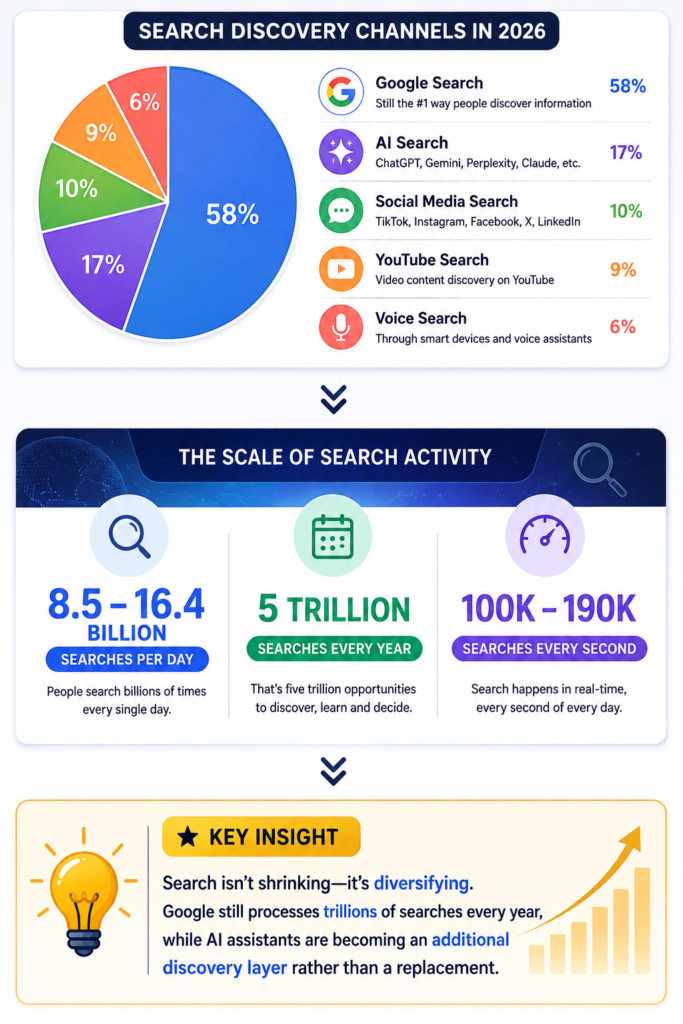
Global Search Activity
Design an infographic showing:
Google Searches Per Day
≈ 8.5–16.4 Billion
↓
Nearly 5 Trillion Searches Every Year
↓
Around 100,000–190,000 Searches Every Second
Include a side note:
Modern searches are becoming longer, more conversational, and increasingly question-based.
AI Overviews Are Reshaping Search Results
The most visible change in Google’s search experience has been AI Overviews.
Instead of simply presenting links, Google increasingly generates summaries for informational searches while citing multiple sources.
That fundamentally changes user behavior. Instead of deciding which article to open first, users often read the AI summary before making any clicking decision.
Research now shows that AI Overviews appear for a significant percentage of informational and commercial searches, with activation rates varying depending on query type, geography, and wording.
Long, conversational questions are considerably more likely to trigger AI-generated summaries than short keyword searches.
That aligns perfectly with a broader trend we’ve observed across the internet:
People no longer search like robots.
They search like they’re talking to another person.
AI Overview Trigger Rates
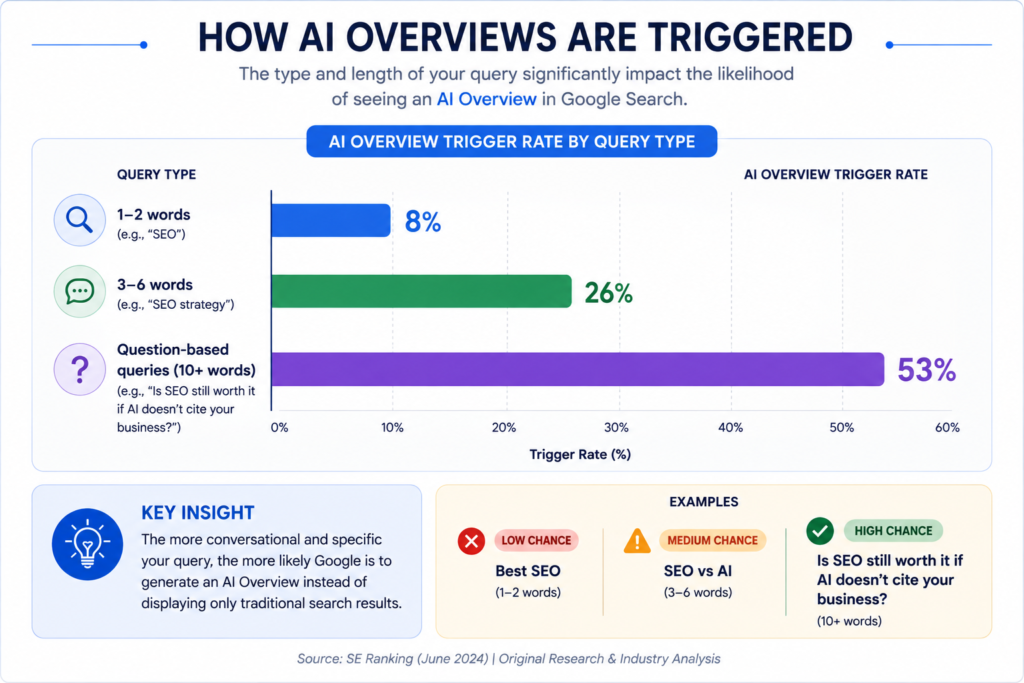
Longer, intent-rich searches have a substantially higher probability of generating AI Overviews.
Zero-Click Searches Are Rising
But That Doesn’t Mean Websites No Longer Matter
One statistic often appears in discussions about AI.
Zero-click searches.
The phrase sounds alarming. It suggests users no longer visit websites, the reality is more nuanced.
A zero-click search simply means the user’s immediate question was answered directly on the search page.
- Weather.
- Definitions.
- Sports scores.
- Simple calculations.
- Directions.
- Currency conversions.
- Quick factual questions.
AI overviews have expanded that behavior to many informational searches.
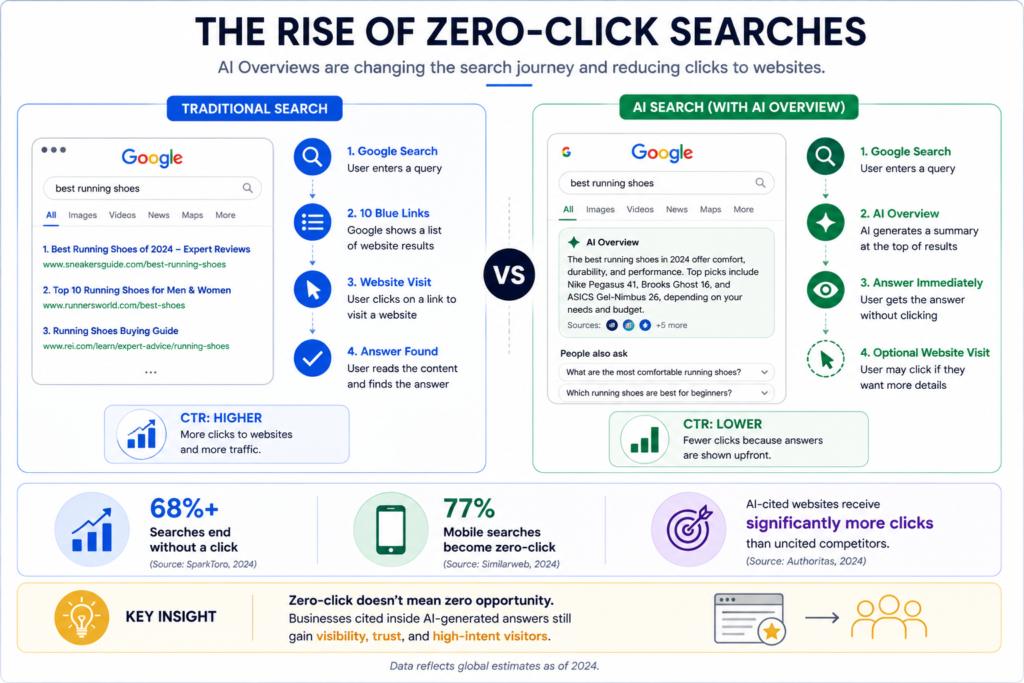
Research indicates that a majority of searches now end without an organic click, particularly on mobile devices.
That sounds frightening until we ask a better question.
Which searches become zero-click?
Mostly simple ones. The moment a user wants to:
- compare services
- evaluate products
- understand pricing
- book appointments
- read reviews
- download resources
- verify claims
They usually leave the search results. Because AI can summarize information. It cannot replace trust.
Traditional Click Journey vs AI Search Journey
Compare:
Without AI Overview
↓
Organic Click Rate
↓
Website Visit
With AI Overview
↓
Immediate Answer
↓
Selective Website Visits
AI reduces unnecessary clicks—not necessarily valuable ones.
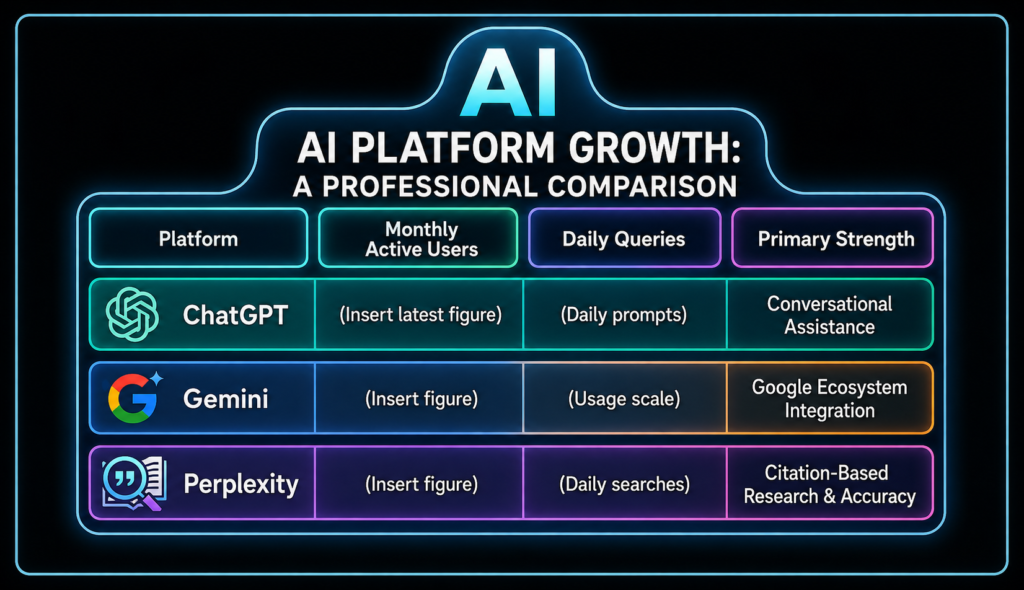
ChatGPT Is Growing Faster Than Almost Any Consumer Technology
One reason businesses have become increasingly interested in GEO is simple. People genuinely use AI assistants.
ChatGPT alone now serves an enormous global audience every month. Millions of users ask questions ranging from:
“What should I cook tonight?” to “Help me build a SaaS pricing strategy.”
That diversity matters. Because AI assistants aren’t competing in one niche. They’re becoming everyday decision-making tools.
For businesses, this means visibility inside conversational AI is becoming an entirely new acquisition channel—not a replacement for search but an addition to it.
Businesses Aren’t Abandoning SEO
Perhaps the strongest evidence that SEO remains valuable comes from marketers themselves. If SEO truly no longer worked, budgets would collapse.
Instead, industry surveys show something very different. A significant majority of businesses continue investing in SEO. Many are increasing those investments.
What’s changing isn’t the decision to invest. It’s where the investment goes.
Businesses are expanding beyond the following:
keyword rankings
↓
towards:
- authority
- topical expertise
- structured content
- AI discoverability
- semantic optimization
- content quality
- entity development
Note – SEO isn’t disappearing, but it’s maturing.
Digital Marketers Investing in SEO
Illustrate:
- Continue Investing
- Increasing Budget
- Maintaining Budget
- Reducing Budget
Use your collected statistics.
Organic Search Still Delivers The Largest Share of Website Traffic
Another statistic surprised many people during my research. Despite the explosion of AI, organic search continues to generate more website traffic than
- social media
- referral traffic
- paid campaigns
combined in many industries. Especially in B2B sectors.
That makes perfect sense. High-intent users still search before making important decisions.
- Buying software.
- Hiring agencies.
- Booking services.
- Researching investments.
- Planning travel.
- Choosing healthcare providers.
These journeys rarely end with one AI answer—trust still requires exploration.
SEO Delivers One Advantage That Paid Ads Never Can
Advertising is powerful, there’s no denying that. Launch a campaign today, and you can begin receiving traffic within hours.
The downside?
The moment your advertising budget stops, your visibility disappears.
SEO works differently.
A high-quality article published today can continue attracting visitors months—or even years—later.
- Every new backlink strengthens it.
- Every internal link reinforces it.
- Every update improves it.
- Organic visibility compounds.
- Paid visibility expires.
That’s why successful businesses rarely choose one over the other. They use advertising for immediate growth while building SEO as a long-term asset.
SEO vs PPC
Split graphic:
Paid Ads
- Fast Growth
- Immediate Results
- Stops When Budget Ends
SEO
- Slower Growth
- Compounding Returns
- Long-Term Asset
Content Marketing Is Becoming More Valuable—Not Less
Some people predicted AI would eliminate the need for content marketing. Instead, it has increased demand for better content.
Businesses are investing more heavily in:
- educational resources
- original research
- case studies
- tutorials
- comparison guides
- interactive experiences
- thought leadership
Why?
Because generic information has become abundant. Original insights remain scarce.
That’s exactly what AI struggles to generate independently. The businesses producing genuinely useful knowledge continue creating competitive advantages.
AI Referral Traffic Is Small But More Valuable
One fascinating statistic stood out during my research. AI platforms currently send only a fraction of the referral traffic generated by traditional search engines.
At first glance, that seems disappointing until we examine conversion quality.
Early studies suggest visitors arriving through AI citations often demonstrate:
- stronger purchase intent
- longer engagement
- higher trust
- better conversion rates
Why?
Because AI has already answered many preliminary questions before the visitor arrives. The user doesn’t click casually; they click intentionally.
That makes AI referrals particularly valuable for businesses offering specialized expertise.
AI Referral Journey
Question
↓
AI Answer
↓
Citation
↓
Website
↓
Highly Qualified Visitor
↓
Conversion
Numbers Don’t Replace Strategy
Statistics are useful, but statistics alone don’t grow businesses. Understanding why those numbers exist is what creates competitive advantage.
Here’s what the data collectively tells us:
- Search remains enormous.
- AI adoption is accelerating.
- Organic traffic still dominates.
- Businesses continue investing in SEO.
- AI is changing discovery—not eliminating it.
- Trust remains the deciding factor.
And perhaps most importantly…
The companies creating original, structured, experience-based content are positioning themselves to benefit from both traditional search and AI-driven discovery.
Expert Insight
The future isn’t “search vs. AI.”
The future is search + AI working together to connect users with trustworthy information.
Businesses that understand this early won’t need to rebuild their strategy every time the technology changes.
They’ll already be aligned with the direction the web is heading.
10 Golden Rules for Creating Content That Wins in SEO, AEO & GEO
Most articles tell you what to do.
Very few explain why it works.
After building my own website, studying Google’s evolution, analyzing AI platforms, reviewing industry research, and observing how modern search behaves, I realized something.
- The fundamentals haven’t changed nearly as much as people think.
- The delivery mechanism has.
- People now search differently.
- AI now answers differently.
- Search engines now understand content differently.
- But valuable information?
- That has never gone out of fashion.
These ten principles summarize everything I’ve learned throughout this research.
Whether you’re a solo blogger, startup founder, marketer, business owner, or content writer, these rules can help you create content that remains valuable regardless of how search evolves over the next decade.
Rule 1
Don’t Just Write. Publish What Only You Can Say.
The internet doesn’t need another rewritten article. It needs another useful one.
One of the biggest mistakes creators make today is publishing content because a keyword has high search volume.
Instead, start with a problem you’ve personally experienced, solved, researched, tested, or observed.
That’s exactly how this article began.
I wasn’t trying to write about SEO. I was trying to understand why AI often answered questions without consistently citing businesses.
That genuine curiosity eventually became this guide. Your experience becomes your competitive advantage.
AI can rewrite existing information. It cannot genuinely recreate your first-hand observations.
Whenever possible, include:
- Original case studies
- Personal experiments
- Real client experiences
- Screenshots
- Research
- Practical examples
- Mistakes you learned from
- Results you measured
Those are the assets that search engines and AI systems increasingly value because they add something new to the web.
If someone else could have written your article without your experience, your content probably isn’t unique enough.
Quick Action
Before publishing any article, ask yourself:
“What information in this article couldn’t exist if I hadn’t written it?”
If you can’t answer that question…
Keep improving it.
Rule 2
Stop Chasing SEO, AEO, and GEO Individually
This may sound surprising in an article discussing all three. Don’t chase them individually; chase usefulness.
SEO, AEO, and GEO
are outcomes of creating information that’s genuinely helpful.
When businesses obsess over algorithms, they often forget users. When they obsess over users, algorithms usually become easier to satisfy.
Think about Google’s Helpful Content System. Think about AI assistants. Think about Perplexity’s citation behavior.
What are they all trying to do? Deliver the most useful answer.
- Not the page with the highest keyword density.
- Not the article with the most H2 headings.
- Not the one with the most internal links.
Those technical optimizations matter but they’re amplifiers. Not substitutes for quality.
Original Framework
The Visibility Pyramid
- AI Citations
(GEO Visibility)
- Direct Answers
(AEO Optimization) - Organic Search Rankings
(SEO Performance)
- Helpful, Original Content
Key Insight
Everything above depends on what’s beneath it.
Without genuinely valuable content, every optimization strategy eventually reaches its limit.
Rule 3
Structure Beats Complexity
One lesson became obvious while comparing Google AI Overviews, ChatGPT, Gemini, and Perplexity.
They all prefer well-organized information.
Think about your own reading habits. Would you rather read:
A wall of text or an article with:
- descriptive headings
- comparison tables
- bullet points
- FAQs
- summaries
- visuals
- clear navigation
The answer is obvious. Humans process structured information more efficiently. AI systems do too.
Good structure improves the following:
- readability
- comprehension
- crawlability
- accessibility
- snippet eligibility
- AI extraction
- user satisfaction
Structure isn’t about pleasing search engines. It’s about reducing cognitive effort.
The easier your information is to consume, the more likely it is to be trusted, remembered, and referenced.
Structured Content vs Unstructured Content
Visual comparison:
- Large paragraph blocks.
- Right:
- Clear headings
- Tables
- Lists
- Images
- FAQs
- Summary boxes
People don’t avoid long content. They avoid difficult content.
Rule 4
Write From the User’s Perspective—Not Your Ego
Many articles fail because they answer the question the writer wanted to answer. Instead of the one the reader actually asked that’s a subtle but important difference.
Suppose someone searches:
“Should I still invest in SEO?”
They probably aren’t looking for the history of search engines. They’re trying to make a business decision. Your content should reflect that every section should reduce uncertainty.
Every paragraph should move the reader closer to clarity. Whenever you include opinions, label them as opinions.
Whenever you include facts, support them with evidence. Whenever you make recommendations, explain your reasoning.
The objective isn’t to prove you’re right. The objective is to help the reader make a better decision.
Rule 5
Quality Always Compounds Faster Than Quantity
One excellent article can outperform fifty average ones.
Unfortunately, many content strategies still prioritize publishing frequency over usefulness.
That approach becomes even riskier in the AI era. AI systems already have access to enormous amounts of generic information.
Publishing more generic content rarely creates an advantage. Publishing something substantially better often does.
High-quality content earns:
- backlinks
- shares
- citations
- bookmarks
- returning visitors
- brand mentions
- AI references
Low-quality content usually earns none of them.
Instead of asking:
“How many articles should I publish this month?”
Ask:
“Would someone recommend this article without me asking them to?”
That’s a much better quality benchmark.
Rule 6
Define What “The Best Content” Actually Means Before You Write
One of the biggest misconceptions in content marketing is believing that every article should follow the same formula.
The “best” content depends entirely on the user’s intent.
- A beginner’s guide
- an academic research paper
- a buying guide
- and a troubleshooting article
All require different approaches.
Before writing, define:
- Who is reading?
- What do they already know?
- What problem are they trying to solve?
- What action should they take after reading?
- What objections might they have?
- What evidence would increase their confidence?
Only then should you begin writing.
Because “best content” isn’t determined by word count.
It’s determined by usefulness for a specific audience.
Write for Search Intent, Not Just Search Volume
If I had to recommend only one mindset shift to beginners entering content marketing today, it would be this:
Stop asking, “Which keyword should I target?”
Start asking, “What is this person actually trying to achieve?”
Search engines have become remarkably good at understanding intent.
AI platforms have become even better.
Two users can type completely different queries while trying to solve the same problem.
Likewise, two identical keywords can represent entirely different intentions depending on context.
For example, consider the keyword:
Content Writing
At first glance, it seems straightforward.
But look deeper.
Different users searching the same topic may have completely different goals.
Informational Intent
The user wants to learn.
Examples:
- What is content writing?
- What does a content writer do?
- How can I become a content writer?
- What skills are required?
Your objective isn’t to sell but to educate.
Commercial Investigation
The user already understands the topic and now they’re comparing options.
Examples:
- Best content writing agency
- SEO content writing services
- Content writing pricing
- Freelance vs agency content writers
Here, users expect:
- comparisons
- pricing guidance
- case studies
- portfolios
- trust signals
- decision-making help
Transactional Intent
The decision has already been made.
Examples:
- Hire content writer
- Content writing services near me
- Book SEO content writing
These users don’t need another 4,000-word explanation about what content writing is.
They need:
- credibility
- pricing
- process
- CTA
- confidence
Navigational Intent
The user already knows where they want to go and they’re simply trying to reach it.
Examples:
- ContentByMayank
- ContentByMayank blog
- ContentByMayank contact
- India Trip Planner
Good website architecture becomes incredibly important here.
- Clear navigation.
- Logical menus.
- Internal linking.
- Breadcrumbs.
- Search functionality.
- Fast loading.
- Simple layouts.
Navigation is often ignored during SEO discussions.
It shouldn’t be a great website doesn’t merely attract visitors but it helps them move effortlessly toward their destination.
Original Framework
The Search Intent Pyramid
Transactional
(“I want to buy.”)
Commercial Investigation
(“I’m comparing options.”)
Informational
(“I want to learn.”)
Navigational
(“Help me reach something. ”)
Key Insight
Great content doesn’t answer keywords.
It answers intentions.
Rule 8
Never Assume You Know Every Question Your Audience Will Ask
One of the biggest advantages AI has introduced is exposing us to the incredible variety of human curiosity.
People don’t ask questions the way marketers expect.
They ask:
- incomplete questions
- emotional questions
- oddly specific questions
- beginner questions
- expert questions
- comparison questions
- follow-up questions
Sometimes…
They ask questions that seem completely unrelated until you understand the context.
Suppose someone searches:
“Is SEO still worth it?”
That question could actually mean the following:
- Should I hire an SEO agency?
- Is SEO worth learning?
- Should I stop blogging?
- Is AI replacing Google?
- Is content marketing dead?
- Is SEO still profitable?
- Should I invest in PPC instead?
One question. Seven different intentions.
This is why modern content should answer the obvious question and then naturally anticipate the next five.
When readers finish your article without opening another browser tab, you’ve probably created something genuinely valuable.
Practical Exercise
Before publishing any article…
Ask AI:
“What follow-up questions would someone naturally ask after reading this?”
Then answer the genuinely relevant ones.
Not because algorithms reward it.
Because readers appreciate it.
Rule 9
Create Content for Tomorrow’s Search, Not Yesterday’s
Search has never remained static. It evolved from:
Directories
↓
Keyword Search
↓
Mobile Search
↓
Voice Search
↓
Visual Search
↓
Conversational AI
↓
Agentic AI
↓
Whatever comes next.
Businesses often optimize only for today’s algorithms. That’s short-sighted. Instead, build assets that remain useful regardless of interface.
For example:
Don’t rely only on paragraphs.
Include:
- diagrams
- charts
- comparison tables
- FAQs
- checklists
- calculators
- templates
- timelines
- downloadable resources
- interactive tools
- videos
- screenshots
Notice something?
Every one of those formats improves the experience for both humans and AI systems.
Future-proof content isn’t about predicting algorithms.
It’s about maximizing usefulness across every possible way people consume information.
Original Framework
The Future-Proof Content Model
Original Research
↑
Interactive Experiences
↑
Visual Learning (Charts, Tables)
↑
Structured Written Content
↑
Clear User Intent
Key Insight
Technology changes.
Useful information survives every platform.
Rule 10
Build Authority Before You Chase Visibility
Perhaps the biggest lesson I’ve learned throughout this research is this: Search engines don’t owe anyone visibility. AI platforms don’t owe anyone citations. Authority has to be earned.
That doesn’t necessarily mean becoming the biggest website.It means becoming one of the most trustworthy. Authority grows through consistency.
- Every helpful article contributes.
- Every original case study contributes.
- Every accurate statistic contributes.
- Every transparent citation contributes.
- Every satisfied reader contributes.
- Every honest correction contributes.
Over time, these small signals compound into something much more valuable than rankings.
They become a reputation, and reputation increasingly influences discoverability across both traditional search and AI systems.
Credibility Is Becoming the New Ranking Signal
Think about the types of sources AI systems frequently reference.
- Government organizations.
- Universities.
- Research institutions.
- Industry reports.
- Established publishers.
Why?
Because they consistently demonstrate credibility that doesn’t mean smaller websites can’t compete.
It means they must become exceptionally trustworthy within their niche.
Note—One outstanding article supported by evidence often carries more long-term value than twenty generic posts written only to target keywords.
Authority Flywheel
Original Experience
↓
Helpful Content
↓
Reader Trust
↓
Shares & Mentions
↓
Backlinks & Citations
↓
Authority
↓
Greater Visibility
↓
More Readers
↓
More Experience
↺
Caption
Key insight—Authority isn’t built overnight. It’s compounded through consistent value creation.
The Rule ContentbyMayank is Run By
If I had to summarize everything in this article into one sentence… it would be this:
Write what’s true. Write what you’ve earned the right to explain.
That simple philosophy naturally aligns with:
- SEO.
- AEO.
- GEO.
- EEAT.
- User experience.
- AI discoverability.
- Trust.
Because regardless of how technology evolves. There will always be demand for people who explain difficult things clearly and honestly
The 10 Golden Rules (Quick Reference)
| Rule | Principle |
| 1 | Publish what only you can say. |
| 2 | Don’t chase algorithms—chase usefulness. |
| 3 | Structure beats complexity. |
| 4 | Write from the reader’s perspective. |
| 5 | Quality compounds faster than quantity. |
| 6 | Define what “best content” means before writing. |
| 7 | Optimize for intent, not just keywords. |
| 8 | Answer today’s question and tomorrow’s follow-up. |
| 9 | Build for future search behaviors. |
| 10 | Authority creates visibility—not the other way around. |
Transition
Everything we’ve covered so far leads to one final question. If you’re starting a business today…
knowing everything we’ve learned about Google Search, AI Overviews, ChatGPT, Gemini, Perplexity, SEO, AEO, GEO, user trust, citations, and content quality…
What should you actually do over the next 12 months?
That’s exactly what we’ll answer next.
The 12-Month Visibility Roadmap
If I Started a Brand-New Business Today, This Is Exactly What I’d Do
One of the questions I kept asking myself while researching this article was:
If I had to build a completely new business today—with no authority, no backlinks, no audience, and no rankings—how would I compete against companies that have been publishing for years?
After studying how Google Search, AI Overviews, ChatGPT, Gemini, Perplexity, and modern search behavior work together…
My answer became surprisingly simple.
- I wouldn’t build an SEO strategy.
- I wouldn’t build an AEO strategy.
- I wouldn’t build a GEO strategy.
I’d build a content authority strategy that naturally performs well across all three. Because algorithms evolve. Authority compounds.
Here’s exactly what my first year would look like.
Month 1
Build the Foundation Before Chasing Traffic
The biggest mistake new businesses make is publishing dozens of articles before creating a proper website structure.
That’s backwards.
Before writing anything, I’d make sure my website clearly answers five questions:
- Who am I?
- What do I do?
- Why should someone trust me?
- What problems do I solve?
- How can someone contact me?
Only after these pages exist would I begin publishing content.
Website Structure
Homepage
↓
About
↓
Services
↓
Contact
↓
Blog
↓
Resources
↓
FAQs
↓
Privacy
↓
Terms
↓
Author Page
Technical Setup Checklist
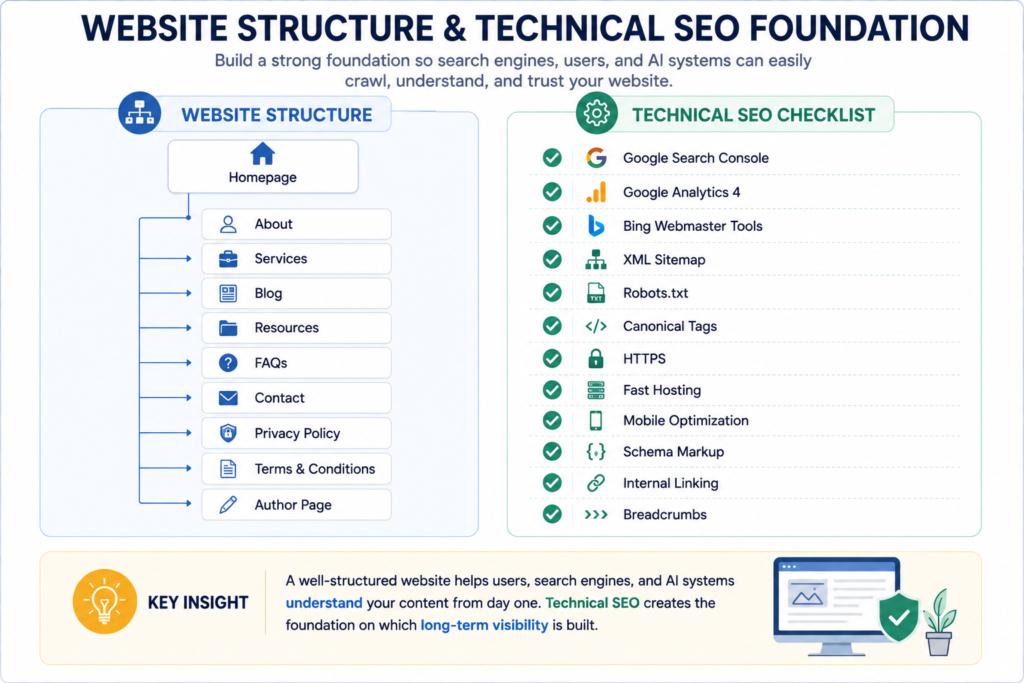
- Google Search Console
- Google Analytics 4
- Bing Webmaster Tools
- XML Sitemap
- Robots.txt
- Canonicals
- HTTPS
- Fast Hosting
- Mobile Optimization
- Schema Markup
- Internal Linking Structure
- Breadcrumbs
Think of technical SEO as constructing the roads before inviting traffic.
Month 2
Publish Your Foundational Content
Instead of chasing trending topics, I’d create the pages my future customers will always need. These are evergreen assets.
Examples:
- Ultimate Beginner Guides
- Service Pages
- Pricing Guides
- Frequently Asked Questions
- Comparison Articles
- Industry Glossaries
Every article should become part of a larger topical cluster.
For example:
Homepage
↓
Content Writing
↓
SEO Writing
↓
AI Writing
↓
Copywriting
↓
Website Content
↓
Latest Blogs
↓
Relevant Supporting Blogs
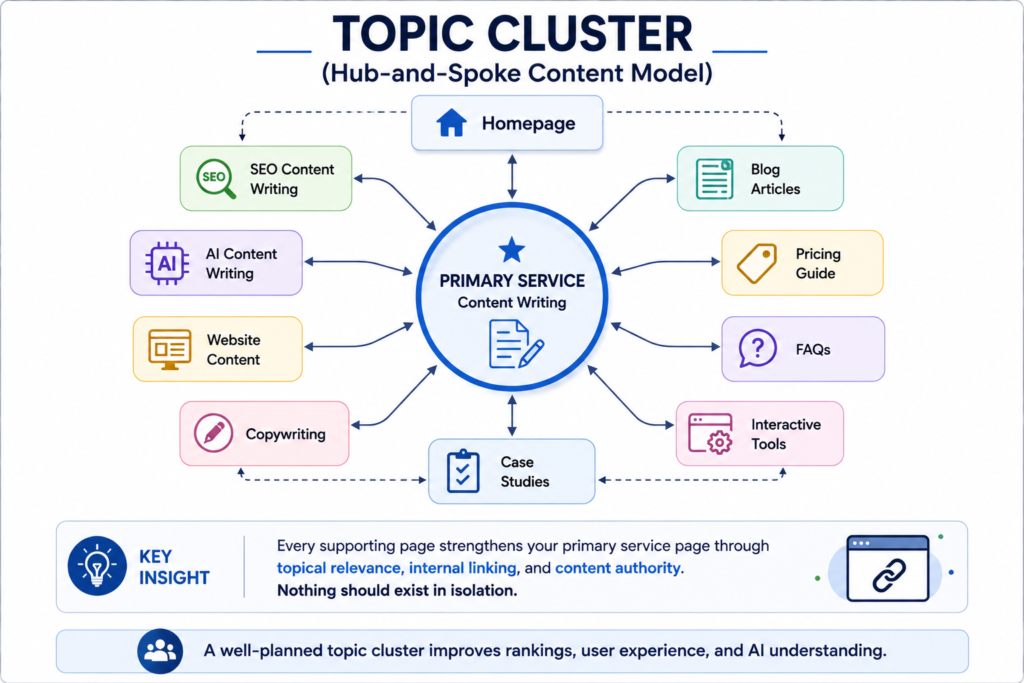
This creates a clear topical hierarchy that helps both users and search engines understand your website.
More importantly…
every article strengthens another page.
Nothing exists in isolation.
Topic Cluster
Create a hub-and-spoke diagram showing:
Homepage
↓
Primary Service
↓
Supporting Articles
↓
Related FAQs
↓
Case Studies
↓
Interactive Tools
Month 3
Become the Best Answer—Not the Loudest Publisher
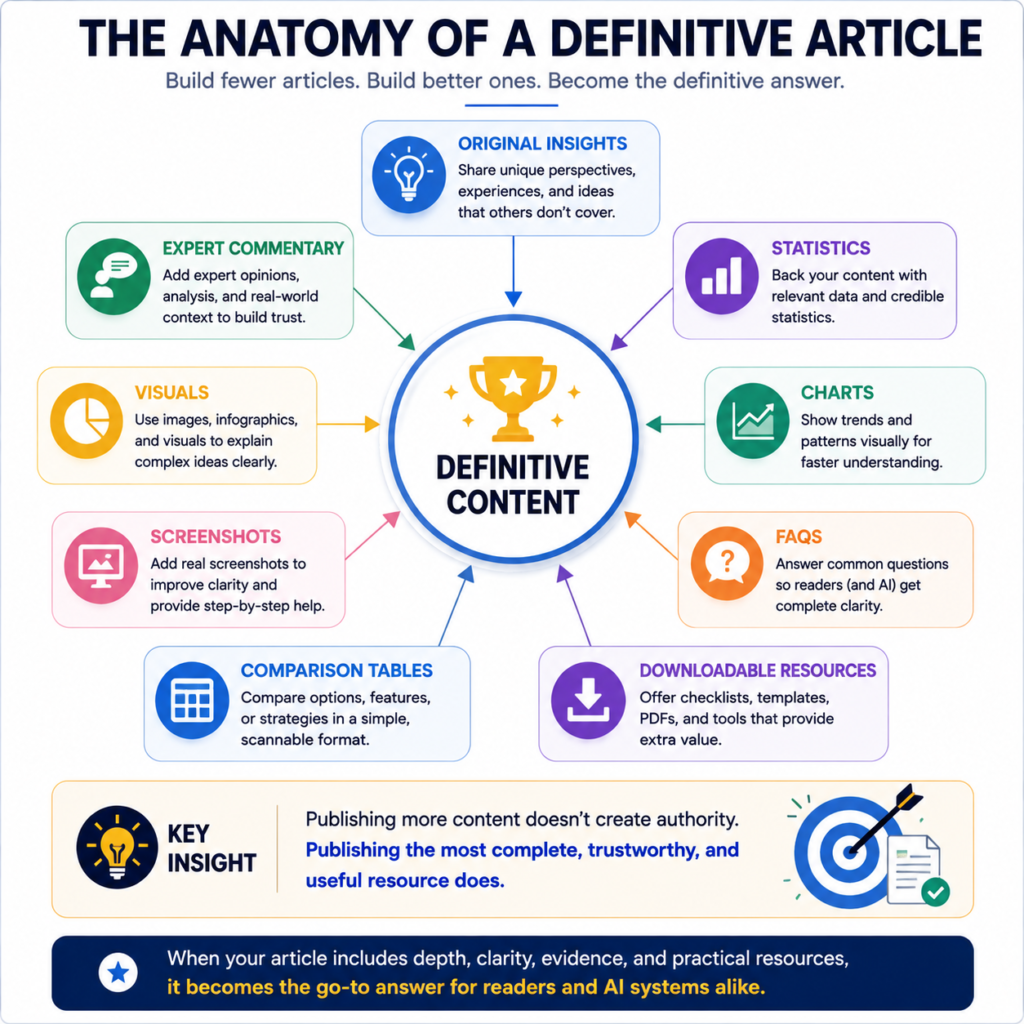
Many businesses think publishing daily automatically leads to growth. It doesn’t. Instead, I’d publish fewer articles with significantly greater depth.
Each article should include:
- original insights
- expert commentary
- visuals
- charts
- screenshots
- FAQs
- statistics
- comparison tables
- downloadable resources
The objective isn’t publishing more. It’s becoming the definitive answer.
Ask Yourself
Before pressing publish, could this article realistically become one of the top three resources on this topic? If the answer is no, keep improving it.
Month 4
Start Building Authority Outside Your Website
Google doesn’t evaluate websites in isolation. It looks at the broader web. During Month Four, I’d begin building digital authority through:
- Guest articles
- Industry interviewsWrite so clearly that AI confidently understands and cites your content.
- Podcasts
- HARO-style media contributions
- LinkedIn thought leadership
- Relevant communities
- Digital PR
- Strategic partnerships
Every mention strengthens your brand’s credibility.
Authority isn’t just built on your own website.
It’s reinforced across the internet.
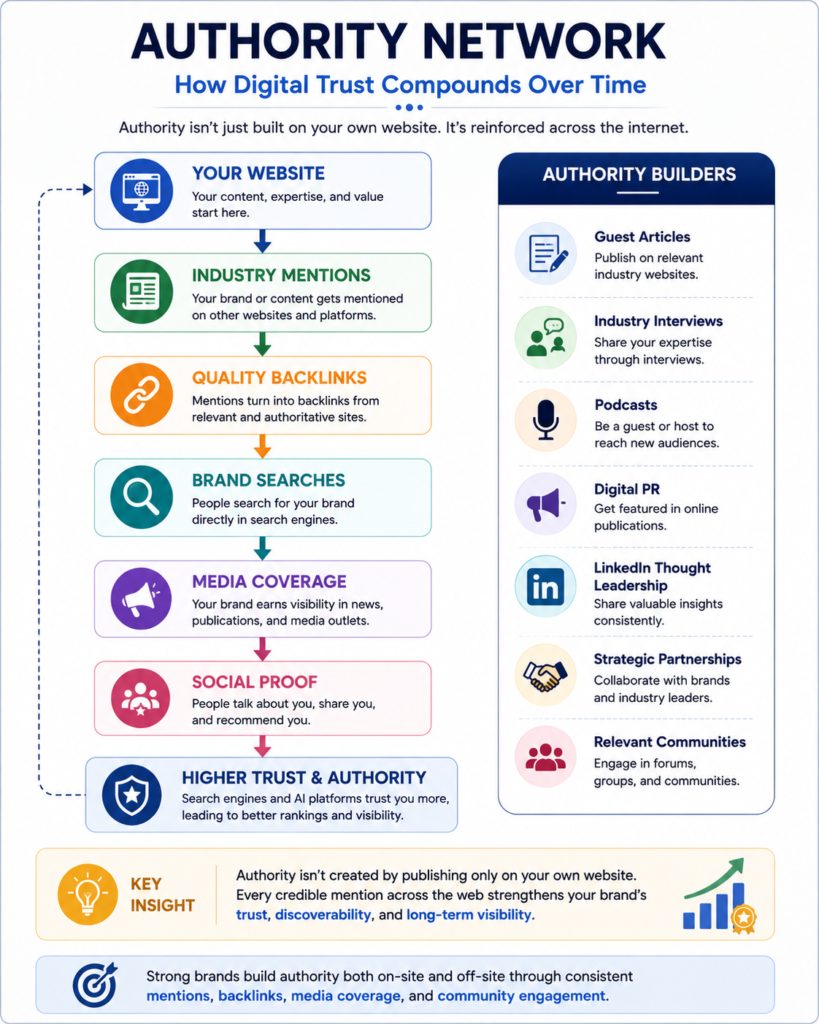
Authority Network
Website
↓
Industry Mentions
↓
Backlinks
↓
Brand Searches
↓
Media Coverage
↓
Social Proof
↓
Higher Trust
Month 5
Optimize for AI Discoverability
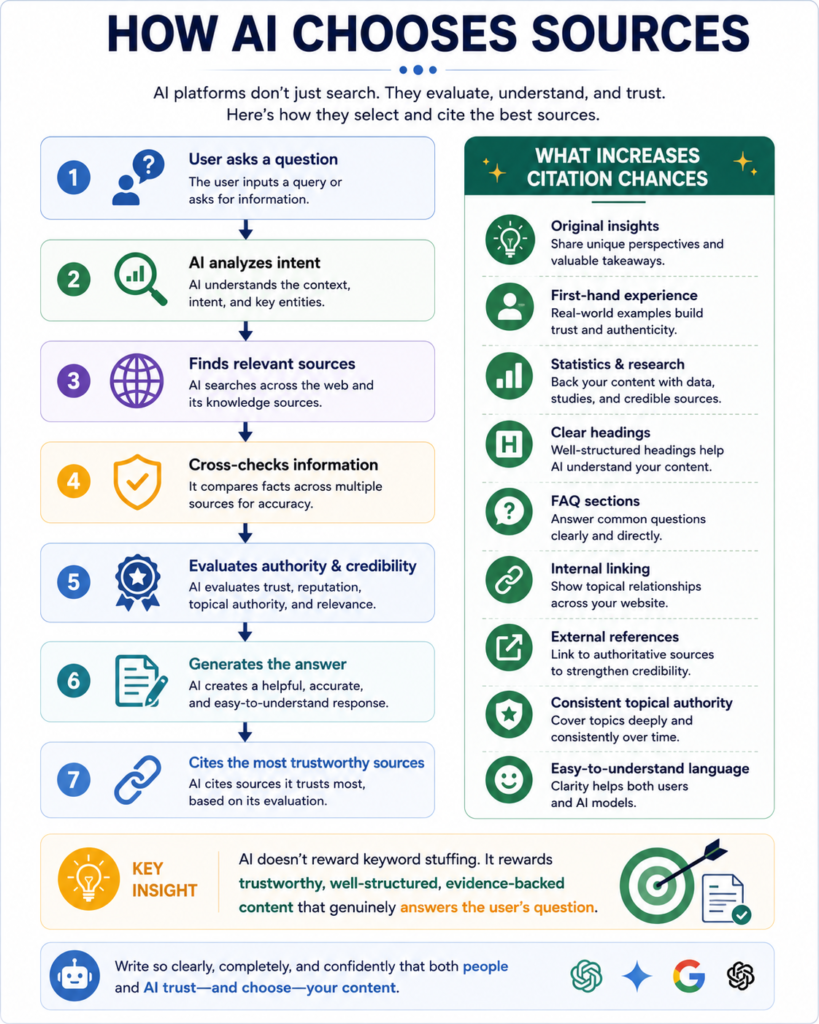
This is where many businesses begin thinking only about GEO. I’d approach it differently and improve content already published.Every article would now be reviewed for:
- Clear headings
- Question-based sections
- Short answer summaries
- Tables
- Definitions
- FAQs
- Entity clarity
- Updated statistics
- Source citations
- Fresh examples
AI systems don’t just retrieve information but they interpret structure. Well-organized content becomes significantly easier to summarize.
Google AI Overview Citing Multiple Sources
“Observe how Google summarizes multiple websites rather than relying on a single source.”
Month 6
Publish Original Research
At this stage – I’d stop competing only with articles and start publishing information no one else has.
Examples:
- Industry surveys
- Original experiments
- Case studies
- Performance reports
- Pricing research
- Customer insights
- Interactive tools
- Calculators
- Templates
Original data is one of the strongest long-term competitive advantages because AI can’t generate information that doesn’t already exist.
Someone has to publish it first so become that someone
Google Analytics Performance Growth
Include:
- Traffic
- Users
- Engagement
- Growth Trend
Month 7
Create Interactive Experiences
One of the biggest lessons I personally learned came from my own website. My India Trip Planner dramatically outperformed traditional blog posts.
Why? Because it wasn’t just content. It solved a problem interactively. That completely changed how I think about content marketing.
Instead of asking, “What article should I write next?”
I’d begin asking:
“What tool can I build next?”
Interactive experiences create the following:
- longer engagement
- repeat visits
- backlinks
- social sharing
- stronger brand recall
- unique value AI can’t easily replicate
Expert Insight
Articles explain problems.
Tools solve them.
The future belongs to businesses capable of doing both.
Month 8
Strengthen Internal Linking
At this stage, the website should begin behaving like an ecosystem rather than a collection of pages.
Every article should naturally connect readers toward the following:
Related Articles
↓
Service Pages
↓
Case Studies
↓
Interactive Tools
↓
Contact Page
Internal links help:
- distribute authority
- improve crawlability
- increase session duration
- guide users
- reinforce topical relevance
One helpful article should create the desire to read another. Not because you’re forcing it because it genuinely adds value.
Internal Linking
Homepage
↓
Service
↓
Supporting Guide
↓
Case Study
↓
Tool
↓
Contact
Highlight the circular relationship between educational and commercial content.
Build a Brand That AI Wants to Mention
By Month Nine, your goal should no longer be “ranking.”
Your goal should be becoming a recognized entity. Search engines rank pages.AI models increasingly recognize brands.
There’s a difference— When Google, ChatGPT, Gemini, Perplexity, or any future AI platform evaluates information, they don’t simply ask the following:
“Is this article optimized?”
They ask something much closer to the following:
- Is this source trustworthy?
- Has this brand discussed this topic consistently?
- Is this information corroborated elsewhere?
- Does this website demonstrate expertise?
- Is this business recognized beyond its own website?
That’s why branding is becoming an SEO strategy.
People who search your brand directly
- talk about it
- share it
- link to it
or mention it elsewhere, all strengthen your digital identity.
What I’d Focus On
- Publish consistently
- Maintain a recognizable writing style
- Keep visual branding consistent
- Use the same author profile everywhere
- Earn mentions from industry websites
- Encourage branded searches
- Keep updating existing content
The Brand Authority Flywheel
Helpful Content
↓
Satisfied Readers
↓
Brand Searches
↓
Mentions
↓
Backlinks
↓
Authority
↓
AI Recognition
↓
More Visibility
↺
Authority compounds. Algorithms reward consistency more than isolated success.
Month 10
Measure What Actually Matters
One mistake I see repeatedly is businesses celebrating rankings while ignoring business outcomes.
Ranking 1 means very little if nobody clicks. Traffic means very little if nobody converts. Instead, I’d create a dashboard measuring four categories.
Visibility Metrics
- Search Impressions
- AI Mentions
- Brand Searches
- Indexed Pages
Engagement Metrics
- Average Engagement Time
- Scroll Depth
- Returning Visitors
- Session Duration
Authority Metrics
- Quality Backlinks
- Referring Domains
- Brand Mentions
- Citations
Business Metrics
- Leads Generated
- Consultation Requests
- Email Subscribers
- Revenue from Organic Search
Because ultimately, SEO isn’t about rankings. It’s about growing a business.
Google Search Console Performance Report
Highlight:
- Total Clicks
- Total Impressions
- CTR
- Average Position
GA4 Engagement Report
Highlight:
- Users
- Sessions
- Average Engagement Time
- Conversions
Month 11
Double Down on What the Data Is Telling You
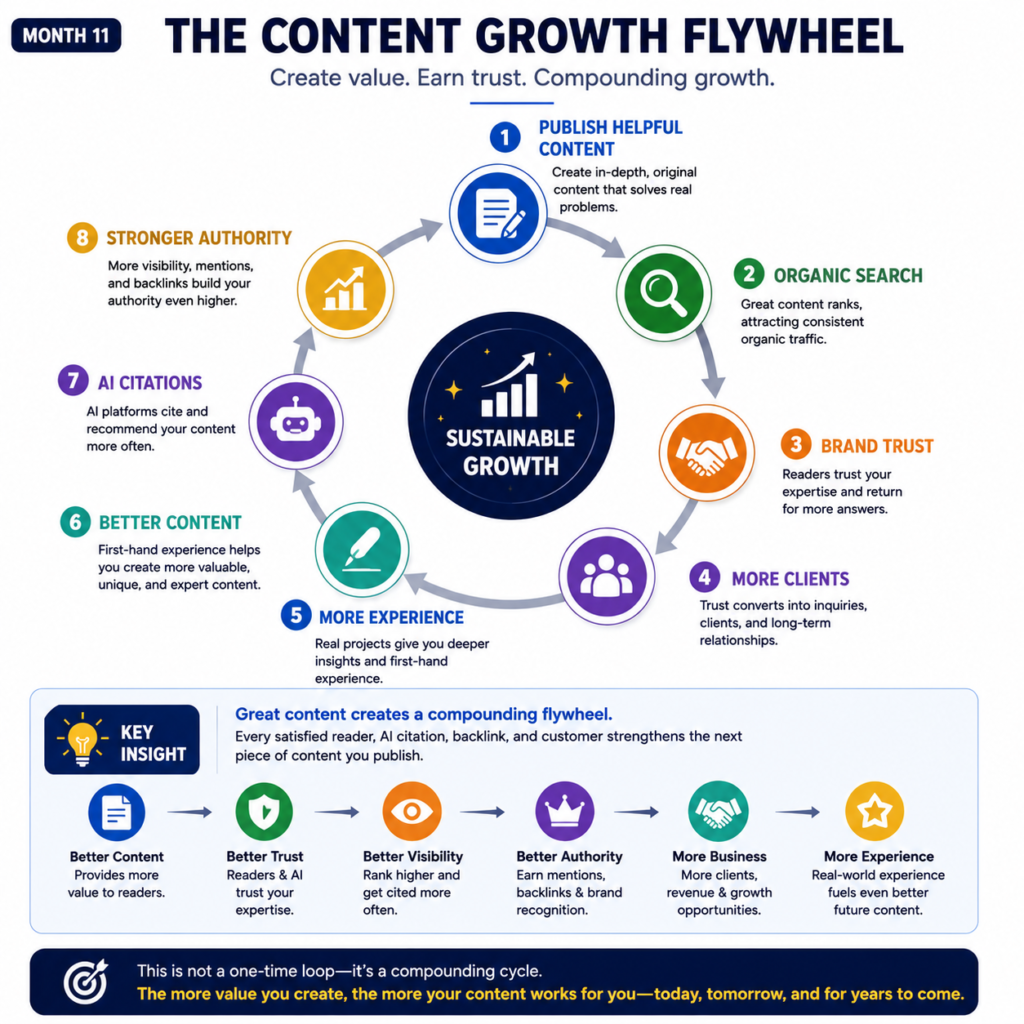
By now, your website has enough data to make informed decisions. This is where many businesses make a costly mistake. They continue publishing based on assumptions. Instead, I’d let the data decide.
Ask questions like:
- Which pages attract the most impressions?
- Which articles keep visitors reading the longest?
- Which pages generate inquiries?
- Which articles earn backlinks naturally?
- Which keywords trigger AI overviews?
- Which topics receive branded searches?
- Which tools attract repeat visitors?
Growth rarely comes from doing more, it usually comes from doing more of what already works.
My Observations
This is exactly what happened while building ContentByMayank.
I expected traditional blog posts to become my biggest traffic source. Instead, my India Trip Planner became the standout performer.
That completely changed my future content strategy.
Instead of publishing only articles, I’ll gradually build the following:
- calculators
- planners
- templates
- interactive experiences
Because users clearly engage with them more. Sometimes your audience discovers your best strategy before you do.
Pay attention.
India Trip Planner vs Traditional Blog Performance
Compare:
Impressions
Clicks
CTR
Average Position
Engagement
Month 12
The final month isn’t about launching something new. It’s about making everything sustainable.
Build Systems Instead of Chasing Algorithms
Because SEO, AEO, and GEO
are not one-time projects.They’re ongoing systems. By the end of Year One, I’d have documented processes for:
Content Research
↓
Keyword & Intent Mapping
↓
Writing
↓
Fact Checking
↓
Visual Design
↓
Publishing
↓
Internal Linking
↓
Promotion
↓
Performance Analysis
↓
Content Updates
Then?
Repeat.
Consistency beats intensity almost every time.
The Biggest Mistake I’d Avoid
If I could warn every new business owner about one thing, it would be this: Don’t rebuild your strategy every time a new AI model launches. Every few months, someone declares:
SEO is dead.
Then?
Google releases another update→A new AI assistant appears→Another ranking factor trends on social media.→Businesses panic→Agencies rewrite their sales pages→Creators change direction →The cycle repeats.
Meanwhile,
The businesses quietly producing genuinely useful content continue growing. Because they’re building assets, not chasing headlines.
The Strategy I’d Follow in 2026
If someone gave me ₹100,000 today to grow a brand online, this is how I’d invest:
| Channel | Allocation | Why |
| SEO & Website Authority | 35% | Build long-term assets, technical SEO, evergreen content, topical authority, and sustainable organic growth. |
| AEO (Answer Engine Optimization) | 20% | Structure content to answer questions clearly, improve AI readability, and increase visibility in AI Overviews and answer engines. |
| GEO (Generative Engine Optimization) | 20% | Create citation-worthy content with original research, entity optimization, structured data, and authoritative references. |
| Social Media | 10% | Repurpose content, strengthen brand awareness, and reach audiences beyond traditional search. |
| Paid Advertising | 10% | Generate immediate leads while organic assets mature. Ideal for testing messaging and landing pages. |
| Innovation Reserve | 5% | Experiment with emerging AI tools, interactive features, and future search technologies without disrupting the core strategy. |
Why SEO Still Receives the Largest Share
Some readers might expect GEO to dominate this budget.
I may disagree here.
Here’s why everything AI generates begins somewhere. Reliable information doesn’t appear out of thin air. It originates from publishers, researchers, businesses, creators, institutions, and experts who produce original work.
SEO helps those sources become discoverable.
Without high-quality content, there would be nothing meaningful for AI to summarize. That’s why I still consider SEO the foundation.
- AEO improves presentation.
- GEO improves discoverability inside AI.
- But SEO remains the infrastructure supporting both.
One Year Later…
If this strategy is executed consistently. I wouldn’t judge success purely by rankings but I’d ask different questions.
- Does Google understand my expertise?
- Do AI platforms increasingly recognize my content?
- Are more people searching for my brand by name?
- Are visitors staying longer?
- Are businesses contacting me?
- Is my content genuinely helping people?
Because those are the signals that survive every algorithm update.
Last Few Suggestions Before We End
- Technology will continue changing.
- Search interfaces will evolve.
- AI models will improve.
- Ranking systems will adapt.
But one thing has remained remarkably consistent throughout the history of the internet:
People reward those who help them make better decisions.
Whether they find you through Google:
- an AI assistant
- a voice search
- or a platform that hasn’t even been invented yet
Your job remains the same.
Create something worth finding.
So… Is SEO Still Worth It If AI Doesn’t Cite You?
After everything we’ve explored:
- the statistics
- the research
- the experiments
- the AI platforms
- the industry shifts
- the Google updates
- the zero-click searches
- the citation behavior
- the changing search habits
We finally arrive at the question that started this entire article.
If AI doesn’t always cite my business… is SEO still worth investing in?
My answer is simple.
Yes.
Not because SEO hasn’t changed. It clearly has.
Not because AI isn’t changing search. It absolutely is but because SEO has never really been about rankings. It has always been about making your business discoverable. The way people discover businesses is evolving.
The need to be discovered isn’t.
AI Didn’t Kill SEO but It Expanded the Playing Field.
Twenty years ago, people searched through directories.
Then Google changed everything. Years later, Mobile search changed user behavior Then voice search appeared.
Now,
Generative AI has introduced another evolution. Every major technological shift has sounded like the end of SEO. None of them actually were.
Instead, SEO absorbed them.
Today’s SEO includes:
- technical optimization
- user experience
- content quality
- topical authority
- structured data
- accessibility
- page experience
- entity optimization
- answer optimization
- AI readability
SEO didn’t shrink but it became larger than ever.
Think About It Like This
Imagine building a beautiful library.
- SEO builds the library.
- AEO organizes every book so people quickly find answers.
- GEO helps AI librarians recommend your books.
Remove SEO
and the library never exists.
Remove AEO
and people struggle to find information.
Remove GEO
- and AI rarely recommends your work.
- They’re not competitors.
- They’re partners.
GEO
(AI Discoverability)
↑
AEO
(Answer Optimization)
↑
SEO
(Content & Website Foundation)
SEO, AEO & GEO Relationship
You don’t choose one. You build all three together.
The Biggest Lesson contentbymayank Taught Me
When I started researching this article, I genuinely thought the biggest problem was AI not citing businesses consistently-yhat concern still exists.
I still believe attribution across AI systems should continue improving.
- Publishers deserve recognition.
- Researchers deserve citations.
- Businesses deserve opportunities to be discovered.
But something interesting happened while researching. I realized I had been asking the wrong question.
Instead of asking:
“Why isn’t AI citing me?”
I should have asked:
“Have I become the kind of source AI would confidently cite?”
That subtle shift changes everything.
Because now, the focus returns to something we can actually control.
- Our content.
- Our expertise.
- Our credibility.
- Our originality.
- Our usefulness.
The Future Belongs to Businesses That Teach
- Products can be copied.
- Services can be copied.
- Pricing can be copied.
- Websites can be copied.
- Even AI can generate content that looks similar.
But one thing remains incredibly difficult to copy—experience.
Businesses willing to openly teach what they know:
- explain complex ideas…
- publish original research…
- share practical insights…
- and genuinely help people…
- are quietly building assets that become more valuable every year.
- Because trust compounds.
- Authority compounds.
- Knowledge compounds.
- Algorithms simply help people find them.
My observations for the Next Five Years
Nobody can predict the future perfectly.
But after reviewing hundreds of reports, observing industry changes, and studying how search has evolved, I believe a few trends are highly likely.
Search will become increasingly conversational.
People will ask complete questions instead of typing fragmented keywords.
AI will become the first touchpoint for many informational queries.
But users will continue visiting websites whenever they need deeper understanding, comparison, proof, pricing, or confidence before making decisions
Original research will become one of the internet’s most valuable assets.
As AI-generated content becomes abundant, genuinely new information will stand out even more.
Interactive experiences will grow significantly.
Calculators.
Planners.
Assessment tools.
Templates.
Configurators.
Visual explainers.
These won’t just improve engagement.
They’ll differentiate businesses in ways generic articles cannot.
Brand authority will matter more than domain authority.
People increasingly trust recognizable experts and businesses over anonymous websites.
Search engines and AI platforms are moving in the same direction.
Credibility will become the strongest competitive advantage.
- Not keyword stuffing.
- Not publishing frequency.
- Not chasing every algorithm update.
- Just consistently earning trust.
Evolution of Search
Traditional Search
↓
Mobile Search
↓
Voice Search
↓
AI Search
↓
Generative Engines
↓
Agentic AI
↓
Context-Aware Personal Search
Search has always evolved. Businesses that adapt continue growing.
What This Means for ContentByMayank
- This article wasn’t written simply to discuss SEO.
- It reflects the philosophy behind how I believe modern content should be created.
- Every project I work on follows the same principle:
- Create content that deserves to rank.
- Create content that deserves to be cited.
- Create content that genuinely helps someone make a better decision.
Because rankings are earned.
Citations are earned.
Trust is earned.
Everything else follows.
Key Takeaways (Save This Section)
If you only remember one page from this entire guide. Let it be this one.
- SEO is evolving—not disappearing.
- AI is changing discovery—not replacing websites.
- AEO improves how your content answers questions.
- GEO improves your chances of being surfaced by AI systems.
- Helpful content remains the common denominator across every platform.
- Authority is becoming more valuable than shortcuts.
- Interactive tools create advantages that ordinary blog posts often cannot.
- Data should guide your strategy—not fear.
- Businesses should optimize for humans first and algorithms second.
- The internet still rewards people who consistently create genuine value.
The Modern Content Formula
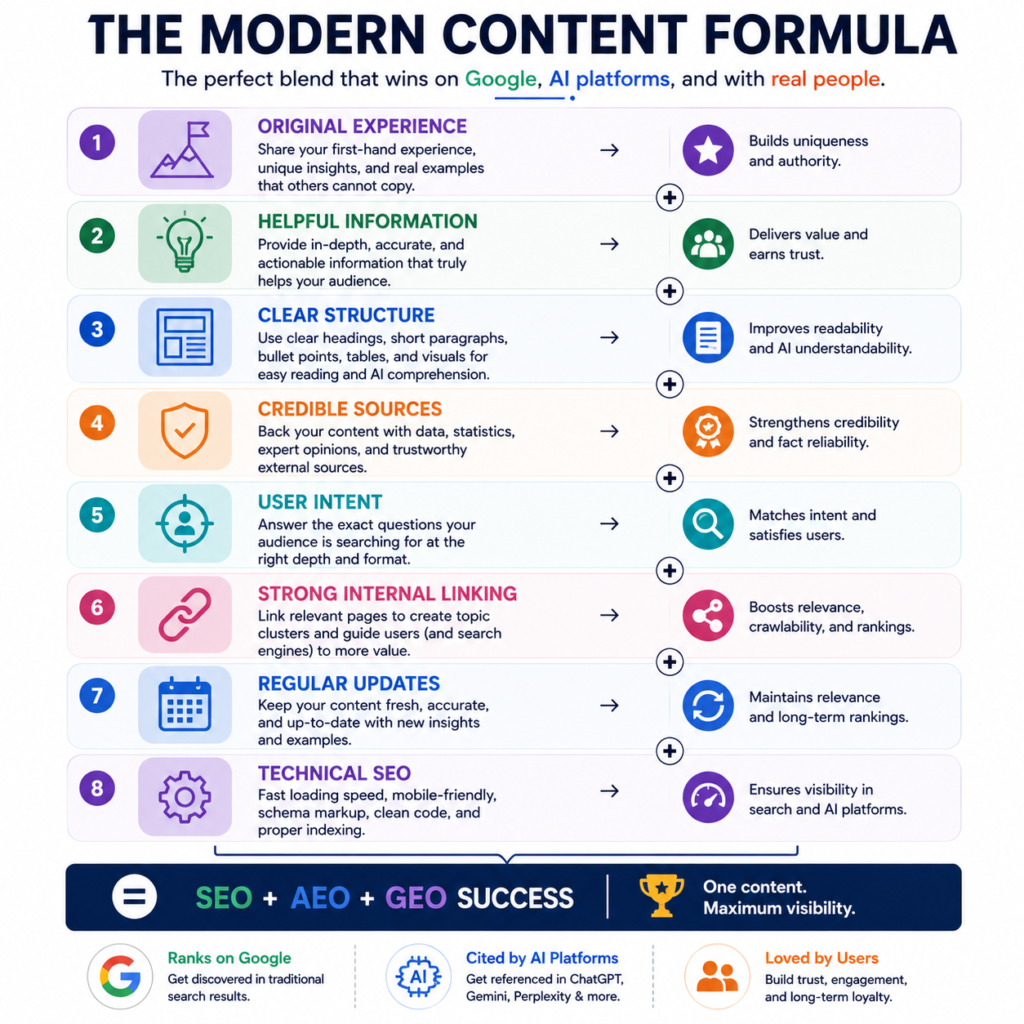
Original Experience
+
Helpful Information
+
Clear Structure
+
Credible Sources
+
User Intent
+
Strong Internal Linking
+
Regular Updates
+
Technical SEO = SEO + AEO + GEO Success
One Last Thought
If you’ve read this far… Thank you.
Not because it increases my engagement metrics. But because it tells me something important. You care about creating better content.
And that’s exactly what the internet needs more of.
Whether you’re a founder launching your first startup, a freelancer trying to grow… a marketer navigating AI… or a business owner wondering where to invest next… Remember this:
Technology will continue changing.
Search engines will continue evolving.
AI will continue becoming smarter.
But people will always search for answers they can trust.
Become that answer.
- The clicks will follow.
- The rankings will follow.
And when your work genuinely deserves it, the citations usually follow too.
About This Research
This guide combines:
- Independent observations from building ContentByMayank
- Practical experiments on a live website
- Google Search Console and GA4 performance analysis
- Public industry research
- Search behavior studies
- AI platform comparisons
- SEO, AEO, GEO, and EEAT best practices
- Real-world content strategy experience
The goal wasn’t to prove that one platform is better than another. The goal was to understand how businesses can remain visible as search continues to evolve.
Because the future doesn’t belong to those who panic every time technology changes.
It belongs to those who learn, adapt, and keep creating work worth discovering.
Frequently Asked Questions
Is SEO still worth it in 2026?
Yes. SEO remains one of the most sustainable digital marketing channels because it builds long-term visibility, authority, and trust. Rather than replacing SEO, AI has expanded the importance of creating well-structured, authoritative content that serves both users and AI systems.
Will AI replace Google Search?
No. AI and traditional search are increasingly working together rather than competing directly. Google has integrated AI into its search experience through AI Overviews.
Why doesn’t ChatGPT always cite websites?
AI models generate responses differently depending on the query, available information, confidence level, and platform design. Some answers require citations because they rely on external sources, while others are generated from the model’s learned patterns or internal reasoning.
What is the difference between SEO, AEO, and GEO?
SEO (Search Engine Optimization) focuses on improving visibility in traditional search engines. AEO (Answer Engine Optimization) focuses on structuring content so it can directly answer user questions. GEO (Generative Engine Optimization) focuses on making content understandable and citation-worthy for AI-powered search experiences.
Does schema markup guarantee AI citations?
No. Schema helps search engines and AI systems better understand your content, but it does not guarantee rankings or citations.
Can AI-generated content rank on Google?
Yes—but only when it genuinely helps users.
Google evaluates content based on quality rather than whether it was written by a human or AI. Low-value, repetitive, or misleading AI-generated content is unlikely to perform well, while well-edited, experience-driven, accurate content can rank successfully
Should businesses stop blogging because of AI?
No.
Businesses should publish fewer but significantly better articles.
Original research, practical guides, case studies, interactive tools, comparison pages, and educational resources continue attracting users from both traditional search engines and AI-powered platforms.
Absolutely.
Are backlinks still important?
Backlinks remain one of the strongest signals of authority in traditional search. They also increase brand credibility, improve discoverability, and often correlate with higher trust across the broader web ecosystem.
Can small businesses compete with large brands in AI search?
Yes.
AI increasingly rewards relevance and usefulness rather than simply domain size. Smaller businesses that publish highly specialized, experience-driven content within a focused niche can often outperform larger websites on specific topics.
What type of content is most likely to be cited by AI?
AI platforms generally favor content that demonstrates:
- Original research
- First-hand experience
- Clear structure
- Accurate facts
- Credible references
- Question-and-answer formatting
- Updated information
- Strong topical authority
Ready to Future-Proof Your Content Strategy?
Whether you’re a business owner, marketer, startup, or personal brand, building content that performs across Google Search, AI Overviews, ChatGPT, Gemini, and future AI platforms requires more than traditional SEO. Explore ContentByMayank for strategic SEO, AEO, GEO, and human-first content writing designed to build authority, visibility, and long-term business growth.
Author’s Note
This guide reflects extensive research, real-world observations, and practical experiments conducted while building ContentnbyMayank. It will be regularly updated as Google Search, AI platforms, and search behavior evolve. For more in-depth resources, interactive tools like the India Trip Planner, and expert content solutions, keep exploring ContentbyMayank.

Pingback: 2-DAY RISHIKESH TRIP FROM DELHI: DON'T PLAN BEFORE READING!
Pingback: Independence Day campaign Ideas from 2024–25: Learn for 2026